If you are weighing a move to the Dominican Republic, healthcare is usually the first practical question after housing and visas. The short answer: healthcare in the Dominican Republic for expats is generally good when you use the private system. That is especially true in and around Santo Domingo, Santiago, Punta Cana, and the North Coast. Costs run a fraction of US prices. Specialist appointments are often available the same week. Most major private hospitals have at least some bilingual staff.
The country runs a two-tier system, public and private. Most expats and retirees skip the public option and pay either a local Dominican insurance plan or an international policy. This guide walks through how the system works, which hospitals to know by region, what insurance actually costs, what to expect in an emergency, how prescriptions work, and how to factor healthcare access into where you choose to live.
How the Dominican Healthcare System Works
The Dominican Republic operates a two-tier system. The public side runs through SENASA, the government-funded insurer. It is built around three financing tiers: a fully subsidized tier for low-income residents, a contributive tier funded by employer and employee payroll contributions, and a contributive-subsidized tier for self-employed workers. Public hospitals are free or nearly free at the point of care for those covered.
The private side is administered through ARS plans (Administradoras de Riesgos de Salud), which are essentially Dominican HMOs. Major insurers include Humano, Universal, and Mapfre (which absorbed Palic). Private ARS members use a network of private hospitals, clinics, and specialists, with predictable copays and short wait times.
Most expats use the private system with either a local ARS plan or international health insurance. The reason is simple: better facilities, English-speaking staff in major hubs, modern equipment, and far shorter waits.
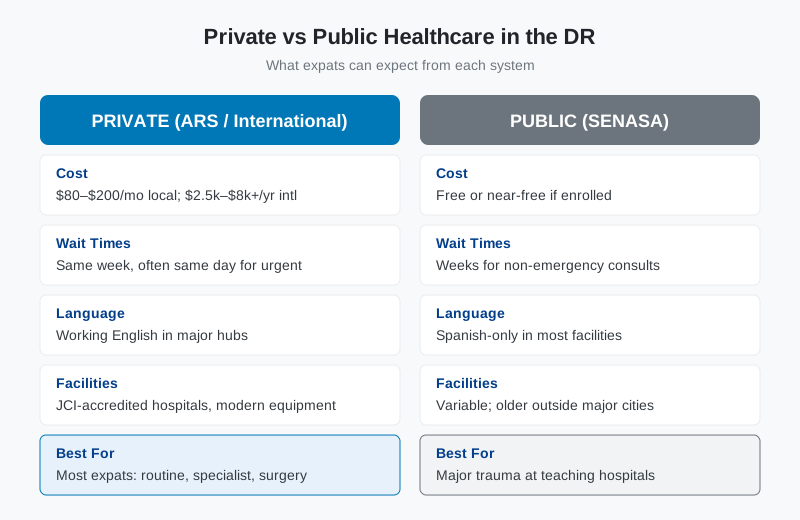
View text version of this infographic
Private (ARS / International) vs Public (SENASA) in the Dominican Republic
| Factor | Private (ARS / International) | Public (SENASA) | |--------|-------------------------------|-----------------| | Cost | $80–$200/month for local ARS plans; $2,500–$8,000+/year for international plans | Free or near-free for those enrolled | | Wait Times | Same week for specialists; often same day for urgent issues | Weeks for non-emergency consultations | | Language | Working English in Santo Domingo, Santiago, Punta Cana, North Coast | Spanish-only in most facilities | | Facilities | International-standard hospitals, modern equipment, full surgical services | Variable; older equipment outside major cities | | Best For | Most expats — routine care, specialists, surgery, maternity | Major trauma at teaching hospitals in Santo Domingo and Santiago |
Public Healthcare (SENASA): What Expats Should Know
SENASA covers Dominican citizens and legal residents. As an expat with temporary or permanent residency, you can technically enroll in the contributive tier through an employer or as a self-employed contributor. Most expats do not, because the practical experience is limited.
What public hospitals offer:
- Emergency trauma care, particularly in Santo Domingo and Santiago, where major teaching hospitals operate.
- Free or very low-cost basic services.
- Maternity care and primary medicine in clinics across most provinces.
The realistic limitations:
- Equipment is older and inconsistent outside the major cities.
- Staff usually speak only Spanish.
- Wait times for non-emergency consultations can stretch into weeks.
- Patients often need to bring their own supplies (gauze, basic medications, sometimes even sutures).
Public hospitals can still be the right choice for serious trauma in cities with major facilities, simply because that is where the trauma specialists are. For routine and elective care, almost every expat goes private.
Private Healthcare: The Standard Most Expats Choose
Private healthcare in the major Dominican hubs is solid. Several major facilities operate to international standards and hold international quality certifications. The larger facilities use modern imaging, pathology labs, and surgical suites. Cardiology, orthopedics, general surgery, OB/GYN, oncology (basic to mid-complexity), gastroenterology, and routine internal medicine are all well covered.
You will typically see a specialist within the same week, often the same day for urgent issues. Office visits run on time more often than not. Many physicians trained in the US, Spain, or Cuba and speak working English, especially in Santo Domingo, Santiago, and the resort regions.
What you should still plan to handle abroad: highly specialized oncology (advanced trial protocols), complex pediatric subspecialties, and the most advanced cardiac procedures. Most expats with serious or rare conditions carry international insurance with evacuation coverage so they can fly to Miami or San Juan if needed.
Hospitals and Clinics by Region
This is the area where most online guides come up thin. Here is the regional rundown.
Santo Domingo
The capital has the deepest medical bench in the country. Hospital General Plaza de la Salud is one of the most respected institutions. CEDIMAT (Centro de Medicina Avanzada) is widely considered the top private hospital for complex care, with strong cardiology and oncology departments. Hospital Metropolitano and Clínica Abreu are also frequently used by the expat community, and Hospiten Santo Domingo serves the international resident population.
If you want the strongest healthcare access in the country, you live within a 30-minute drive of one of these hospitals. Browse Santo Domingo listings if proximity to top-tier care is your priority.
Santiago
Santiago is the second medical hub. HOMS (Hospital Metropolitano de Santiago) is a flagship private hospital with modern facilities, broad specialties, and bilingual staff. Several specialty clinics surround it. For expats in the Cibao Valley, Santiago handles almost everything short of the most advanced cases.
Puerto Plata, Sosúa, and Cabarete
The North Coast is served primarily by Centro Médico Bournigal in Puerto Plata. It has been the main private hospital for the established expat communities in Sosúa and Cabarete for decades. Clínica Brugal also operates in Puerto Plata. Both have bilingual staff, ICU capacity, and full surgical services. From Sosúa or Cabarete, Bournigal is roughly a 15 to 25 minute drive depending on traffic. See Puerto Plata listings for the closest base of all.
Punta Cana, Bávaro, and Cap Cana
The east coast has grown a serious private hospital network in the past 15 years to support the resort population and the growing expat community. Hospiten Bávaro is the largest and most international facility in the area, with a multilingual international department supporting eight languages, including English, French, German, and Italian. Hospital Punta Cana also serves the region. From Cap Cana you are roughly 20 minutes to Hospiten Bávaro. Browse Punta Cana listings for properties in this medical catchment.
Las Terrenas and Samaná
This is where you start trading scenery for medical access. The Samaná peninsula has small clinics suitable for routine issues and minor emergencies, but anything serious means a transfer. From Las Terrenas, the realistic options are a roughly two-hour drive to Santo Domingo or a similar drive to Puerto Plata via the southern peninsula. Some residents arrange private air evacuation in advance for peace of mind.
Health Insurance Options for Expats
There are three realistic paths for Dominican Republic health insurance for expats.
Local ARS Plans
Plans from Humano, Universal, and Mapfre (which absorbed Palic) typically run about $80 to $200 per person per month, depending on age and tier. They cover the Dominican private network and pay essentially nothing if you fly home for treatment. They are inexpensive and well-suited to expats who plan to receive care locally.
Watch the fine print:
- Most local insurers cap new enrollment around age 65, with maximum coverage typically ending around age 70. If you arrive at 67, your options narrow quickly.
- Pre-existing conditions are usually excluded for the first year or longer, sometimes permanently for chronic conditions.
- Higher tiers buy you nicer rooms and broader specialist panels, not necessarily better medicine.
International / Global Health Insurance
Cigna Global, Allianz Care, IMG, and GeoBlue are the most common providers. Premiums are higher (often $2,500 to $8,000+ per year for a 60-year-old, depending on coverage and deductible), but you get:
- Coverage in the US or Canada, often as an optional rider.
- Medical evacuation included or available cheaply.
- No age cap on most plans, though pricing climbs sharply.
- Coverage for pre-existing conditions on some plans after underwriting.
For US retirees and anyone with a chronic condition, international insurance is usually the right call.
Travel Insurance
Travel insurance is fine for visits and the first few months of a move while you sort out residency and longer-term coverage. It is not a long-term solution. Most policies cap out at 90 to 180 days and exclude routine and pre-existing care.
A Note on Medicare
This is the single most important point for US retirees: Medicare does not cover care outside the United States, with very narrow exceptions. Medigap Plans C, D, F, G, M, and N include limited foreign emergency care (typically 80 percent after a deductible, lifetime cap of $50,000), and that is essentially it. If you are moving to the DR and counting on Medicare, you are not covered. Plan for either a local ARS plan, an international policy, or both.
What Healthcare Actually Costs
These ranges reflect typical private-system out-of-pocket prices in 2026, before insurance applies. Insured patients pay much less:
- General practitioner visit: $35 to $60.
- Specialist consultation: $50 to $120.
- Standard blood panel: $40 to $90.
- Ultrasound: $60 to $150.
- MRI: $300 to $600.
- CT scan: $200 to $450.
- Emergency room visit (uncomplicated): $100 to $300.
- Uncomplicated vaginal birth (private hospital): $1,500 to $3,500.
- Cesarean delivery: $2,500 to $5,000.
- Knee replacement: $8,000 to $15,000.
Compared to US sticker prices, the savings are large, often 70 to 90 percent. This is also why healthcare ranks high in any honest cost-of-living calculation for the Dominican Republic.
Pharmacies and Prescriptions
Pharmacies are everywhere. Most neighborhoods have a Farmacia Carol, Farmax, or local independent within a few blocks, and many deliver to your door at no extra charge.
What is different from the US:
- Many drugs that are prescription-only in the US are sold over the counter behind the pharmacy counter in the DR. That includes many antibiotics, blood pressure medications, and antihistamines. The pharmacist will often consult you directly.
- Controlled substances (opioids, benzodiazepines, ADHD stimulants) require Dominican prescriptions and can be hard to source. If you take these, talk to a local doctor about switching to what is locally available.
- Importing a personal supply of prescription medication for personal use is generally allowed in reasonable quantities, but bring documentation and original packaging.
- Generics dominate. A 30-day supply of common maintenance drugs often runs $5 to $25.
Emergencies and Medical Evacuation
The 911 system works in Santo Domingo, Santiago, the Punta Cana area, and parts of the North Coast. Outside those zones, public ambulance response is unreliable.
Most expats who can afford it use private ambulance services such as ProMed or Movimed. These are paid services, but they arrive faster, carry better equipment, and will transport directly to a private hospital. A membership runs roughly $100 to $300 per year and covers most calls.
For serious cases that need to be flown out, US-based medical evacuation services such as Medjet, SkyMed, or Global Rescue offer membership plans starting around $300 per year. Many international health insurance policies include evacuation as standard. The US Embassy in Santo Domingo also keeps a medical assistance page with hospital lists and emergency contacts that is worth bookmarking.
If you are factoring safety in the Dominican Republic into your move, healthcare and emergency response usually map onto the same regional considerations.
Dental and Vision Care
Dental tourism is a real thing in the DR for a reason. A standard cleaning runs $30 to $60. A porcelain crown is typically $250 to $450. A single dental implant including the crown often falls between $900 and $1,800, compared to $3,500 to $6,000 in the US.
Vision care is similarly affordable. An eye exam is roughly $30 to $60. Single-vision glasses with frames start around $80. LASIK is widely available in Santo Domingo and Santiago for about $1,200 to $2,000 per eye. Quality at the major clinics is on par with US standards.
Tips from Expats
A few things long-term expats wish they had known:
- Pay an annual private ambulance membership before you need it, not after.
- Get on a local doctor's roster within your first month, even if you feel fine. Building the relationship before you are sick saves you in a crisis.
- Keep a binder (paper, not just digital) with your medical history, prescriptions, and allergies translated into Spanish.
- If you take a controlled substance, sort out your supply before you move, not after.
- Carry international insurance for at least the first year while you learn how the system works locally.
Choosing Where to Live with Healthcare in Mind
For retirees and anyone with a chronic condition, healthcare access should shape your shortlist of areas. The general rule: pick a base within 30 minutes of a top private hospital.
The strongest healthcare access:
- Santo Domingo and surrounding suburbs (CEDIMAT, Plaza de la Salud, Hospiten).
- Santiago and the immediate Cibao Valley (HOMS).
- Punta Cana, Bávaro, and Cap Cana (Hospiten Bávaro).
- Puerto Plata, Sosúa, and Cabarete (Bournigal, Brugal).
The healthcare-access trade-off:
- Las Terrenas and Samaná are beautiful but require planning for serious cases.
- Rural inland zones and small coastal towns can be charming but should be limited to expats in good health or those with strong evacuation coverage.
If you are still narrowing down a region, our comparison of Mexico vs. Dominican Republic covers healthcare alongside the other factors that matter. Our how to buy property in the DR guide covers the residency and purchase process once you have a target area.
Frequently Asked Questions
Is healthcare free in the Dominican Republic?
Public healthcare through SENASA is free or nearly free for Dominicans and legal residents enrolled in the subsidized tier. Private healthcare, which is what most expats use, is paid out of pocket or through an ARS or international insurance plan. It is much cheaper than US care but not free.
Do expats need health insurance in the Dominican Republic?
Yes. Out-of-pocket costs for routine care are manageable, but a serious illness or surgery without insurance can still run thousands of dollars. Almost every long-term expat carries either a local ARS plan or an international policy.
How much does health insurance cost in the Dominican Republic?
Local ARS plans typically run $80 to $200 per person per month depending on age and tier. International plans usually cost $2,500 to $8,000+ per year for older adults, with broader coverage and evacuation included.
Does Medicare work in the Dominican Republic?
No. Medicare does not cover care outside the US, except for limited foreign emergency care under certain Medigap plans. US retirees moving to the DR need separate insurance.
What are the best hospitals in the Dominican Republic?
CEDIMAT and Hospital General Plaza de la Salud in Santo Domingo, HOMS in Santiago, Hospiten Bávaro in Punta Cana, and Centro Médico Bournigal in Puerto Plata are among the most respected private facilities.
Can foreigners use SENASA?
Foreigners with legal residency can enroll in SENASA through employment, self-employment contributions, or in some cases the subsidized tier. Most expats do not, because the private system is more practical and still affordable.
Is the Dominican Republic safe for medical care?
Private healthcare in major cities is safe and meets international standards. Several major hospitals operate to international standards. Outside the major hubs, quality drops, which is why most expats build their lives around access to a top private facility.
Do doctors in the Dominican Republic speak English?
Many private-hospital physicians in Santo Domingo, Santiago, Punta Cana, and the North Coast speak working English, and some are fluent. Public hospitals and rural clinics are usually Spanish-only. Bringing a Spanish-speaking friend or translator app is wise outside the resort and capital regions.
Can I get prescription medication in the Dominican Republic?
Most common medications are widely available, often without a prescription. Controlled substances such as opioids, benzodiazepines, and ADHD stimulants require Dominican prescriptions and can be difficult to source. Plan ahead if you take these.
Is there an age limit for health insurance in the Dominican Republic?
Most local ARS plans cap new enrollment around age 65, with maximum coverage typically ending around age 70. International plans generally have no age cap but become expensive in your 70s and beyond. Apply for coverage well before you move if you are over 60.
How does emergency care work in the Dominican Republic?
911 works in Santo Domingo, Santiago, and the Punta Cana area. Most expats supplement public response with a private ambulance membership through ProMed or Movimed, and many carry medical evacuation coverage for serious cases.
Where should retirees live in the DR for healthcare access?
The best healthcare access is in Santo Domingo, Santiago, Punta Cana/Bávaro/Cap Cana, and the Puerto Plata/Sosúa/Cabarete corridor. Las Terrenas, Samaná, and rural inland areas are beautiful but require planning for medical emergencies.
David Logan
site_adminContributing writer for DRListings.com, sharing insights about Dominican Republic real estate.
Comments
Log in to join the conversation