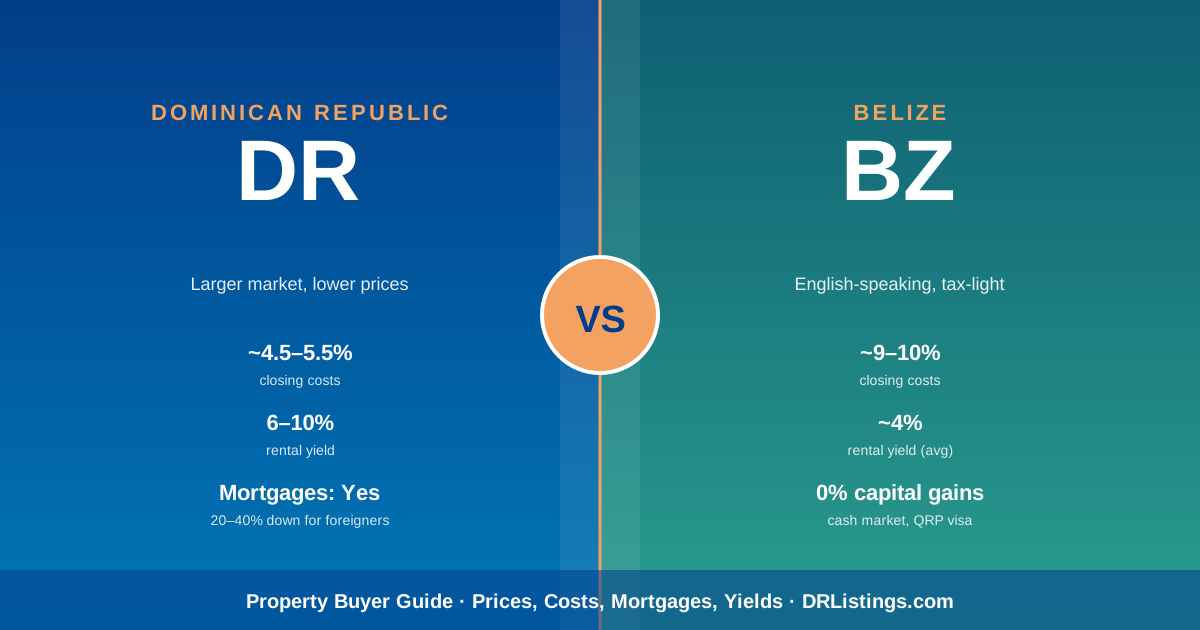
Weighing the Dominican Republic against Belize for a vacation home, retirement, or investment? The short answer: they solve different problems. The Dominican Republic offers a much larger, cheaper, and more liquid property market. It has mortgage access for foreigners and rental yields between 6 and 10 percent. Belize is smaller, English-speaking, and tax-light, with no capital gains and a quieter pace. You will usually pay cash there, and you will pay more at closing.
This guide covers the six things that actually matter for a foreign buyer: legal process, prices, closing costs and taxes, financing, rental yield, and lifestyle. By the end you should know which country fits your money and your life.
Quick Verdict: Dominican Republic vs Belize at a Glance
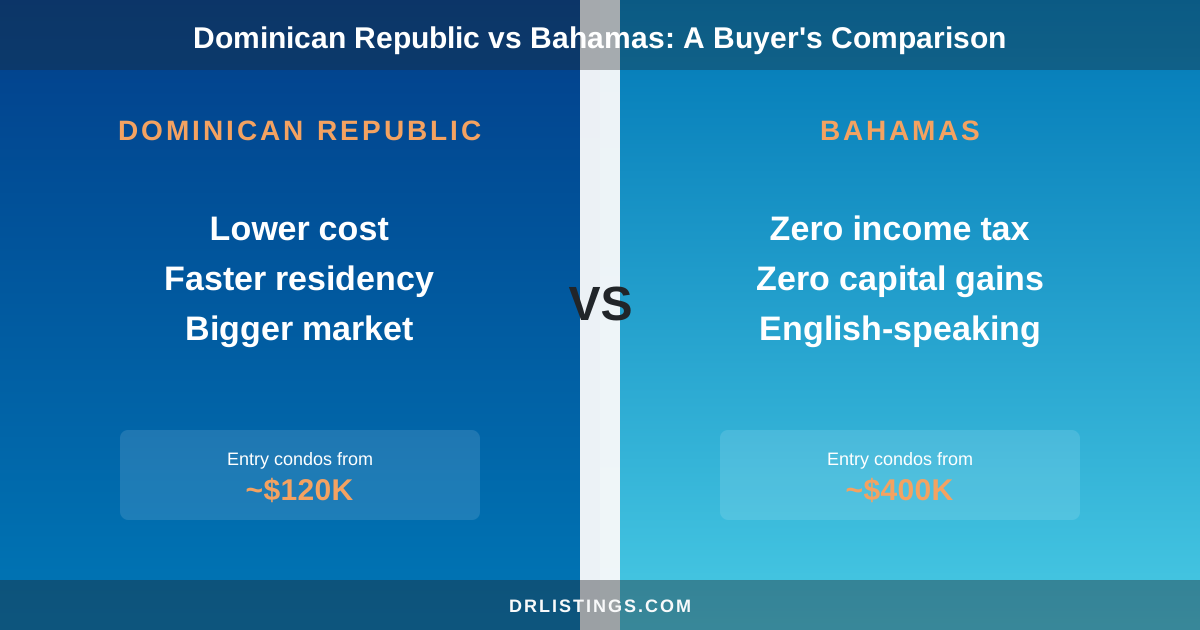
For most North American buyers, the DR wins on price, market depth, and yield. Belize wins on language, simplicity, and capital gains treatment. If you have to pick on one factor, the deciding question is usually "Do I need a mortgage?" If yes, the DR is the only practical option. If you are paying cash and want English-speaking, eco-focused living, Belize earns a closer look.
View text version of this infographic
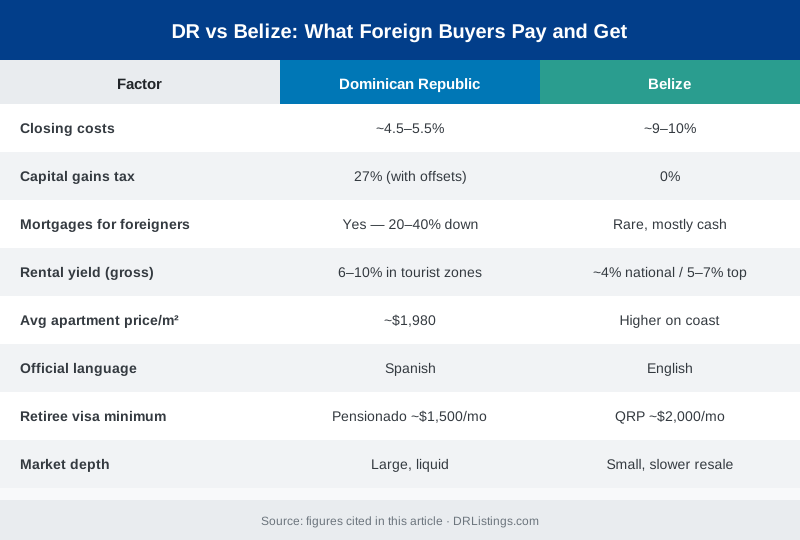
DR vs Belize side-by-side for foreign buyers:
- Closing costs: DR ~4.5–5.5% · Belize ~9–10%
- Capital gains tax: DR 27% (with cost basis offsets) · Belize 0%
- Mortgages for foreigners: DR yes, 20–40% down · Belize rare, mostly cash
- Rental yield (gross): DR 6–10% in tourist zones · Belize ~4% national, 5–7% on top product
- Avg apartment price per m²: DR ~$1,980 · Belize higher on coast
- Official language: DR Spanish · Belize English
- Retiree visa minimum: DR Pensionado ~$1,500/mo · Belize QRP ~$2,000/mo
- Market depth: DR large and liquid · Belize small, slower resale
| Factor | Dominican Republic | Belize | |---|---|---| | Population | ~11 million | ~410,000 | | Official language | Spanish | English | | Currency | Dominican peso (DOP), USD widely accepted | Belize dollar (BZD), pegged 2:1 to USD | | Foreign ownership | Full rights, no permits | Full rights, fee simple titles | | Avg apartment price | ~$1,980 per square meter | Typically higher in coastal hot zones | | Closing costs | ~4.5 to 5.5 percent | ~9 to 10 percent | | Annual property tax | 1 percent IPI above ~RD$10.7M | 1 to 1.5 percent of assessed value | | Capital gains | 27 percent (with cost basis offsets) | 0 percent | | Rental yield | 6 to 10 percent in tourist zones | ~4 percent national average | | Mortgages for foreigners | Yes, 20 to 40 percent down | Rare, mostly cash or seller financed | | Retiree visa | Pensionado (~$1,500/mo) | QRP (~$2,000/mo) | | Flight from US East Coast | 3 to 4 hours | 2.5 to 4 hours |
Foreign Ownership and the Legal Process
Both countries let foreigners own property in their own name with the same rights as a citizen. There are no rules tied to nationality, no special permits for residential lots, and no need for a local nominee or a corporation. That part is genuinely simple in both places. What differs is the legal tradition behind the title and the friction you hit at closing.
The Dominican Republic uses a Torrens-style title registry. Properties are recorded at the Title Registry Office (Registro de Títulos). The most defensible form of title comes through a Deslinde, a modern georeferenced survey that produces a Certificado de Título Definitivo. You will hear "deslindado" thrown around at viewings, and it matters. A property that has been deslindado is far easier to insure, finance, and resell. You can sign on a tourist visa, and most deals close in 30 to 60 days. For a deeper walk-through, see how to buy property in the Dominican Republic.
Belize runs on British-based common law and uses fee simple titles, recorded at the Lands Department. The system feels familiar to anyone who has bought a house in the US or Canada, with a title search, transfer deed, and registration. Expect 30 to 90 days to close. Most coastal residential purchases by foreigners do not require a special permit, though large agricultural parcels can trigger added review.
If you only ever buy in places where contracts are written in English, Belize will feel less foreign on day one. The DR will need either fluent Spanish or a bilingual attorney. The underlying rights are equally strong.
Property Prices and What You Actually Get
The Dominican Republic is the larger and more liquid market by an order of magnitude. National averages sit around $1,980 per square meter for apartments and $1,569 per square meter for detached houses in 2025. Translate that into something you can picture. A 100-square-meter (about 1,075 square feet) two-bedroom condo in Cabarete or Sosúa often runs $120,000 to $180,000. A modern beachfront one-bedroom in Punta Cana typically prices between $150,000 and $250,000. New construction in Las Terrenas, on the Samaná Peninsula, tends to run $2,200 to $3,500 per square meter for finished beach product.
You can browse current inventory in Punta Cana, Cabarete, Sosúa, Las Terrenas, Puerto Plata, and Santo Domingo to get a feel for what is on market. There is also a meaningful split between pre-construction vs pre-built homes in the DR. Pre-construction is often discounted 15 to 30 percent against finished comparables.
Belize has a much smaller pool of inventory. Ambergris Caye is the flagship market and the most expensive. Small interior lots can start near $49,000, while turn-key homes near the beach often clear $400,000 to $700,000. Waterfront villas push past $1 million. Placencia, a peninsula in the south, is the next-largest market, generally 10 to 20 percent below Ambergris on comparable product. Corozal, on the northern border with Mexico, is the budget pocket, with detached homes available from the low $100,000s.
The practical implication: in the DR, you can compare ten properties in a week and find five that fit. In Belize, you might wait months for the right two-bedroom on Ambergris to hit the market. That illiquidity also affects resale.
Closing Costs, Taxes, and Fees
This is where the two countries split most sharply, and where the DR's cost advantage is largest.
In the Dominican Republic, expect roughly 4.5 to 5.5 percent in total closing costs:
- 3 percent transfer tax (paid to DGII on the appraised, not contract, value)
- 1 to 1.5 percent legal fees
- Notary, registration, and document fees of about 0.5 percent
Annual property tax (IPI) is 1 percent on the value of property holdings above roughly RD$10.7 million (about $182,000 USD). The exemption puts most modest properties below the threshold. Capital gains are taxed at 27 percent. With cost basis adjustments and inflation indexing, the effective hit is usually smaller.
If you buy in a CONFOTUR-approved development, you can avoid both the 3 percent transfer tax and the IPI for up to 15 years. That single program is the most underused lever in DR investing. The full mechanics are covered in CONFOTUR tax benefits.
In Belize, total closing costs typically land at 9 to 10 percent:
- 8 percent stamp duty on the transfer (with the first $10,000 USD of value often exempt for residential)
- 1 to 2 percent legal fees
- General Sales Tax may apply in certain commercial deals
Annual property tax runs 1 to 1.5 percent of assessed value, though assessed values usually sit well below market. The headline win for Belize is zero capital gains tax at the federal level. If you plan to flip or sell after appreciation, that is real money.
Belize also has a QRP (Qualified Retired Persons) program. It exempts foreign-source income from local tax and allows duty-free import of household goods. It does not change the closing math.
On a $300,000 purchase, the Belize closing bill is about $27,000 to $30,000. The DR equivalent is about $14,000 to $17,000, and potentially zero in a CONFOTUR project. That gap pays for a lot of plane tickets.
Financing for Foreign Buyers
If you need a mortgage, this section settles the debate.
The Dominican Republic has an active mortgage market that lends to foreigners. Major banks like Banco Popular, Banreservas, and Scotiabank routinely finance non-resident buyers with 20 to 40 percent down. Rates in 2025 have run roughly 8 to 13 percent depending on currency (USD vs DOP) and term. Developers often offer in-house financing on pre-construction with even lower down payments. Full detail on the process and current lender requirements is in our guide to mortgages for foreigners in the DR.
Belize has effectively no foreign-buyer mortgage market. A handful of local banks lend, but typically only to residents with Belize-source income, at high rates and short terms. In practice, every foreign purchase is cash, seller-financed (often 30 to 50 percent down with 5 to 10 year terms at 7 to 9 percent), or financed against assets back home.
For buyers without enough cash to write the full check, Belize is a non-starter. For cash buyers, this difference does not matter.
Rental Yields and Investment Outlook
Yield is where the DR pulls clearly ahead. Tourist-zone short-term rentals in Punta Cana, Cabarete, and Las Terrenas commonly produce gross yields of 6 to 10 percent. The higher end is reachable on well-managed Airbnb units in beach districts. The DR welcomed more than 11 million tourists in 2024, anchored by direct flights from dozens of US and Canadian cities into Punta Cana, Santo Domingo, and Puerto Plata. Public infrastructure spending is also speeding up, as covered in major DR infrastructure projects and the broader DR economy and investment climate.
Belize trends nearer 4 percent gross national average. Ambergris Caye and Placencia outperform at 5 to 7 percent on the right product. Belize received about 500,000 stayover visitors in 2024, less than 5 percent of the DR's volume. Smaller market, smaller airlift, smaller rental engine. The upside is less competition for the well-located property you do buy, plus a tourism brand built around reef diving and eco-travel that supports premium nightly rates.
Cost of Living and Lifestyle
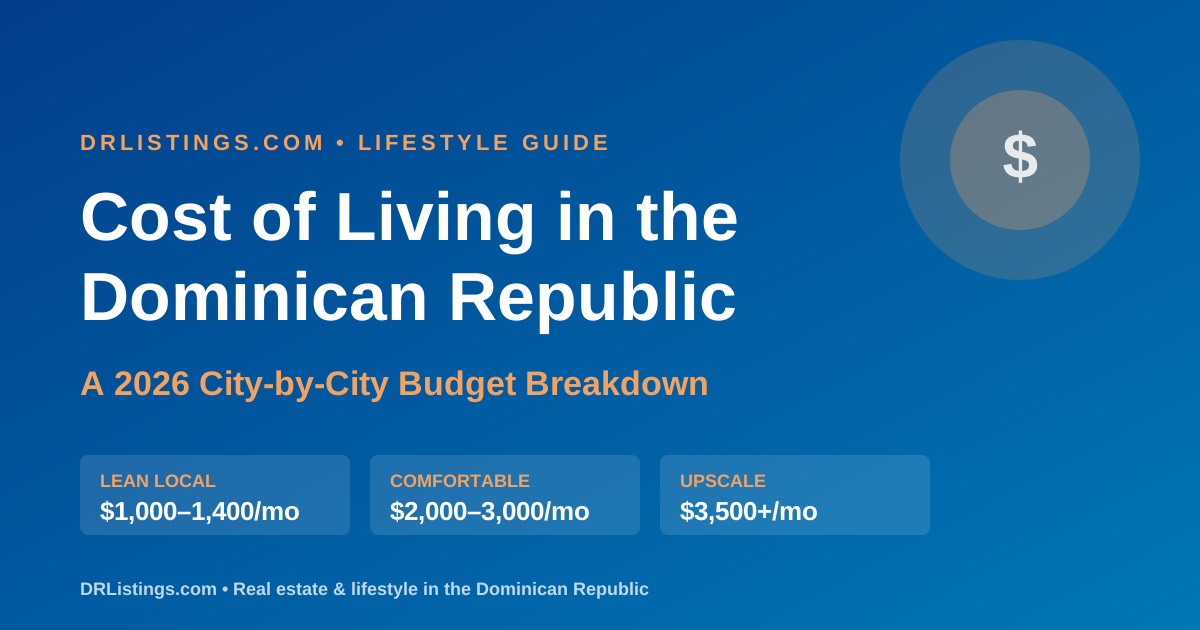
Numbeo and Expatistan both show the Dominican Republic running roughly 21 to 28 percent cheaper than Belize on a basket-of-goods basis. Groceries, restaurant meals, fuel, and domestic help are all noticeably less expensive in the DR. A couple living comfortably in Las Terrenas or Sosúa often reports monthly spending of $2,000 to $2,800. The Belize equivalent in San Pedro is more often $2,800 to $3,500.
Language is the biggest lifestyle trade-off. Spanish is the only language of daily life in most of the DR outside resort zones, where English works fine. In Belize, English is the official language, taught in schools, and used in every legal and government interaction. For an American or Canadian retiree who has no plans to learn a second language, Belize is genuinely easier.
Healthcare in both countries is adequate for routine care. The DR has more options, with internationally accredited hospitals in Santo Domingo and Punta Cana. Belize has good clinics in Belize City, but most expats fly to Mérida (Mexico) or Houston for serious procedures. Internet is solid in major DR cities (fiber widely available, 100 to 500 Mbps common) and decent but pricier in Belize.
Flights are roughly comparable. New York to Punta Cana runs 3 hours 45 minutes. Houston to Belize City is 2 hours 30 minutes. The DR has many more direct routes from secondary North American cities.
Safety, Stability, and Climate Risk
Crime statistics put both countries in the moderate band, with rates that vary heavily by region. Belize's national homicide rate is higher than the DR's per capita, but most expat-heavy areas (Ambergris Caye, Placencia) are safe by Caribbean standards. The DR has lower violent crime in expat areas like Cabarete and Las Terrenas, but petty theft and vehicle break-ins are common. We cover the practical safety picture in Is the Dominican Republic safe?.
Both countries sit in the Atlantic hurricane belt. The DR's north coast (Puerto Plata, Cabarete, Sosúa) is somewhat sheltered by Hispaniola's mountain spine, while the south coast and Punta Cana are more exposed. Belize is hit less often than the eastern Caribbean but takes direct strikes when it does. Reef erosion is a real concern for Ambergris Caye over the next 20 years.
The Dominican peso has been one of the steadier emerging-market currencies in the Caribbean. The Belize dollar's hard 2:1 USD peg removes currency risk entirely.
Residency and Retirement Visas
The Dominican Republic's Pensionado program needs about $1,500 per month in qualified retirement income (or $2,000 per month under the rentista track for non-pension passive income). Benefits include exemptions on import duties for household goods, partial exemptions on real estate transfer taxes, and a fast track to residency. Citizenship is eligible after two years of residency.
Belize's Qualified Retired Persons (QRP) program needs roughly $2,000 per month in foreign retirement income. Benefits include duty-free import of personal effects and a vehicle, full exemption from Belizean tax on foreign-source income, and a residency permit that does not lead to citizenship.
QRP has slightly higher financial bars but the strongest tax shield. Pensionado is cheaper to qualify for and offers a real path to a second passport. Pick based on whether you value tax simplicity (Belize) or long-term residency optionality (DR).
Which Country Is Right for You?
Choose the Dominican Republic if you:
- Want the biggest selection of properties and the best prices per square meter
- Need or want a mortgage as a foreign buyer
- Are buying as an investment and care about rental yield
- Plan to fly back to North America frequently from many origin cities
- Want a path to citizenship and a long-term tax-favored residency
Choose Belize if you:
- Want English as the language of daily life and legal paperwork
- Are paying cash and prioritize zero capital gains tax
- Prefer a smaller, quieter expat community focused on reef and eco-living
- Want duty-free import of household goods and a vehicle on day one
- Have no need for a mortgage or rental income
For the third option in this comparison, see Mexico vs. Dominican Republic. Mexico sits between the two on price and offers a different bundle of trade-offs.
Frequently Asked Questions
Is it better to live in Belize or the Dominican Republic?
It depends on language and budget. Belize is easier if you only speak English and want a small, eco-focused community. The Dominican Republic is cheaper, has more direct flights, larger expat enclaves, and a much wider property market. Most retirees on a budget land in the DR. Cash-rich English-only retirees often choose Belize.
Can foreigners own property in Belize and the Dominican Republic?
Yes, in both. Foreigners hold the same ownership rights as citizens with no special permits required for residential property. Belize uses fee simple titles under common law. The DR uses a Torrens-style title registry. Both are well-protected legal systems for foreign owners.
Is Belize or the Dominican Republic cheaper?
The Dominican Republic is cheaper across the board. Cost-of-living indexes from Numbeo and Expatistan put the DR roughly 21 to 28 percent below Belize on groceries, restaurants, transport, and housing rentals. Property prices per square meter also run lower in the DR, especially outside top resort zones.
Which is safer, Belize or the Dominican Republic?
Both have moderate crime levels concentrated in specific neighborhoods. Belize has a higher national homicide rate, but expat-heavy areas like Ambergris Caye and Placencia are safe. DR expat areas like Cabarete and Las Terrenas have low violent-crime rates with some petty theft. Practical safety is similar in the places foreigners actually live.
What are the closing costs when buying property in Belize vs the DR?
Belize closing costs run 9 to 10 percent of the purchase price, driven by an 8 percent stamp duty plus legal fees. Dominican Republic closing costs total 4.5 to 5.5 percent, including a 3 percent transfer tax and roughly 1.5 percent in legal and registration fees. CONFOTUR projects in the DR can wipe out the transfer tax entirely.
Can foreigners get a mortgage in Belize or the Dominican Republic?
In the Dominican Republic, yes. Major banks finance foreigners with 20 to 40 percent down at rates of 8 to 13 percent. In Belize, foreign-buyer mortgages are essentially unavailable. Nearly all transactions are cash or seller-financed. If you need bank financing, the DR is the only practical option.
Does the Dominican Republic or Belize have better beaches?
Both have excellent beaches but in different styles. The DR offers long stretches of soft white sand at Bávaro, Punta Cana, and Playa Rincón, with reliable surf at Cabarete. Belize is built around the world's second-longest barrier reef, with cayes and small beach pockets ideal for snorkeling and diving rather than long beach walks.
Which country has better tax incentives for retirees?
Belize's QRP program exempts all foreign-source income from local tax and allows duty-free import of household goods, the most generous tax shield in the region. The DR's Pensionado offers partial transfer-tax and IPI exemptions plus discounts on imports. Belize wins on income tax simplicity. The DR wins on real-estate-specific incentives like CONFOTUR.
Is English spoken in the Dominican Republic and Belize?
English is the official language of Belize and used in all government, legal, and business contexts. In the Dominican Republic, Spanish is the only language of daily life outside resort zones. English is common in tourist areas, with real estate professionals, and at international hospitals, but not in courts, banks, or government offices.
What is the rental yield for investment property in the DR vs Belize?
Gross rental yields in DR tourist zones (Punta Cana, Cabarete, Las Terrenas) typically run 6 to 10 percent, with well-managed short-term rentals at the high end. Belize national averages sit near 4 percent, with Ambergris Caye and Placencia reaching 5 to 7 percent on premium product. The DR's larger tourism volume drives the yield gap.
David Logan
site_adminContributing writer for DRListings.com, sharing insights about Dominican Republic real estate.
Comments
Log in to join the conversation