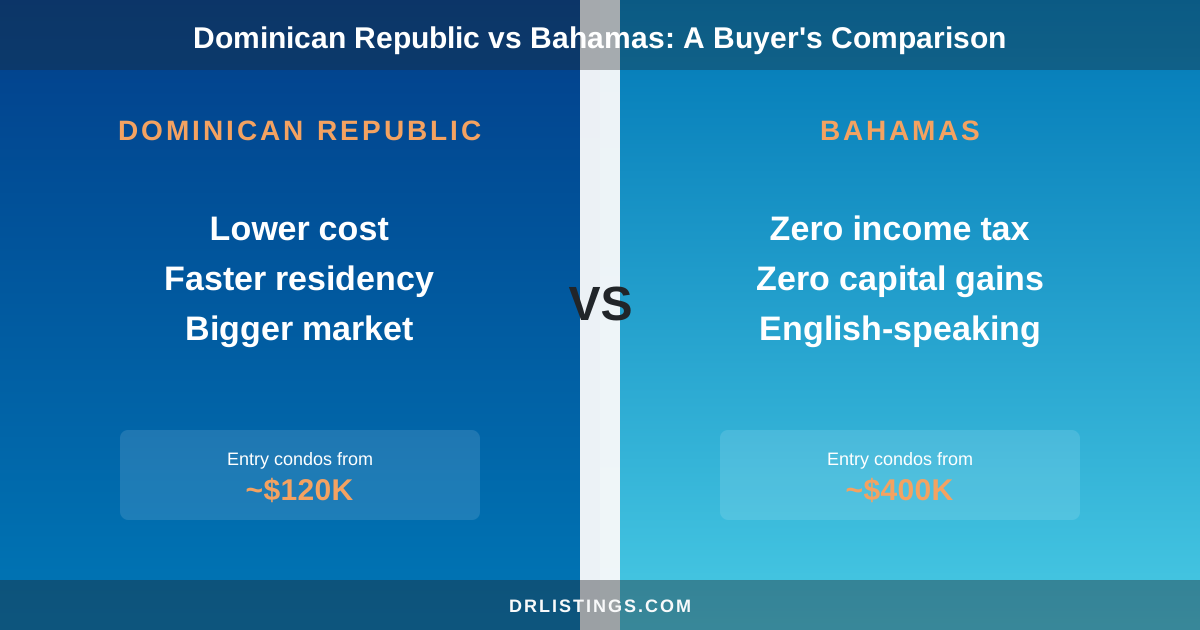
The Dominican Republic vs Bahamas decision usually comes down to budget, taxes, and lifestyle. Both countries let foreigners own beachfront property outright, and both sit a short flight from the US East Coast. But they fall on opposite ends of the Caribbean cost-and-lifestyle spectrum. The Bahamas is an English-speaking, tax-free luxury market. The Dominican Republic is a Spanish-speaking, fast-growing market where prices and daily costs run roughly half of what you'll pay in Nassau or Paradise Island.
If you're choosing between the two for a vacation home, retirement base, or rental investment, the right answer depends on three things: your budget, your tax situation, and how much you care about speaking Spanish. This guide walks through real estate markets, foreign ownership rules, taxes, cost of living, climate risk, and the path to residency in each country. The goal is to help you match the destination to your actual priorities.
Snapshot Comparison
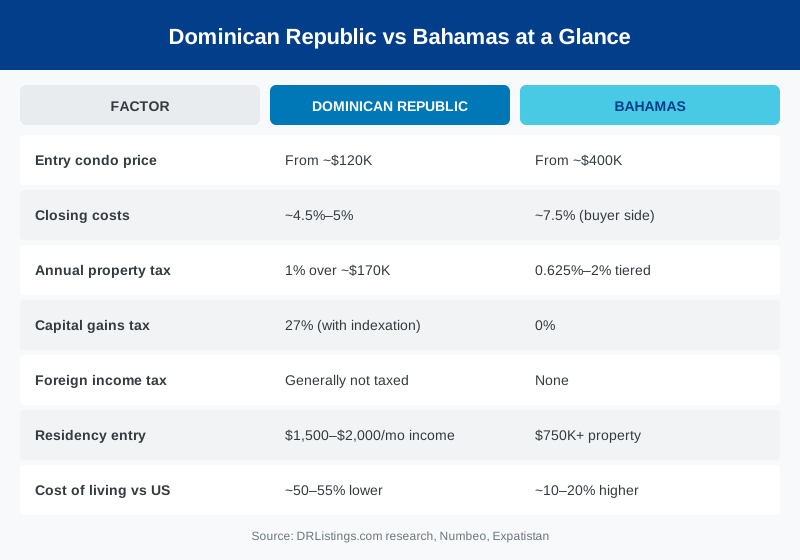
View text version of this infographic
| Factor | Dominican Republic | Bahamas | |---|---|---| | Entry condo price | From ~$120K | From ~$400K | | Closing costs | ~4.5%–5% | ~7.5% (buyer side) | | Annual property tax | 1% over ~$170K | 0.625%–2% tiered | | Capital gains tax | 27% (with indexation) | 0% | | Foreign income tax | Generally not taxed | None | | Residency entry | $1,500–$2,000/mo income | $1M+ property ($1.5M accelerated) | | Cost of living vs US | ~50–55% lower | ~10–20% higher |
Source: DRListings.com research, Numbeo, Expatistan.
| Factor | Dominican Republic | Bahamas | |---|---|---| | Language | Spanish (English in expat hubs) | English | | Currency | Dominican peso (DOP) | Bahamian dollar (BSD), pegged 1:1 to USD | | Foreign ownership | Full freehold, no restrictions | Freehold under 5 acres; permit required above | | Transfer tax (one-time) | 3% of appraised value | ~10% VAT on conveyance (often split buyer/seller) | | Annual property tax | 1% over ~$170k USD threshold | 0.625%–1% tiered, up to 2% on investment property | | Capital gains tax | 27% on gain | 0% | | Income tax (foreign income) | Generally not taxed (territorial) | None | | Residency threshold | $1,500–$2,000/mo income | $1M+ property ($1.5M accelerated) | | Cost of living vs US | ~50–55% lower | ~10–20% higher than US | | Flight time from NYC | ~3.5–4 hours | ~3 hours |
Dominican Republic vs Bahamas Real Estate Markets at a Glance
The two markets look different the moment you start browsing listings.
The Dominican Republic offers depth. Thousands of active listings spread across distinct submarkets: Punta Cana real estate on the east coast for resort-style condos and beachfront villas, Cap Cana for gated luxury, Cabarete real estate and Sosúa on the north coast for expat-friendly beach towns, Las Terrenas on the Samaná peninsula for a European feel, and Santo Domingo for urban condos in the capital. Entry-level beach condos start around $120,000–$180,000. Mid-range two and three-bedroom condos in established expat areas run $250,000–$450,000. Beachfront villas range from $600,000 to several million.
The Bahamas market is thinner and more concentrated. Most foreign buyers shop in Nassau and Paradise Island, with secondary interest in the Exumas, Eleuthera, and Abaco. Inventory is smaller, and prices reflect both scarcity and the country's tax-haven premium. A modest two-bedroom condo in Nassau typically starts around $400,000–$600,000. A beachfront home on Paradise Island or in the Exumas comfortably crosses $1.5 million. Entry-level pricing is roughly 2–3x what you'd pay for an equivalent property in the DR.
New construction tells the same story. The DR is in the middle of a multi-year build cycle driven by tourism growth and foreign demand. See our overview of the Dominican Republic investment climate. Bahamian construction is more contained, with luxury developments dominating new supply.
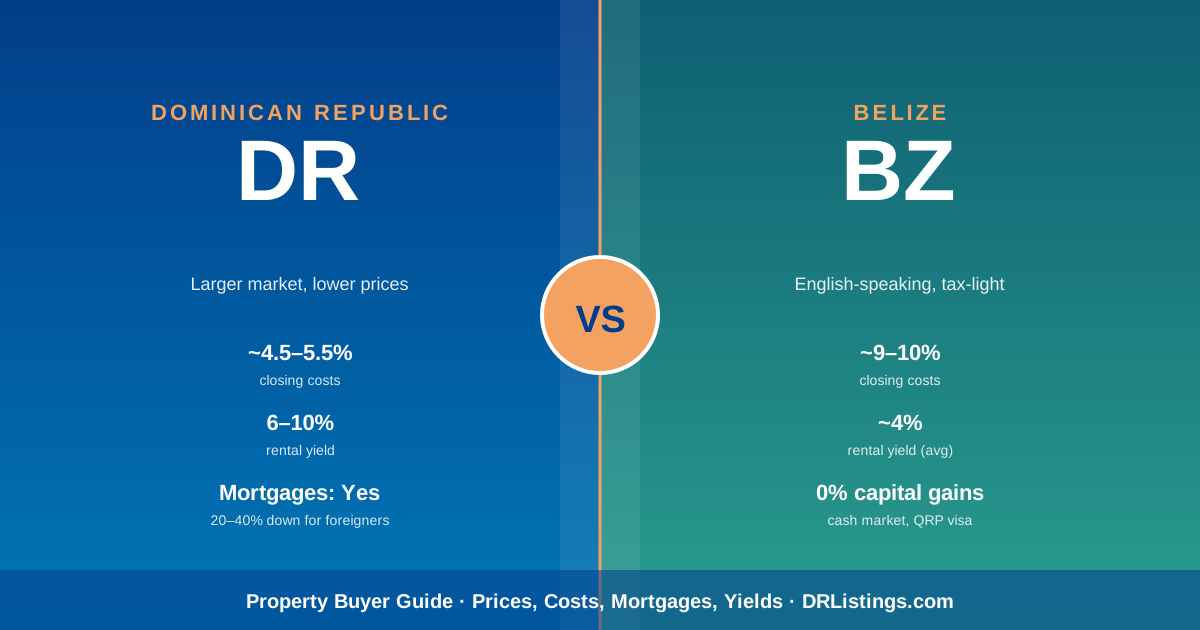
Rental yields generally favor the DR. Lower entry prices plus strong tourism volume — Punta Cana alone handles around 8 million annual airport passengers — mean short-term rental gross yields of 8–12% are realistic. Bahamian rentals can perform well in peak season, but the higher purchase price drags net yield down.
Foreign Ownership Rules
Both countries treat foreign buyers fairly, but the mechanics differ.
Dominican Republic. Foreigners have the same property rights as Dominican nationals. There's no residency requirement, no minimum investment, and no restriction on what you can buy. The country uses a Torrens-style title system run by the Title Registry (Registro de Títulos). Once your title is registered, ownership is guaranteed by the state. The full process is covered in our guide to how to buy property in the DR.
Bahamas. Foreigners can also own freehold, but the rules are tiered. Properties under 5 acres for residential use can be bought without government approval. Properties of 5 acres or more, or any property meant for commercial development or rental as a business, require a permit under the International Persons Landholding Act. Most individual buyers don't hit these thresholds, but the extra paperwork is worth knowing about if you're eyeing larger plots or rental-focused investments.
Title in the Bahamas runs on a more traditional deed-and-conveyance system. Title searches typically go back 30 years, and a Bahamian attorney must conduct the search and certify the title. Closings tend to be slower than in the DR.
Taxes: The Big Fork in the Road
This is where the two countries differ most, and where many buyers ultimately make their decision.
Transfer Tax (One-Time, On Purchase)
- Dominican Republic: A flat 3% transfer tax on the appraised value of the property, paid by the buyer at closing. Notary and registration fees add roughly another 1–1.5%. Total closing costs typically land around 4.5–5%.
- Bahamas: A 10% VAT applies to the conveyance of real estate, customarily split 50/50 between buyer and seller. Each side typically absorbs about 5%. Properties under $100,000 use a lower tier. Legal fees add another 2.5% on the buyer side.
On a $750,000 purchase, you're looking at roughly $34,000–$38,000 in DR closing costs versus $56,000–$60,000 in the Bahamas.
Annual Property Tax
- Dominican Republic: The IPI tax is 1% on the portion of property value above an indexed threshold (around $170,000 USD as of recent indexation). Owner-occupied primary residences get added exemptions. Properties registered under CONFOTUR — a tourism investment law — can be exempt from IPI for up to 15 years. Read our deep dive on CONFOTUR tax benefits for the details.
- Bahamas: Owner-occupied residences pay 0% on the first $300,000, 0.625% on $300,000–$500,000, and 1% above $500,000, capped at $120,000 annually. Investment and non-resident property is taxed at 1% up to $500,000 and 2% above $500,000.
For a $1 million owner-occupied home: roughly $8,300 per year in the DR (before exemptions), versus around $7,300 in the Bahamas. For a $1 million rental property: similar in the DR, but closer to $15,000 in the Bahamas because of the higher non-resident rate.
Capital Gains
- Dominican Republic: 27% on the realized gain, with cost-basis indexation rules that adjust your purchase price for inflation. That softens the bite on long-held properties.
- Bahamas: 0%. There is no capital gains tax. This is the single biggest tax advantage the Bahamas offers, and it's why the country is a preferred base for high-net-worth buyers.
Income, Inheritance, and Wealth
The Dominican Republic uses a territorial tax system. Foreign-source income (US Social Security, pensions, dividends from US accounts) is generally not taxed. Local income is taxed progressively. There's no wealth tax. Inheritance tax exists, but rates are modest.
The Bahamas has no income tax, no capital gains tax, no inheritance tax, and no wealth tax. Government revenue comes from VAT, customs duties, and property tax. This is a genuine zero-income-tax jurisdiction.
The verdict: If you're a high-earning American or Canadian who wants to legally minimize tax exposure, the Bahamas is structurally better — provided you can establish bona fide residency and untangle your home-country obligations. If you're a retiree on Social Security, or someone whose foreign income wouldn't be taxed locally anyway, the DR's territorial system gives you most of the same benefit at a fraction of the property entry price.
Cost of Living and Lifestyle
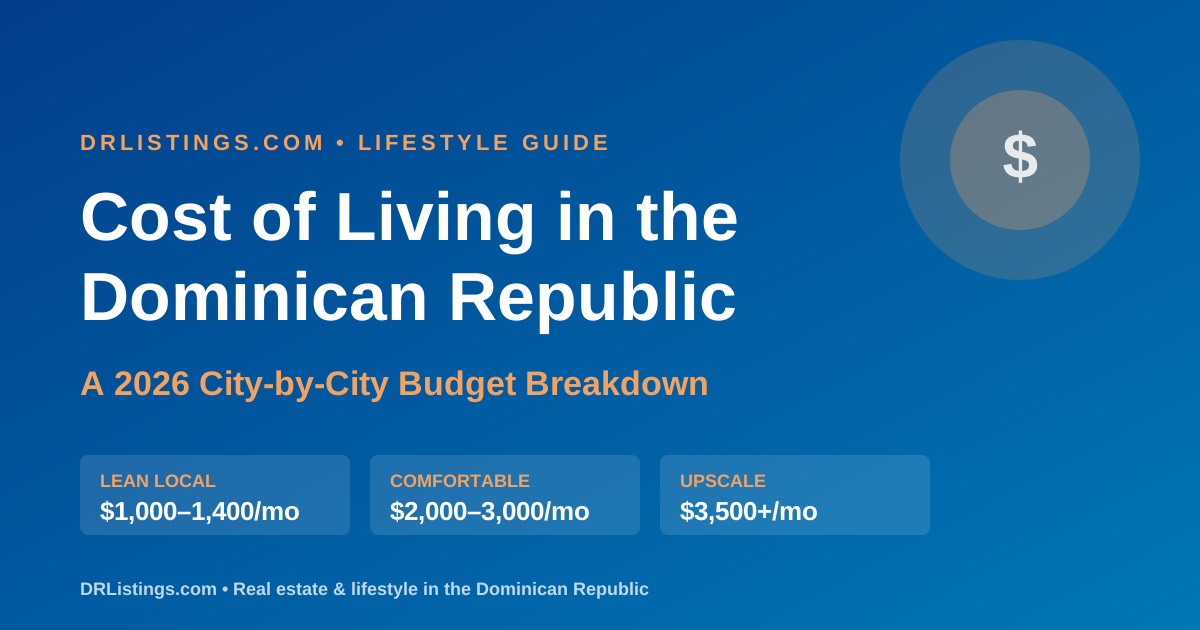
The headline number: the Dominican Republic costs roughly 50% less to live in than the Bahamas, according to Numbeo and Expatistan data. Expatistan's index puts daily life in the DR at around 53% cheaper than in the Bahamas as of recent comparisons.
Where you'll feel the gap:
- Groceries. A weekly grocery run that costs $250 in Nassau runs closer to $120 in Santo Domingo or Cabarete.
- Utilities. Bahamas electricity is among the most expensive in the Caribbean. DR power is cheaper but less reliable in some areas. Most expat homes have inverters or generators.
- Internet. Both have solid fiber in expat areas. Pricing is comparable.
- Dining. A casual dinner for two: $30–$50 in the DR; $80–$120 in the Bahamas.
- Imported goods. The Bahamas applies heavy customs duties (often 25–35%) on imports, which is why grocery prices are so high. The DR also taxes imports, but a much larger local production base keeps everyday goods cheaper.
Language. The Bahamas is fully English-speaking. The DR is Spanish-speaking, but expat hubs like Cabarete, Sosúa, and Las Terrenas operate largely in English, German, and French. You can get by in those areas without Spanish, though learning the basics goes a long way.
Healthcare. This catches buyers off guard. The DR has strong private hospitals — Hospiten and Centro Médico Punta Cana on the east coast, Hospital General Plaza de la Salud and CEDIMAT in Santo Domingo — at a fraction of US prices. The Bahamas has limited specialist care, and many residents fly to Florida for serious procedures. If healthcare access matters, the DR is meaningfully better.
Flight access. Nassau is roughly 3 hours from New York and under 2 from Miami, with frequent daily service. Punta Cana is 3.5–4 hours from New York and 2.5 from Miami, but offers more direct routes from secondary US and Canadian cities (Toronto, Montreal, Boston, Charlotte, Atlanta). For the broader picture on tourism and lifestyle, see DR tourism growth and lifestyle.
Climate, Hurricane Risk, and Geography
Both countries are tropical, with average highs in the 80s year-round and a defined rainy season from roughly May through November.
The geography is different in ways that matter for property buyers.
The Bahamas is an archipelago of low-lying islands. Most landmass sits just a few feet above sea level. The country sits squarely in the main Atlantic hurricane corridor. Hurricane Dorian in 2019 caused catastrophic damage on Abaco and Grand Bahama, with sustained winds of 185 mph. Insurance costs in the Bahamas reflect this risk.
The Dominican Republic shares the island of Hispaniola with Haiti and is much larger, with a mountainous interior. The Cordillera Central tops out above 10,000 feet. The south coast (Punta Cana, La Romana, Santo Domingo) sits in a position that has historically seen fewer direct hurricane hits than either the Bahamas or the DR's own north coast. The mountains also moderate weather inland.
Beach quality is a genuine point in the Bahamas' favor. The white sand and electric-blue water of the Exumas are hard to match anywhere. The DR offers more variety: Caribbean beaches on the south and east coasts, dramatic cliffs and surf on the north coast, mountain towns inland, and jungle on the Samaná peninsula.
Residency, Visas, and Path to Citizenship
Dominican Republic. Two main investor-friendly tracks:
- Pensionado: $1,500/month in pension income ($1,750 for couples). Aimed at retirees with Social Security or private pensions.
- Rentista: $2,000/month in stable passive income from any source.
Permanent residency typically issues within 1–2 years. Citizenship eligibility kicks in roughly 2 years after PR — one of the fastest paths in the Americas.
Bahamas. Three main paths:
- Annual Homeowner's Residence Card: Available to any property owner, renewable yearly. Lets you live in the country, but isn't permanent residency.
- Permanent Residency: Requires a minimum property investment of $1,000,000 (raised from $750,000 effective January 1, 2025). Properties of $1.5 million or more qualify for accelerated processing, with approvals typically issued within roughly three weeks. Investments must be held for at least 10 years.
- Citizenship: Long road, generally 10+ years of residency.
The DR's residency path is the easier and cheaper of the two by a wide margin, especially for retirees. The Bahamas residency path is essentially price-gated — fine if you were already buying at that level, prohibitive if you weren't.
If you're financing a DR purchase, our overview of DR mortgage options for foreign buyers walks through what's actually available.
Dominican Republic vs Bahamas: Which Is Right for You?
This isn't a winner-take-all decision. It's a match-the-destination-to-your-priorities decision.
Choose the Bahamas if:
- You're high-net-worth and tax efficiency is your top priority
- You want English-speaking and minimal cultural adjustment
- You're already shopping above $1 million (or $1.5M for accelerated PR) and the residency threshold isn't a stretch
- You don't mind a smaller, more contained expat scene
- You want the closest possible flight access to the US East Coast
Choose the Dominican Republic if:
- Budget matters and you want more home for your money
- You want strong rental yields and a market that's actively growing
- You're a retiree on pension income (Social Security alone often qualifies)
- You're open to learning some Spanish, or planning to live in an English-friendly expat hub
- You want diverse geography (mountains, jungle, multiple coastlines)
- A faster path to residency and citizenship matters
For buyers weighing more than two countries, our Mexico vs Dominican Republic comparison covers the other destination North American buyers most often weigh against the DR.
Frequently Asked Questions
Is it cheaper to live in the Dominican Republic or the Bahamas? The Dominican Republic is significantly cheaper — roughly 50% less than the Bahamas overall. Cost of living indexes from Numbeo and Expatistan show the gap across groceries, dining, utilities, and rent. Property prices are also about half on a like-for-like basis.
Can foreigners buy property in the Bahamas and the Dominican Republic? Yes, both countries allow foreign freehold ownership. The DR has no restrictions on foreign buyers. The Bahamas requires a permit only for properties of 5+ acres or commercial-purpose property; standard residential purchases under 5 acres need no government approval.
Which is safer, the Dominican Republic or the Bahamas? Both have areas to avoid and areas that are very safe. Tourism zones and gated expat areas in the DR (Cap Cana, parts of Cabarete, Casa de Campo) are statistically very safe. Nassau has higher reported violent crime per capita than Punta Cana, but it's concentrated in specific neighborhoods. Our guide on is the Dominican Republic safe covers DR specifics in detail.
What are the property taxes in the Bahamas vs the Dominican Republic? The DR charges 1% annually on property value above roughly $170,000 USD, with significant exemptions for owner-occupied homes and CONFOTUR-registered properties. The Bahamas charges 0.625%–1% on owner-occupied homes and up to 2% on investment property above $500,000.
Is the Bahamas or Dominican Republic better for retirement? For most retirees on pension or Social Security income, the DR is a better fit: lower cost of living, easy residency via the Pensionado program at $1,500/month, and strong private healthcare. The Bahamas suits retirees with substantial liquid wealth who want zero income and capital gains tax.
How much money do you need to retire in the Bahamas vs the Dominican Republic? A comfortable retirement in the DR runs $2,000–$3,500/month for a couple in most expat areas, including rent or mortgage. The same lifestyle in the Bahamas typically requires $5,000–$8,000/month, plus the Bahamas residency program effectively requires a $1,000,000+ property purchase ($1.5M for accelerated processing).
Does the Dominican Republic have capital gains tax on real estate? Yes, 27% on the realized gain, with cost-basis indexation that adjusts the purchase price for inflation. The Bahamas has no capital gains tax.
How long does it take to get residency in the Dominican Republic vs the Bahamas? DR permanent residency typically takes 1–2 years from application, with citizenship eligibility around 2 years after PR. Bahamas permanent residency requires a $1,000,000+ property purchase (raised from $750,000 in January 2025; $1.5M for accelerated processing) and processing time of several months to a year; citizenship typically requires 10+ years of residency.
Are the beaches better in the Bahamas or the Dominican Republic? The Bahamas, especially the Exumas and Eleuthera, is hard to beat for white sand and clear shallow water. The DR offers more variety — Caribbean beaches on the east coast, surf and cliffs on the north coast, and palm-lined coves on the Samaná peninsula. If postcard beaches are the only criterion, the Bahamas wins narrowly. If variety matters, the DR wins.
Which has better healthcare, the Dominican Republic or the Bahamas? The DR has stronger healthcare infrastructure. Private hospitals in Santo Domingo and Punta Cana handle most specialist care at a fraction of US prices. Bahamian healthcare is limited; many residents fly to Florida for serious procedures, which is a real cost and logistical factor for older buyers.
Sources
- Fragomen — Bahamas Increased Investment Amount for Economic Certificate of Permanent Residence
- Numbeo, Expatistan — cost of living indexes
- Dominican Republic DGII — IPI threshold (Resolution DDG-AR1-2026-00001)
David Logan
site_adminContributing writer for DRListings.com, sharing insights about Dominican Republic real estate.
Comments
Log in to join the conversation