If you're a North American with $300,000 to $700,000 to put toward a beach lifestyle that ideally pays for itself, the Dominican Republic vs Costa Rica decision keeps coming back to the same short list of questions. Both countries deliver year-round warm weather. Both have English-speaking expat communities, direct flights from the US East Coast, and a Caribbean rhythm that takes about a week to settle into. That's where the similarity ends.
Tourism brochures love both countries equally. Property buyers shouldn't. Once you push past the postcards, the two diverge sharply. They differ on what foreigners can actually own, what you'll pay in taxes, how much rental income you can pull in, and what it costs to live there. This guide compares both countries on the things that matter when real money changes hands. Not which one has prettier sunsets.
Quick TL;DR: The Dominican Republic suits buyers chasing value, fee-simple beachfront ownership, and rental yield. Costa Rica suits buyers who'll pay a premium for political stability, lower crime statistics, and the eco-wellness lifestyle. If your goal is "best Caribbean property dollar," the DR usually wins. If your goal is "lowest-stress retirement in Latin America," Costa Rica earns its higher price tag.
Quick-Glance Comparison
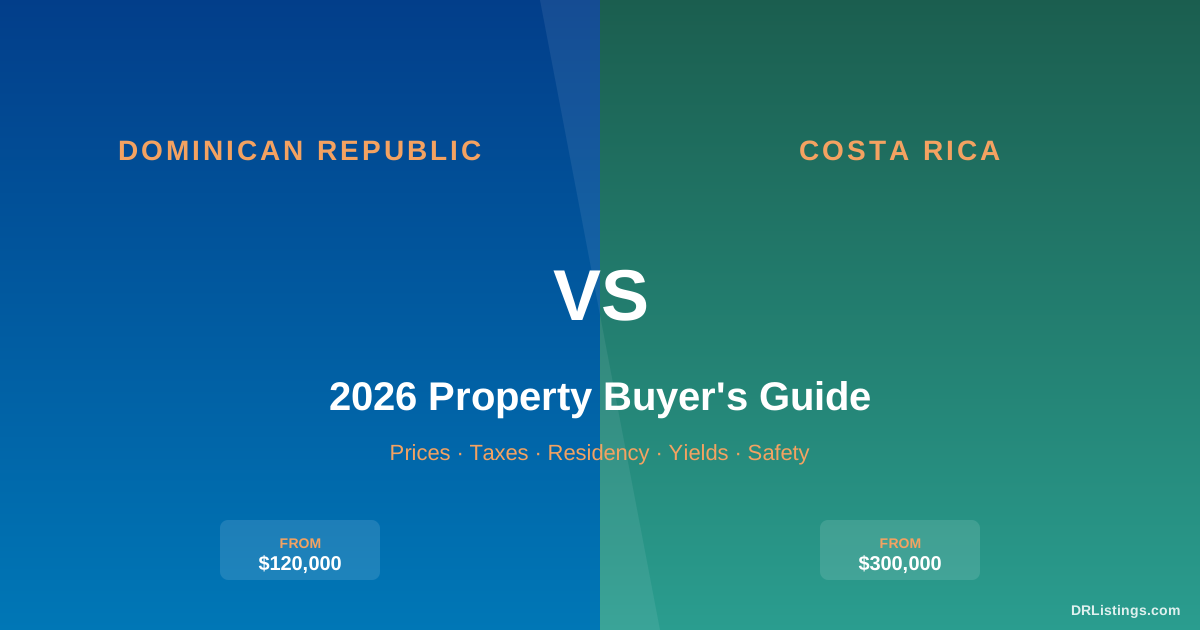
| Factor | Dominican Republic | Costa Rica | |--------|-------------------|------------| | Entry-level beachfront condo | $120,000 – $300,000 | $300,000 – $600,000+ | | Foreign ownership of beachfront | Fee-simple, in your own name | Concession (lease) in first 200m of coast | | Annual property tax | 1% IPI above ~$182,000 USD threshold | 0.25% on full registered value | | Transfer tax | 3% | ~1.5% + ~0.85% in stamps | | Tax incentive for new builds | CONFOTUR — up to 15-year exemption | None equivalent | | Typical gross rental yield | 5.6% – 7.7% | 4% – 6% | | Pensionado residency minimum | $1,500/month income | $1,000/month income | | Investor residency | $200,000 USD | $150,000 USD (reverts to $200,000 after July 14, 2026 absent renewal) | | Currency | Dominican peso (DOP) | Costa Rican colón (CRC) | | Flight time from Miami | ~2 hours | ~3 hours | | Time zone | Atlantic Standard (no DST) | Central Standard (no DST) |
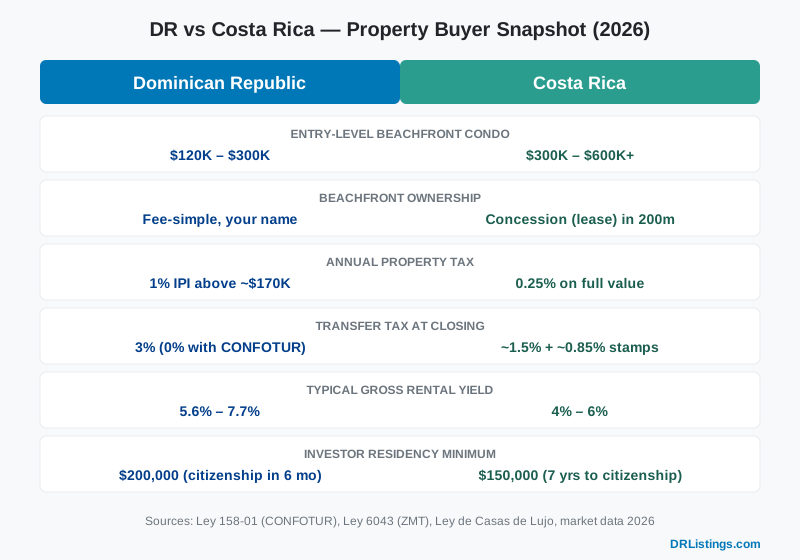
View text version of this infographic
DR vs Costa Rica — Property Buyer Snapshot (2026)
- Entry-level beachfront condo: DR $120K – $300K | Costa Rica $300K – $600K+
- Beachfront ownership: DR fee-simple in your own name | Costa Rica concession (lease) in first 200m
- Annual property tax: DR 1% IPI above ~$182K | Costa Rica 0.25% on full value
- Transfer tax at closing: DR 3% (0% with CONFOTUR) | Costa Rica ~1.5% + ~0.85% stamps
- Typical gross rental yield: DR 5.6% – 7.7% | Costa Rica 4% – 6%
- Investor residency minimum: DR $200,000 (citizenship eligible in 6 months) | Costa Rica $150,000, set to revert to $200,000 after July 14, 2026 absent renewal (7 years to citizenship)
Sources: Ley 158-01 (CONFOTUR), Ley 6043 (ZMT), Ley de Casas de Lujo, DGII Resolution DG-AR1-2026-00001 (DR IPI threshold), Costa Rica Executive Decree N° 45358-H (Luxury Home Tax threshold), Law 9996 (CR Inversionista temporary threshold), market data 2026.
Property Ownership and Foreign Buyer Rights
This is the biggest structural difference between the two countries, and most travel-comparison articles skip it entirely.
In the Dominican Republic, foreign nationals hold the same property rights as Dominican citizens. You can buy a beachfront condo in Punta Cana, a villa in Cabarete, or a finca in the mountains, and the title goes in your own name. Everything sits inside one national title registry called the Jurisdicción Inmobiliaria. That means you're buying a registered, surveyed parcel with a clean ownership history that any attorney can verify in a few hours. There's no "foreigner version" of a deed. You get what a Dominican gets.
Costa Rica is more complicated, especially on the coast. The country's Maritime Terrestrial Zone (Zona Marítimo Terrestre, governed by Ley 6043) covers the first 200 meters inland from the high-tide line on most of the coast. The first 50 meters are public. Nobody can own them. The next 150 meters can only be held under a renewable concession, typically 20 years, granted by the local municipality. Foreigners who haven't lived in Costa Rica for at least five years cannot directly hold concessions. That's why so many beachfront listings in places like Tamarindo or Nosara are structured through a Costa Rican corporation with a local majority shareholder on paper.
Here's what that means in practice. A "beachfront" listing in Costa Rica is often a long-term lease wrapped in a corporate structure, not a deed. Inland properties (anything more than 200 meters from the high-tide line) are straightforward fee-simple. But the dream of waking up 80 feet from the surf with a true title in your name is harder to pull off there.
If clean ownership matters to you, this alone tips many buyers toward the DR. For a step-by-step walkthrough, see our guide on how to buy property in the Dominican Republic.
Property Prices and Where Your Money Goes Further
Prices vary wildly by town in both countries, but the broad pattern is consistent. Comparable Costa Rican coastal property runs roughly 15% to 30% more than its Dominican equivalent.
Dominican Republic — typical 2026 ranges:
- Sosúa and Cabarete (north coast): 1- to 2-bedroom condos $120,000 – $250,000; 3-bedroom villas with pool $300,000 – $600,000
- Punta Cana and Bávaro (east coast): condos $150,000 – $300,000; beachfront villas $500,000 – $1.5M+
- Las Terrenas (Samaná peninsula): condos $180,000 – $350,000; villas $400,000 – $900,000
- Cap Cana (luxury enclave): entry around $400,000, with most homes $750,000 – $3M+
Costa Rica — typical 2026 ranges:
- Tamarindo / Playa Grande: condos $300,000 – $550,000; villas $600,000 – $1.2M
- Jacó: condos $250,000 – $450,000; villas $500,000 – $1M
- Nosara and Santa Teresa: condos and small homes $400,000 – $800,000; villas regularly cross $1M
- Manuel Antonio: villas typically $700,000 – $2M
The same monthly budget that buys a turnkey 2-bedroom condo a five-minute walk from the beach in Cabarete or Las Terrenas typically gets you a smaller, older unit further from the water in Nosara or Tamarindo. Construction costs follow the same pattern. Building in the DR runs roughly $90 to $150 per square foot for solid mid-range work. Costa Rica routinely lands at $130 to $220 per square foot once you factor in the cost of getting materials to the Pacific coast.
For pricing in specific markets, browse current inventory in Punta Cana, Las Terrenas, Cabarete, Sosua, and Cap Cana.
Taxes, Fees, and Holding Costs
The tax math is where this comparison really separates. Costa Rica looks cheap on annual property tax until you factor in transaction costs and the Luxury Home Tax.
Dominican Republic:
- 3% transfer tax on registered value, paid once at closing
- 1% IPI annual property tax, but only on the value above RD$10,695,494 (about $182,000 USD per DGII Resolution DG-AR1-2026-00001). Below that threshold, primary residences pay zero
- CONFOTUR: properties in approved tourism-development projects qualify for a 15-year exemption from both the 3% transfer tax and the 1% IPI. This is governed by Law 158-01 and is the single biggest financial lever in the DR market. Many new-construction condos in Punta Cana, Las Terrenas, and Cap Cana carry CONFOTUR status.
- Capital gains: rolled into income tax at the standard 27% rate on the gain (not on the full sale price)
Costa Rica:
- ~1.5% transfer tax plus roughly 0.85% in stamps and registration fees, paid at closing
- 0.25% annual property tax on the full registered value, with no significant exemption threshold
- Luxury Home Tax (Ley de Casas de Lujo): a sliding scale starting around 0.25% and rising to 0.55% annually, applied to homes whose construction value exceeds roughly $270,000 USD (the colón threshold — ¢143 million per Executive Decree N° 45358-H — is updated each year)
- Capital gains: 15% on the gain, or you can elect 2.25% of the full sale price if it's lower
Run the numbers on a $400,000 beachfront condo held for ten years and the gap is hard to ignore. In the DR with CONFOTUR status, you pay zero transfer tax at purchase and zero IPI for the holding period. Total tax friction over ten years can sit near zero. In Costa Rica, the same property costs roughly $9,400 in transfer taxes and stamps at closing. Add another $1,000 to $2,500 per year in property and luxury home tax, depending on construction value.
For a deeper dive into the DR tax incentive side, see our CONFOTUR tax benefits guide, or browse current CONFOTUR-approved properties directly.
Cost of Living
Numbeo and Expatistan both put Costa Rica's cost of living roughly 22% to 35% higher than the Dominican Republic's once you strip out rent. Day-to-day, this shows up in groceries, gasoline, restaurants, and utilities. It's especially noticeable on imported goods. Anything brought in from the US tends to cost more in Costa Rica because of higher import duties and the longer supply chain to the Pacific coast.
Rough monthly budgets for a single expat living comfortably (rent excluded):
- Dominican Republic: $1,200 – $1,800 (more in Punta Cana or Cap Cana, less on the north coast)
- Costa Rica: $2,000 – $2,800 (more in San José or Nosara, less in inland towns)
Healthcare is reasonably priced in both. Costa Rica's CAJA system is a mature universal-access program. Legal residents can join for roughly 7% to 11% of declared income, and private hospitals like CIMA in San José are excellent. The DR has SeNaSa as its public option plus a strong private hospital network like Hospiten and CEDIMAT. North Americans typically pay out of pocket or through international insurance for prices that look like a 70% to 80% discount on US equivalents.
Rental Yields and Investment Returns
If you plan to rent the property when you're not using it, the DR has a meaningful structural advantage on Dominican Republic vs Costa Rica real estate returns.
Gross rental yields cited across DR markets cluster between 5.6% and 7.7% in established tourism towns like Punta Cana and Las Terrenas. Professionally managed short-term rentals in high-demand zones occasionally push 8% to 10% gross. Costa Rica's mature beach markets like Tamarindo, Jacó, and Manuel Antonio typically deliver 4% to 6% gross. The gap isn't because Costa Rica has weaker tourism. It's the math: when entry prices are 15% to 30% higher and nightly rates are roughly comparable, yields compress.
Three reasons DR yields tend to outperform:
- Lower entry prices on the denominator
- Year-round high tourism volume. The DR welcomed over 11 million visitors in 2024, more than double Costa Rica's annual numbers
- A dense direct-flight network feeding short-stay demand into properties year-round
Be skeptical of any seller advertising 10%+ guaranteed yields. Once you back out a realistic 25% to 30% vacancy, 18% to 25% management fees, HOA charges, utilities, and maintenance, even strong properties land in the 5% to 7% net range. For yield-focused inventory, villas for sale in Las Terrenas and condos for sale in Punta Cana are the two markets most often modeled by income investors.
For background on what's driving demand, see our DR economic outlook and DR infrastructure projects coverage.
Residency and Visas
Both countries offer residency paths designed for retirees and investors. The thresholds differ enough to matter.
Dominican Republic:
- Pensionado: $1,500/month from a guaranteed pension or government source
- Rentista: $2,000/month from passive income (dividends, rental income, etc.)
- Investor: $200,000 USD invested in real estate, a Dominican business, or government bonds. Eligible for citizenship after just six months as a permanent resident.
Costa Rica:
- Pensionado: $1,000/month lifetime pension
- Rentista: $2,500/month for at least two years, or a $60,000 deposit in a Costa Rican bank
- Inversionista: $150,000 USD invested in property, business, or qualifying assets (this is a temporary threshold under Law 9996 with a sunset date of July 14, 2026 — expected to revert to $200,000 absent legislative renewal)
Costa Rica wins on the pensionado threshold and, for now, on the investor minimum. The DR wins on speed to citizenship. Investor-track residents become eligible to apply for Dominican citizenship after six months of permanent residency. Costa Rica requires seven years of legal residence before naturalization. For tax-residency treatment of foreign income, both countries lean territorial. Costa Rica generally exempts foreign-source pensions from local tax. The DR officially taxes worldwide income, but only after your third year as a tax resident. Even then, enforcement on foreign pensions is light in practice.
Safety and Quality of Life
Costa Rica is consistently rated among Latin America's safest countries on national-level crime statistics. The DR has higher headline national numbers, mostly driven by certain neighborhoods in Santo Domingo and Santiago that no expat is buying property in.
The honest framing: in the established expat zones like Punta Cana, Cap Cana, Cabarete, Sosúa, Las Terrenas, Bávaro, and Casa de Campo, day-to-day safety is comparable to a small US tourist town. The DR has dedicated tourist police forces (CESTUR/POLITUR) that patrol these zones and respond quickly. Most expats living there report the same kind of low-grade vigilance you'd practice in any unfamiliar city. Don't flash valuables. Don't walk drunk in unlit areas at 3 AM. Don't drive at night on rural highways without good reason. For a fuller picture, see our DR safety guide.
Natural risk is the trade-off worth thinking about. The DR sits in the Atlantic hurricane belt, with a season that runs June through November and the highest risk in September and October. Major direct hits on inhabited coastlines are uncommon but real (Hurricane Fiona hit the southeast in 2022). Costa Rica almost never gets hurricanes, but it sits on the Pacific Ring of Fire. Felt earthquakes happen multiple times a year, and the country has several active volcanoes including Arenal and Poás. Neither risk is a deal-breaker for most buyers, but you build differently for hurricanes than for earthquakes, and insurance prices reflect it.
Climate, Beaches, and Lifestyle
The DR offers two coastlines with distinctly different personalities. The east and south coasts are classic Caribbean, with turquoise water, white sand, and calm conditions. Punta Cana and Bayahibe are the obvious examples. The Atlantic north coast around Cabarete and Encuentro is a global kitesurfing and windsurfing destination. The Samaná peninsula, anchored by Las Terrenas, splits the difference with palm-fringed beaches and a more European expat scene. Wet season runs roughly May through October. For a regional breakdown, see North Coast real estate and East Coast real estate.
Costa Rica gives you Pacific surf coast, Caribbean low-key coast, and mountain-valley living. Tamarindo and Jacó draw the surf and party crowd. Nosara and Santa Teresa skew yoga and wellness. The Central Valley around San José and Atenas offers a year-round 70°F climate that retirees who don't love beach humidity often prefer. Wet season runs May through November, often heavier than in the DR.
The cultural texture differs. Costa Rica leans pura vida with eco-tourism, yoga, and slow living. The DR is Latin-Caribbean with merengue, bachata, baseball, Spanish that flies fast, more energetic nightlife, and more developed all-inclusive resort infrastructure. For lifestyle context, our DR tourism and lifestyle guide covers the full picture.
Getting There and Connectivity
The DR has eight international airports, including Punta Cana (PUJ), Santo Domingo (SDQ), Puerto Plata (POP), Samaná (AZS), Santiago (STI), and La Romana (LRM). Flight times from major US East Coast hubs are short. About 3.5 hours from New York, 2 hours from Miami, and 4 hours from Toronto. Punta Cana alone handles direct flights from over 25 US and Canadian cities.
Costa Rica has two main international airports: San José (SJO) and Liberia (LIR). Most beach destinations require either a domestic flight or a 3- to 5-hour drive from one of the two. Tamarindo and Nosara are reachable from Liberia in about 1.5 hours. The Pacific south, like Manuel Antonio or Dominical, is a 3-hour drive from San José or a domestic flight.
For owners who plan to fly down for long weekends, or for landlords managing short-term rentals where guest turnover is constant, the DR's denser flight network is a meaningful operational advantage.
Which Is Right for You?
Pick the Dominican Republic if you:
- Want fee-simple beachfront ownership in your own name
- Are buying primarily for rental yield or value
- Want CONFOTUR's 15-year tax holiday on a new build
- Plan frequent short trips and need the dense flight network
- Want a fast track to second citizenship via investment
Pick Costa Rica if you:
- Will pay 20%+ more for stronger national crime stats
- Prefer the pura vida eco-wellness lifestyle
- Want mountain-valley climate options like Atenas or San Ramón
- Are comfortable with concession-based beachfront or buying inland
- Don't plan to rent the property aggressively
There's no wrong answer between two countries that both work. There is a wrong answer in buying without knowing how the ownership rules work, what the holding costs are, and what the rental math actually looks like. If you're leaning DR, our guide on DR mortgages for foreigners walks through financing options. You can also browse current inventory across the country: villas for sale and condos for sale.
For a related comparison, see our Mexico vs Dominican Republic comparison.
Frequently Asked Questions
Is the Dominican Republic cheaper than Costa Rica?
Yes. Cost-of-living indexes from Numbeo and Expatistan put Costa Rica roughly 22% to 35% higher than the DR excluding rent, and beachfront real estate runs 15% to 30% more. A single expat lives comfortably on $1,200 to $1,800 per month in the DR versus $2,000 to $2,800 in Costa Rica.
Can foreigners own beachfront property in Costa Rica?
Not in the same way as in the DR. Costa Rica's first 200 meters from the high-tide line is the Maritime Terrestrial Zone. The inner 50 meters is public, and the outer 150 meters can only be held under a 20-year renewable concession (a lease, not a deed). Foreigners typically structure beachfront concessions through Costa Rican corporations. Inland property is standard fee-simple.
Is Costa Rica safer than the Dominican Republic?
On national-level crime statistics, yes. Costa Rica consistently ranks among the safer Latin American countries. But established expat zones in the DR (Punta Cana, Cap Cana, Cabarete, Las Terrenas, Bávaro) are statistically safe and have dedicated tourist police. The honest answer: both require basic urban precautions, and neither is dangerous for residents of expat communities.
Where do US expats live in the Dominican Republic vs Costa Rica?
In the DR, North Americans cluster in Punta Cana, Cap Cana, Cabarete, Sosúa, Las Terrenas, and Casa de Campo. In Costa Rica, the main expat hubs are Tamarindo, Nosara, Santa Teresa, Jacó, Manuel Antonio, Atenas, and the Central Valley towns around San José.
What is the property tax in the Dominican Republic vs Costa Rica?
The DR charges 1% IPI annually on the value above roughly $182,000 USD (RD$10,695,494 per DGII Resolution DG-AR1-2026-00001). Primary residences below that threshold pay zero. CONFOTUR-approved properties are exempt for 15 years. Costa Rica charges a flat 0.25% on the full registered value with no significant threshold, plus a Luxury Home Tax of 0.25% to 0.55% on homes with construction value above roughly $270,000 USD (¢143 million per 2026 Executive Decree N° 45358-H).
Which has better rental yields, DR or Costa Rica?
The DR. Gross yields in established Dominican tourism markets typically run 5.6% to 7.7%, with professionally managed properties pushing 8% or higher. Costa Rica's mature beach markets generally produce 4% to 6%. Lower entry prices and a denser direct-flight network give the DR the structural edge.
Is the Dominican Republic or Costa Rica better for retirement?
It depends on priorities. Costa Rica wins on lower headline crime stats, mature universal healthcare via CAJA, and lifestyle if you want pura vida or a mountain-valley climate. The DR wins on cost of living, ownership rights, residency speed, and real estate value. Many retirees on a $2,000 to $3,000 monthly budget find the DR considerably more comfortable.
Does the Dominican Republic have hurricanes?
Yes. The Atlantic hurricane season runs June through November, with peak risk in September and October. Direct hits on inhabited DR coastlines are uncommon. Most storms track north of Hispaniola, but they do happen (Hurricane Fiona made landfall on the southeast coast in 2022). Modern construction in tourist zones is built to withstand hurricane-force winds.
How much money do you need to retire in Costa Rica vs the Dominican Republic?
The DR requires $1,500/month from a guaranteed pension for the pensionado residency program. Costa Rica requires $1,000/month. Lifestyle-wise, retirees report comfortable budgets of around $2,000 to $3,000/month in the DR (rent included) versus $2,800 to $4,000/month in Costa Rica for a similar standard of living.
What residency visa options exist in each country?
The DR offers Pensionado ($1,500/month), Rentista ($2,000/month), and Investor ($200,000 invested, with citizenship eligibility after 6 months). Costa Rica offers Pensionado ($1,000/month), Rentista ($2,500/month or $60,000 bank deposit), and Inversionista ($150,000 invested under temporary Law 9996 — set to revert to $200,000 after July 14, 2026 absent renewal). The DR's path to citizenship is dramatically faster: 6 months of residency for investors versus 7 years in Costa Rica.
David Logan
site_adminContributing writer for DRListings.com, sharing insights about Dominican Republic real estate.
Comments
Log in to join the conversation