Yes, you can open a bank account in the Dominican Republic as a foreigner. The process in 2026 is stricter than it was five years ago. Tourists, retirees, snowbirds, and property buyers from the US and Canada still do it every week. The difference now is that some branches will turn you away even when bank policy says they shouldn't. You need to walk in prepared.
This guide covers what actually happens at the branch, which banks treat North American expats best, what documents you need, and how the whole thing connects to buying property. It is a practical lifestyle guide, not legal or tax advice.
TL;DR:
- Non-residents can open accounts at most major banks with a passport, a secondary ID, and a bank reference letter.
- Plan for an in-person visit, an initial deposit between US$100 and US$500, and 1 to 10 business days for full activation.
- Scotiabank, Banreservas, and Banco Popular are the most common picks for foreigners, each with trade-offs.
Can a Foreigner Actually Open a Bank Account in the Dominican Republic?
Short answer: yes. Longer answer: it depends on your immigration status, which branch you walk into, and how your paperwork is presented.
The rule the banks use is "regular legal status." If you entered the country legally and your stamp or visa is current, you are eligible. Tourists with valid entry stamps are usually fine. People who have overstayed their tourist status cannot open an account. Recent overstays are also a problem because banks now ask for the entry record in their know-your-customer (KYC) checks.
Even when policy says yes, individual branches sometimes say no. Banks have tightened anti-money-laundering rules over the past few years. Part of this comes from FATCA pressure from the US Treasury. Part comes from broader CRS reporting standards. A branch officer who has had a difficult non-resident file recently may quietly stop accepting new ones for a while. This is the most common surprise for first-timers.
The workaround most expats use is straightforward. Apply with someone who already has a relationship at the bank. That can be a Dominican attorney, your real estate agent, an employer, or a friend who banks there. A short letter of introduction in Spanish, on letterhead, often makes the difference between "we are not taking non-residents this month" and "please have a seat."
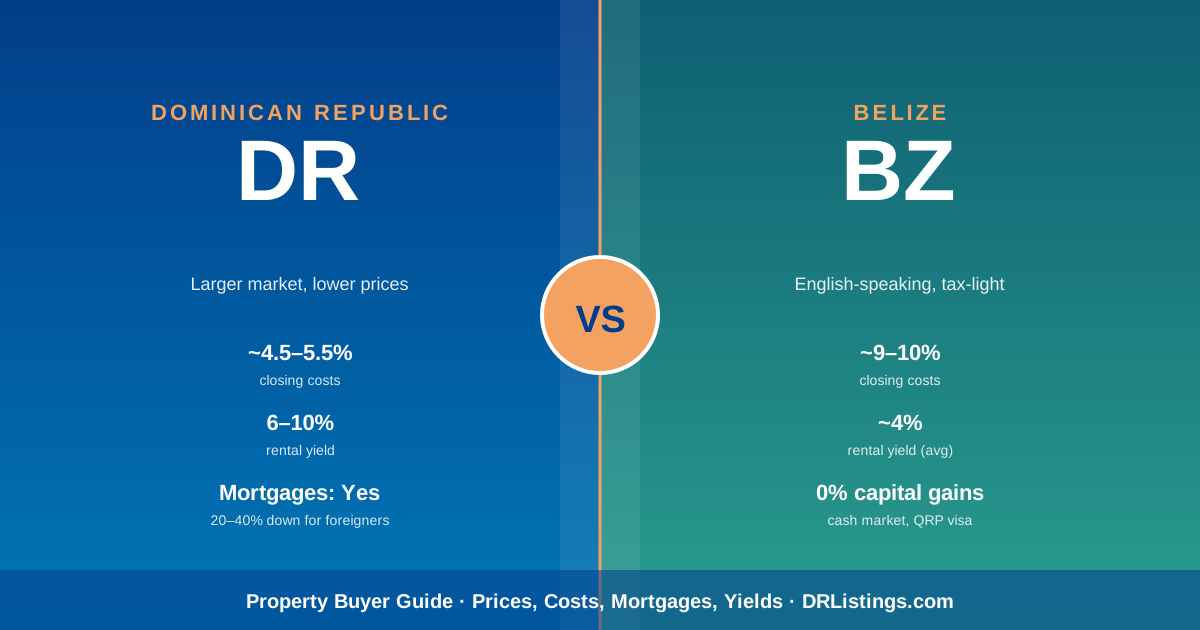
If you are also working through a property purchase, see our guide on how to buy property in the Dominican Republic as a foreigner for how the two processes overlap.
Documents You Need to Open a Dominican Bank Account
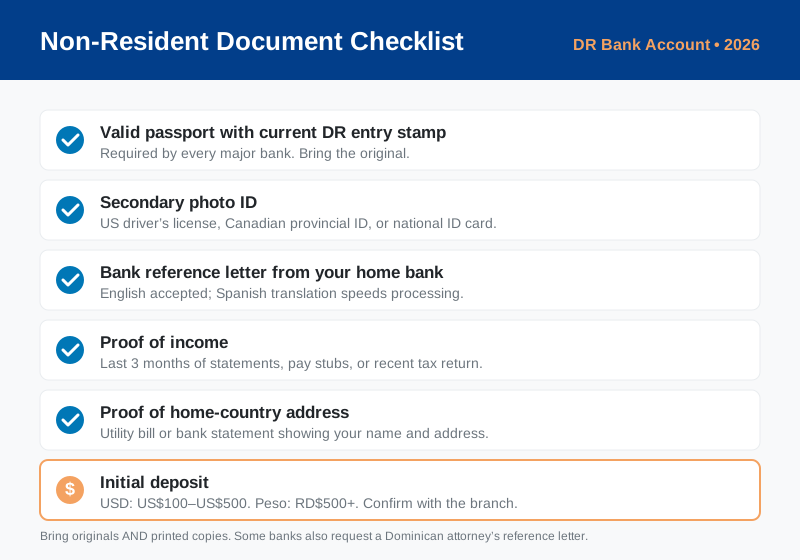
Every bank publishes its own checklist, and the lists do drift over time. The package below is what most major banks ask for from a non-resident in 2026. Bring originals AND printed copies. Banks keep the copies and stamp them.
View text version of this infographic
Non-Resident Document Checklist — DR Bank Account, 2026:
- Valid passport with current DR entry stamp — required by every major bank; bring the original.
- Secondary photo ID — US driver's license, Canadian provincial ID, or national ID card.
- Bank reference letter from your home bank — English accepted; Spanish translation speeds processing.
- Proof of income — last 3 months of statements, pay stubs, or recent tax return.
- Proof of home-country address — utility bill or bank statement showing your name and address.
- Initial deposit — USD: US$100–US$500. Peso: RD$500+. Confirm with the branch.
Bring originals AND printed copies. Some banks also request a Dominican attorney's reference letter.
Standard non-resident package:
- Valid passport with a current Dominican entry stamp.
- Secondary photo ID. A US driver's license, Canadian provincial ID, or your home country's national ID card all work.
- Reference letter from your current bank. English is usually accepted, but a Spanish translation cuts processing time.
- Proof of income. The last three months of bank statements, recent pay stubs, or your most recent tax return are all acceptable.
- Proof of address from your home country. A utility bill or a bank statement showing your name and address is the standard.
- Initial deposit. Plan for US$100 to US$500 for a USD account, or RD$500 and up for a peso account. Exact minimums shift; ask the bank for current numbers when you call ahead.
If you are already a resident:
- Your cédula (the Dominican ID card). With a cédula in hand, the process is much faster and more banks will accept you.
Extra items some banks request:
- A reference letter from a Dominican attorney. Banco Popular and Banreservas ask for this from non-residents fairly often.
- Source-of-funds documentation for any deposit over roughly US$10,000. A property purchase contract, a sale of a home back in the US, or a retirement account distribution statement all qualify.
A note on translations: a sworn translator (traductor judicial) is sometimes required for non-English documents. For US and Canadian applicants, English documents are usually accepted as-is at the major branches. A translated bank reference letter still smooths the process.
The Best Banks for Foreigners in the Dominican Republic in 2026
There is no single best bank for every expat. The right pick depends on whether you need English-speaking staff, where you live, and whether you are mostly using the account for property closings or for daily life.
Banco Popular Dominicano. The largest private bank, with the most branches and ATMs across the country. The mobile app is the most polished of the local banks. Online banking has English options at the major urban branches. The downside is that Banco Popular has become noticeably stricter with non-residents over the last two years. A Dominican attorney's referral is often the unlock.
Banreservas. State-owned, and named the best bank in the Caribbean by Global Finance in 2023 and 2024. Branches are everywhere. Banreservas is a common choice for property closings because attorneys frequently use it. Service is mostly in Spanish; English fluency varies branch to branch.
Scotiabank. Canadian-owned, and the most North-America-friendly bank on the island. English-speaking staff are easy to find at the major branches in Santo Domingo, Santiago, Punta Cana, and Sosúa. USD and CAD accounts are straightforward. The branch network is smaller than Popular's or Banreservas's, so check whether there is a branch near your home or property.
Banco BHD. Strong digital experience and a younger customer base. Popular with professionals in Santo Domingo and Santiago. The branch footprint on the north coast is thinner.
Banco Caribe and Banco Santa Cruz. Smaller banks that are sometimes more flexible on documents when the larger ones have said no. Worth knowing about as a backup.
For ballpark comparison, here is how foreigners commonly rate these banks on what matters:
| Bank | English service | USD account | App quality | Non-resident friendly (1 to 5) | |------|-----------------|-------------|-------------|-------------------------------| | Scotiabank | Strong at major branches | Yes (also CAD) | Good | 5 | | Banco Popular | Mixed | Yes | Best of locals | 3 | | Banreservas | Limited | Yes | Improving | 4 | | Banco BHD | Mixed | Yes | Good | 3 | | Banco Caribe | Limited | Yes | Basic | 4 |
Step-by-Step: What Happens When You Walk Into the Branch
The branch visit usually takes 60 to 90 minutes for a non-resident, longer if it is busy. Here is the typical flow.
1. Call ahead, or have your attorney or agent call. Confirm that the branch is currently accepting non-residents and ask which officer handles foreign clients. Skipping this step is the biggest cause of wasted trips.
2. Show up with originals AND printed copies. Banks keep copies and stamp them. If you only bring originals, expect to find a copy shop nearby and come back.
3. Sit down with a customer service officer. They will go through your file and ask about the source of your funds, your intended use of the account, and your expected monthly transaction volume. Be specific. "I am buying a $250,000 condo in Las Terrenas and need to pay HOA and utilities" lands better than "for general expenses."
4. Sign the disclosure forms. This includes the bank's KYC declaration, a FATCA W-9 if you are a US person, and a CRS self-certification for everyone else. Read them, but do not be surprised by their length.
5. Make the initial deposit at the teller window. Cash or a wire from your home bank both work. Cash is faster the same day.
6. Wait for activation. Residents often walk out with an account number and debit card the same day. Non-residents typically get an account number that day. Full activation, online banking access, and a debit card take 1 to 10 business days. Your card may be held at the branch for in-person pickup; some banks will not mail to a non-resident address.
If you are setting up financing alongside your account, our breakdown of Dominican Republic mortgages for foreigners explains how local lenders and US-based options compare.
Account Types and Currency Choices
Most expats open two accounts.
Peso (DOP) account. This is your daily-life account. Utilities, internet, payroll if you are working locally, supermarket card payments, and HOA dues for many communities all come out of pesos. The exchange rate floats; in 2026 it has been hovering near RD$60 to US$1, but check the day's rate before any large transaction.
USD account. This is your real-estate-and-savings account. Wire receipts from the US, holding funds for a closing, and sending money back to a US account are all easier in dollars. Many sellers and developers in tourist areas quote in USD.
EUR account. Available at most major banks but only useful if you are dealing with European income or vendors. Niche.
A common setup is a USD account for the closing, plus a peso account opened the same day for ongoing expenses. Many expats add an automatic monthly transfer between the two.
Costs, Minimums, and What to Expect Monthly
Fees on Dominican accounts are higher than what most Americans and Canadians are used to. Plan for the following ranges.
- Maintenance fees. Many accounts charge a monthly fee unless you maintain a minimum balance. Typical minimums sit between US$1,000 and US$5,000 to waive fees on a USD account.
- ATM withdrawal limits. Per-transaction limits of RD$10,000 to RD$20,000 are standard. If you need more, you can usually pull two or three transactions in a row, or visit the teller.
- Foreign-card surcharges. Using a US-issued card at a Dominican ATM typically adds RD$200 to RD$300 per withdrawal on top of your home bank's fee.
- Wire transfer fees. Incoming wires usually cost US$10 to US$25. Outgoing wires run US$30 to US$60 plus correspondent bank fees.
- Interest. Savings interest on USD is low, often under 1 percent. Peso CDs (certificados financieros) can pay much more, sometimes 8 to 12 percent annualized for a one-year term. That rate reflects peso inflation expectations rather than free money.
- Cards. Debit cards usually arrive with the activated account. Local credit cards for non-residents are rare; expect to wait until you have residency.
Tax and Reporting: What North Americans Need to Know
This section is general information, not personalized tax advice. Talk to a cross-border accountant for your specific situation.
For US persons. Every Dominican bank you open an account with will ask for a FATCA W-9 form. The bank reports your account balances and interest income to the IRS through the Dominican tax authority. You also have your own US filing duties: an FBAR (FinCEN 114) if your aggregate foreign account balances ever exceed US$10,000 during the year, and Form 8938 with your tax return at higher thresholds.
For Canadians. Canada participates in CRS, so the bank will report to the Canada Revenue Agency through the same channel. CRA's T1135 Foreign Income Verification Statement is required if the cost amount of your foreign property, including bank balances, exceeds CAD$100,000 at any point in the year.
On the Dominican side. Non-residents are not taxed by the DR on foreign-source income. Interest you earn on a DR account is local-source income and is subject to a withholding tax at the source. Rates change; ask your bank what they currently withhold on non-resident interest before you assume your CD math.
Pair this with our overview of the Dominican Republic's economy and investment climate to see why the local rate environment looks the way it does.
Do You Even Need a Dominican Bank Account to Buy Property?
This is the question that surprises most first-time buyers. The answer is no, you do not need a DR bank account to close on a property. Closings are typically done by wiring USD directly into the seller's escrow, a real estate brokerage's trust account, or a Dominican attorney's escrow account. The bank account question can wait until after the closing.
What you do need an account for, eventually:
- HOA and condo association dues, often paid in pesos.
- IPI (Impuesto al Patrimonio Inmobiliario), the annual property tax on properties above the exempt threshold.
- Utilities, especially electricity if you are buying a unit not on a community master meter.
- Deslinde (title-clarification) fees, which sometimes get billed long after closing.
- Rental income if you plan to rent the unit, since most local property managers pay out in pesos.
If you are using developer incentives like CONFOTUR, having a local account simplifies a few mechanical steps, though it is not required. See CONFOTUR tax benefits for the specifics.
Common Problems and How to Solve Them
The branch refused you. Try a different branch of the same bank, or move to another bank entirely. Have an attorney or a local agent ready to call ahead and provide an introduction. The system has a lot of officer-level discretion.
Your wire did not arrive. Confirm the SWIFT code, the intermediary bank if your sender used one, and the exact account-holder name as it appears on the bank's records. Wires often hold for 1 to 3 business days at the intermediary; they rarely vanish.
The app locked you out. Online banking resets are done in person at any branch. Bring your passport. Phone-only resets usually do not work for non-residents.
Your cédula expired. Residency renewals can take months. Keep your cédula current; expired ID will halt new account activity and sometimes locks online banking.
A "source of funds" review delays your transfer. Provide the underlying document: the property purchase contract, a closing statement from the sale of your US home, or a brokerage withdrawal record. Banks accept documentation; they do not accept "trust me."
Tips from Expats
- Open the account in the city where you will spend the most time. Branch transfers within a bank are not always smooth.
- Keep your passport stamp current. Overstaying voids your "regular legal status" and is the fastest way to get an account frozen.
- Ask for the manager's email at account opening. Email reaches DR bank managers far more reliably than the call center.
- Do not move large sums into a fresh account in week one. Banks watch new-account activity closely; staged deposits draw fewer questions than a single seven-figure wire on day three.
- Two banks beat one. Many expats keep Scotiabank for English service plus Banreservas or Popular for everyday merchants, since not every business takes every card.
- If you are coming from cold-weather Canada or the US northeast, keep your home account active for at least the first year. You will want it for emergencies and for any cross-border bills that do not accept Dominican cards.
For broader context on settling in, is the Dominican Republic safe? is a useful companion read.
Frequently Asked Questions
Can a foreigner open a bank account in the Dominican Republic? Yes. Foreigners can open a Dominican bank account, including as non-residents, with a valid passport, a secondary ID, a bank reference letter, and proof of income. Activation typically takes 1 to 10 business days. Scotiabank, Banco Popular, and Banreservas are the most common picks for expats.
What documents do I need to open a bank account in the Dominican Republic? You need your passport with a current entry stamp, a secondary photo ID, a reference letter from your current bank, three months of recent bank statements or pay stubs, proof of address from your home country, and an initial deposit. Some banks also request a Dominican attorney's referral for non-residents.
Do I need to be a resident to open a Dominican bank account? No. Non-residents can open accounts at most major banks. Residents with a cédula get faster activation and a wider product range, including local credit cards. In practice, residency makes the process easier but is not required.
What is the minimum deposit to open a bank account in the Dominican Republic? For a USD account, plan for US$100 to US$500. For a peso account, RD$500 and up is typical. Exact minimums vary by bank and product. Many accounts also have minimum balance rules to waive monthly maintenance fees, often US$1,000 to US$5,000.
Which is the best bank in the Dominican Republic for expats? Scotiabank is the most North-America-friendly, with English-speaking staff and USD and CAD accounts. Banco Popular has the largest branch network and the strongest mobile app. Banreservas is widely used for property closings. Most expats end up with one of the three.
Can I open a US dollar account in the Dominican Republic? Yes. All the major banks offer USD accounts to foreigners and residents. Most also offer peso accounts; many expats keep both. EUR accounts are available at the larger banks but have niche use.
How long does it take to open a bank account in the Dominican Republic? Same-day account number is typical. Full activation, including online banking and a debit card, runs 1 to 10 business days for non-residents. Residents with a cédula often walk out fully set up the same day.
Is online banking available in English in the DR? Banco Popular and Scotiabank offer the best English online banking experience. Banreservas and BHD are improving but are still primarily Spanish. Expect mobile apps to be more bilingual than the desktop sites.
Do Dominican banks report to the IRS (FATCA)? Yes. The Dominican Republic has a FATCA agreement with the US. Local banks collect a W-9 from US persons at account opening and report account balances and interest income annually. Canadian banks report the same data under CRS to the CRA.
Can I open a Dominican bank account remotely from the US or Canada? Generally, no. The major banks require an in-person visit to a Dominican branch for KYC and signature verification. Some private banking products allow document pre-submission, but the final visit is still required. Plan a trip; it is the single most reliable way to get this done.
David Logan
site_adminContributing writer for DRListings.com, sharing insights about Dominican Republic real estate.
Comments
Log in to join the conversation