Due diligence on a Dominican Republic property is the verification work you do between falling in love with a listing and signing a binding contract. For American and Canadian buyers, this stage matters more in the DR than at home. There is no mandatory title insurance. There is no required agent licensing. And by default, there is no regulated escrow. The verification burden sits on you and your lawyer.
This guide walks through every check, in order. It includes the Spanish document names you will see and what each one actually proves. Use it as a checklist you can hand to a Dominican real estate attorney as your scope of work.
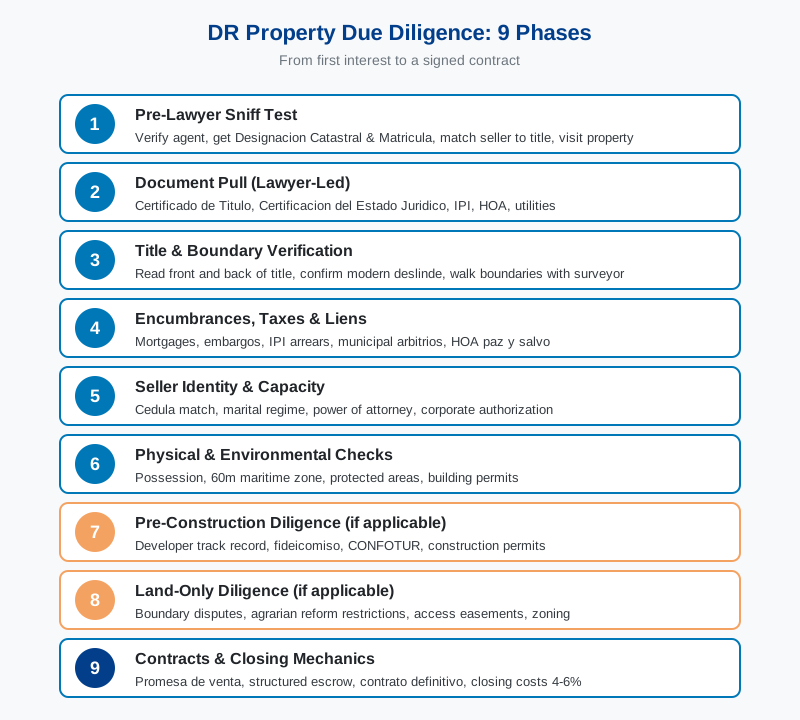
View text version of this infographic
DR Property Due Diligence: 9 Phases — From first interest to a signed contract.
- Pre-Lawyer Sniff Test — Verify agent, get Designacion Catastral and Matricula, match seller to title, visit property.
- Document Pull (Lawyer-Led) — Certificado de Titulo, Certificacion del Estado Juridico, IPI, HOA, utilities.
- Title and Boundary Verification — Read front and back of title, confirm modern deslinde, walk boundaries with surveyor.
- Encumbrances, Taxes and Liens — Mortgages, embargos, IPI arrears, municipal arbitrios, HOA paz y salvo.
- Seller Identity and Capacity — Cedula match, marital regime, power of attorney, corporate authorization.
- Physical and Environmental Checks — Possession, 60m maritime zone, protected areas, building permits.
- Pre-Construction Diligence (if applicable) — Developer track record, fideicomiso, CONFOTUR, construction permits.
- Land-Only Diligence (if applicable) — Boundary disputes, agrarian reform restrictions, access easements, zoning.
- Contracts and Closing Mechanics — Promesa de venta, structured escrow, contrato definitivo, closing costs 4-6%.
What property due diligence in the Dominican Republic involves
Property due diligence in the Dominican Republic means verifying the title at the Registro de Títulos, pulling a recent Certificación del Estado Jurídico to expose liens or court annotations, confirming a modern GPS-based deslinde, checking IPI and HOA arrears, and validating the seller's identity, marital status, and authority to sell — all before signing a Promise of Sale.
Why Due Diligence in the DR Is Different
The Dominican Republic uses a Torrens-style land registry. That means the Certificado de Título issued by the Registro de Títulos is the legal source of truth on ownership. That sounds reassuring, and most of the time it is. But three things make DR diligence different from a typical US or Canadian closing:
- No mandatory title insurance. A few US carriers will write Dominican policies, but most foreign buyers close without any insurance backstop. If a defect surfaces after closing, you litigate.
- No agent licensing requirement. Anyone can call themselves an agent. There is a voluntary Professional Membership ID through industry associations, but no government license. Vetting the agent is part of your job.
- No regulated escrow by default. Deposits often sit in a lawyer's trust account or a private escrow service. The structure has to be written into the contract. It does not happen automatically.
Foreigners have full ownership rights in the DR. There is no nationality restriction on owning real estate, no foreigner permit, no holding company requirement. The trade-off is that the verification rigor that title insurance and licensed escrow agents enforce in the US has to be replicated manually.
If you want the broader process context, our guide to how to buy property in the DR covers the full timeline. This post is the deep dive on the verification phase.
Phase 1: What You Can Verify Before Hiring a Lawyer
Before you spend money on legal fees, do a sniff-test pass yourself. None of this requires a Spanish-speaker or a lawyer.
- Confirm the agent and agency exist. Search the agent's name and brokerage independently. Cross-check on DRListings agent profiles — agents listed on the platform have been onboarded and are tied to a verifiable office.
- Get the property identifiers in writing. Ask the seller or listing agent for the Designación Catastral (cadastral number — the property's unique geographic ID) and the Matrícula (title number). These two numbers are how every downstream document gets pulled. If the seller cannot or will not provide them, that is a red flag on its own.
- Match the listed seller to the title holder. The name on the listing should match the name on the Certificado de Título. Common mismatches: a relative listing on behalf of an elderly owner, an ex-spouse who never updated the title, an LLC that was dissolved.
- Visit the property — or have someone visit. Confirm the unit or lot exists, that the seller (or their tenant) is the one in possession, and that visible boundaries roughly match what is being marketed. For raw land, this catches the most common scam: someone selling a parcel they do not own or whose boundaries are disputed.
If any of those four steps fail, stop. There is no point engaging a lawyer until the basics check out.
Phase 2: The Document Pull (Lawyer-Led)
Once you have hired an independent attorney — not the seller's lawyer, not the agent's lawyer, your own — they will pull a packet of documents from the Registro de Títulos, the DGII (tax authority), the municipality, and the HOA if applicable.
The standard pull includes:
| Document | What It Proves | |---|---| | Certificado de Título | Current ownership, registered surface area, encumbrances annotated on the back | | Certificación del Estado Jurídico del Inmueble | Real-time legal status — liens, mortgages, court annotations, embargoes. Must be pulled within ~30 days of closing | | Deslinde | Modern, GPS-based survey establishing exact boundaries. Required since 2007 for any registry-recordable transfer | | Plano Catastral | The cadastral plan showing the parcel in relation to neighbors | | IPI receipts | Property tax (Impuesto al Patrimonio Inmobiliario) — proof no arrears | | Arbitrios municipales receipts | Local taxes, trash collection (basura) — proof no arrears | | HOA paz y salvo letter | Condo or community certifying no outstanding fees | | Utility bills | EDE (electric), INAPA or CAASD (water) — proof of no debt | | Seller's cédula or passport | Identity verification | | Marriage certificate | If married, confirms whose consent is required |
The single most important document on this list is the Certificación del Estado Jurídico del Inmueble. The Certificado de Título you may receive from the seller could be months or years old. The Certificación is generated fresh by the Registry. It shows everything currently encumbering the property: a mortgage filed last week, a judicial annotation from a pending lawsuit, an embargo. Insist on a Certificación dated within 30 days of your closing.
A more detailed walkthrough of the closing mechanics lives in our Dominican Republic property closing process post.
Phase 3: Title and Boundary Verification
The Torrens system means the Certificado de Título is what matters — not the deed of sale, not the prior owner's paperwork. Reading the certificate is straightforward once you know the layout:
- Front side: Cadastral designation, registered surface area in square meters, owner's full legal name, date of issuance.
- Back side: Encumbrances. This is where mortgages, easements, court annotations, and any registered restrictions are recorded.
A clean front and a blank back is the goal. Anything written on the back needs an explanation.
Why the deslinde matters so much. Before 2007, many DR properties held a título provisional, a provisional title without a modern survey. Properties still holding only a provisional title cannot be transferred at the Registry until a full deslinde is completed. The deslinde process can take months and costs money the seller may not want to spend. If the property does not have a deslinde, the seller has to commit in writing to completing one before closing. Otherwise you walk.
Even with a deslinde on file, hire an independent surveyor to walk the boundaries with the plano catastral in hand. A piece of paper showing a 2,000-square-meter lot is no good if the neighbor's wall has been sitting 40 meters inside your line for fifteen years.
Phase 4: Encumbrances, Taxes, and Liens
The Certificación del Estado Jurídico will surface most of these, but verify each line item independently:
- Mortgages registered against the title. Confirm the payoff figure and that the lender will issue a release at closing.
- Embargo retentivo or other judicial annotations. These freeze the property while a lawsuit is pending. You cannot close on a property with an active embargo.
- IPI arrears. The IPI is an annual property tax of 1% on the value above an exemption threshold (RD$10,695,494 for 2026, roughly $182,000 USD per DGII Resolution DDG-AR1-2026-00001 — your lawyer will confirm the current figure with DGII). Arrears travel with the property. See our Dominican Republic property taxes post for the full IPI breakdown.
- Municipal arbitrios and basura. Small amounts, easy to overlook, also travel with the property.
- HOA arrears. In condos and gated communities, unpaid maintenance fees attach to the unit. The paz y salvo letter from the HOA is non-negotiable.
Phase 5: Seller Identity and Capacity
A clean title is worthless if the person selling does not have the legal right to sell.
- Identity match. The cédula (Dominican national ID) or passport on file must match the name on the Certificado de Título. Sounds obvious. You would be surprised how often it does not match because of a maiden name, a missing accent, or a typo from a 1990s registration.
- Marital regime. The Dominican default is comunidad de bienes, community property. If the seller is married, both spouses must sign the deed of sale, regardless of whose name is on the title. The marriage certificate confirms the regime.
- Power of attorney. If the seller signs through an apoderado (someone holding power of attorney), demand the original notarized POA and confirm it has not been revoked. Powers of attorney granted abroad need to be apostilled.
- Corporate sellers. If the owner is a Dominican company (SRL or SA), pull the RNC (tax ID), the acta de asamblea authorizing the sale, and the company's good-standing certificate. Beneficial owner disclosure has tightened over the past few years. Your lawyer will know the current rules.
A licensed independent attorney is essential here. Our overview of hiring a real estate lawyer in the Dominican Republic covers what to look for.
Phase 6: Physical and Environmental Checks
Paper diligence is half the job. The property itself has to check out.
Possession. Who is currently living in or using the property? Tenants with registered leases have rights you will inherit. Ocupantes (informal occupants or squatters) can be very hard to remove. Eviction in the DR is a slow civil process, not a 30-day notice. Domestic employees who have worked at the property may also have severance claims (prestaciones laborales). The buyer can be on the hook for these if not settled at closing.
Coastal properties. Law 305 establishes a 60-meter maritime-terrestrial zone measured from the high-tide line. Land within that strip is public domain. No private title is valid there. If a beachfront listing claims to extend "right to the water," confirm the deslinde shows the title boundary stops at the 60-meter line. Anything else is misrepresentation.
Environmental. The Ministerio de Medio Ambiente designates protected areas, and parcels inside them have severe building restrictions. Check for: protected status, riverbed proximity, flood zones, and hurricane exposure. For most coastal areas, hurricane insurance availability and cost will affect carrying costs significantly.
Permits. For a built property, confirm the original licencia de construcción (building permit), use permit, and any no-objection letters from the local Ayuntamiento (municipality). Unpermitted construction can be ordered demolished, and it makes future resale harder.
Phase 7: Pre-Construction–Specific Diligence
Pre-construction is its own world. The property does not exist yet, so you are buying the developer's promise to deliver it. The diligence shifts from the parcel to the company.
- Developer track record. Prior projects delivered on time, lawsuits in the DR courts, registry filings against the developer's other parcels. Ask for a list of completed projects and visit one.
- Deposit protection. A fideicomiso (trust) structure or a bonded escrow account holding deposits is the gold standard. Deposits going straight into the developer's operating account are a major risk. If the project stalls, the money is gone.
- CONFOTUR status. If the project is marketed as CONFOTUR-eligible (offering buyers transfer-tax and IPI exemptions), verify the registration directly with the Ministerio de Turismo. Marketing language is not proof. Our CONFOTUR Dominican Republic post covers what the program actually delivers.
- Construction permits and environmental license. Licencia de construcción, licencia ambiental, and eventually the recepción definitiva (final occupancy approval).
- Contract terms. Schedule, late-delivery penalties, assignment rights (can you resell before delivery?), and what happens if the developer changes the spec.
The trade-offs between pre-construction and finished inventory are covered in pre-construction vs pre-built homes in the DR. Browse current new development projects on DRListings to see how disclosure varies between developers.
Phase 8: Land-Only Diligence
Buying land in the Dominican Republic carries its own risk profile.
- Boundary disputes are the #1 land issue. Insist on a fresh deslinde, even if one was done a decade ago. Neighbors build, fences move, surveys get redone.
- Agrarian reform land. Parcels distributed under reforma agraria programs have transfer restrictions. The title will note this if it applies.
- Access. Is there a registered servidumbre de paso (easement) granting legal access from a public road? "We just drive across the neighbor's field" is not a legal access right.
- Zoning and use. Verify with the Ayuntamiento what is permitted on the parcel: agricultural, residential, tourism. Building plans that conflict with zoning will not be approved.
Phase 9: Contracts and Closing Mechanics
Once diligence checks out, the contract structure protects you.
- Promesa de venta (Promise of Sale). The first binding contract. It locks the price, the closing date, and the conditions precedent. Diligence findings should be reflected here as conditions. For example, "deslinde to be completed at seller's expense before closing."
- Contrato de venta definitivo. The final deed of sale, signed and notarized at closing.
- Escrow. Not regulated by default. Use a structured escrow — a lawyer's trust account with written disbursement instructions, or a third-party provider — and never wire deposits directly to the seller. Our escrow in Dominican Republic real estate post covers the available structures.
- Closing costs. Budget 4–6% of the sale price: 3% transfer tax on the DGII-appraised value (often lower than the sale price), 1–1.5% legal fees (plus 18% ITBIS on the legal fee), and registry stamps.
If you are financing locally, the bank will run its own diligence in parallel. See DR mortgage options for foreign buyers for what lenders require. Many foreign buyers also layer on optional title insurance in the Dominican Republic for the closing-cost premium.
Red Flags That Should Pause or Kill a Deal
- The seller will only produce a título provisional, not a Certificado de Título with a deslinde.
- The deslinde is older than 10 years on raw land where neighboring development has changed.
- The seller refuses or delays providing a recent Certificación del Estado Jurídico.
- The seller pushes for a cash-only or off-registry transfer to "save on transfer tax."
- Unrelated parties — a cousin, a friend, a "manager" — are demanding deposits.
- Pre-construction deposits going to the developer's operating account, not a trust or escrow.
- A married seller wants to close without the spouse's signature.
- Listing price is far below comparables for the area, with no obvious explanation.
- The seller's identity documents do not match the title in any way the lawyer cannot reconcile.
Any one of these is a stop sign. They do not always mean fraud. Sometimes they are just messy paperwork. But they all need to be resolved before you sign anything binding.
The One-Page Buyer's Checklist
Hand this to your attorney as the scope of work.
- [ ] Cadastral number and Matrícula confirmed in writing
- [ ] Listed seller name matches Certificado de Título
- [ ] Certificación del Estado Jurídico pulled within 30 days of closing — clean
- [ ] Deslinde on file and matches a fresh independent boundary walk
- [ ] Plano catastral matches the deslinde
- [ ] IPI, arbitrios, and basura receipts current
- [ ] HOA paz y salvo letter received (if applicable)
- [ ] EDE, INAPA/CAASD utility accounts current
- [ ] Seller cédula or passport matches title
- [ ] Spouse signature secured (if married under comunidad de bienes)
- [ ] POA validated (if seller signing through apoderado)
- [ ] Corporate authorization documents pulled (if corporate seller)
- [ ] No tenants, ocupantes, or domestic-employee severance issues
- [ ] Coastal 60-meter maritime zone respected (if applicable)
- [ ] Building permits and use permits on file (if built property)
- [ ] Developer fideicomiso/escrow verified (if pre-construction)
- [ ] CONFOTUR status verified with Ministerio de Turismo (if claimed)
- [ ] Promise of Sale reflects all diligence findings as conditions
- [ ] Escrow structure written into contract
- [ ] Transfer tax base, legal fees, and registry stamps budgeted
Frequently Asked Questions
What documents do I need to verify when buying property in the Dominican Republic?
At minimum: the Certificado de Título, a Certificación del Estado Jurídico del Inmueble pulled within 30 days of closing, the deslinde and plano catastral, IPI and municipal arbitrios receipts, an HOA paz y salvo letter where applicable, utility account statements, and the seller's cédula or passport plus marriage certificate if married.
What is a deslinde and why is it required?
A deslinde is a modern, GPS-based boundary survey that establishes a property's exact registered limits. Since 2007, every property must have a completed deslinde to be transferred through the Registro de Títulos. Without it, the property may only hold a provisional title, which cannot be sold until the deslinde is completed.
Do I need title insurance in the Dominican Republic?
Title insurance is not mandatory and most foreign buyers close without it. A few US carriers will write Dominican policies for a one-time premium. Whether it is worth it depends on your risk tolerance. Strong diligence with an independent attorney is the primary protection. Insurance is a secondary backstop.
Can a foreigner buy beachfront property in the Dominican Republic?
Yes. Foreigners have full ownership rights with no nationality restrictions. The catch is the 60-meter maritime-terrestrial zone. Land within 60 meters of the high-tide line is public domain and cannot be privately titled. Confirm the deslinde shows your title boundary stops at that line.
How long does a title search take in the DR?
A standard Certificación del Estado Jurídico can be issued within a few business days at the Registro de Títulos. Full diligence — including utility checks, HOA letter, surveyor verification, and seller capacity — typically runs two to four weeks. Pre-construction or land-only deals can take longer.
What is the Certificación del Estado Jurídico del Inmueble?
It is a real-time legal-status certificate issued by the Registro de Títulos that lists every encumbrance currently affecting a property: mortgages, embargoes, court annotations, registered easements. It is more current than the Certificado de Título itself and should be pulled within 30 days of closing.
How much does property due diligence cost in the Dominican Republic?
Legal fees for a residential closing typically run 1% to 1.5% of the sale price, plus 18% ITBIS on the legal fee. Most diligence work is bundled into that fee. Independent surveys, additional certifications, and corporate-seller authorizations may add modest extras. Browse villas, condos, or land to see typical price ranges for budgeting purposes.
David Logan
site_adminContributing writer for DRListings.com, sharing insights about Dominican Republic real estate.
Comments
Log in to join the conversation