Title insurance is not legally required to buy property in the Dominican Republic. The country uses a Torrens registration system. The state-issued Certificado de Título carries a government guarantee of ownership. Most foreign buyers of properly deslindado properties rely on a thorough attorney title search instead. Title insurance is optional. It is most useful for un-deslindado land, complex inheritance situations, or when a foreign lender requires a policy.
That short answer surprises a lot of American and Canadian buyers. In the US, title insurance is so embedded in the closing process that most people never question it. In the DR, it's a real choice. For most condo and villa buyers, the smarter spend is on a good attorney. This guide walks through how title insurance works in the DR, who sells it, what it costs, and the specific situations where it actually earns its premium.
What Title Insurance Actually Is
Title insurance is a one-time-premium policy. It protects the buyer (or the lender) if a hidden defect in the property's title surfaces after closing. The classic covered events are forgery, undisclosed liens, fraudulent powers of attorney, missing heirs from a previous succession, boundary errors, and chain-of-title gaps. If something like that emerges later and you lose part or all of your ownership interest, the insurer pays out up to the policy limit.
There are two flavors:
- Owner's policy — protects you, the buyer, for as long as you (or your heirs) own the property.
- Lender's policy — protects the bank or mortgage company up to the loan balance. It does not protect you.
In the US and Canada, owner's policies are nearly universal. Public land records are decentralized and the buyer carries the risk of a bad chain. In the DR, the legal infrastructure is different, which is why the value calculation changes.
How Dominican Property Titles Work
The DR runs on a Torrens system, formalized under Land Registry Law 108-05. The Torrens model treats the government register as the definitive record of ownership. When you buy a registered property, you receive a Certificado de Título. That state-issued certificate names you as the owner. The state, not a private title-search company, is the entity standing behind that record.
In theory, this is the strongest title regime in the Americas. In practice, it works very well for properties that have been deslindado: surveyed, registered with individual coordinates, and assigned their own certificate. A deslindado condo or villa with a clean Certificado de Título is about as bulletproof as Caribbean real estate gets.
The complication is land that hasn't been through deslinde yet. A lot of rural and semi-rural land in the DR still sits under older "carta constancia" titles. These represent a percentage interest in a larger parent parcel rather than a specific surveyed plot. The properties are legal to buy. But the boundaries can be disputed, neighbors can hold competing interests in the same parent title, and you don't get the full Torrens protection until the parcel is individually surveyed and registered.
The Land Registry technically maintains an indemnity fund meant to compensate owners who lose property due to registry errors. In practice, Dominican lawyers have described this fund for years as effectively non-operational. Claims are slow, underfunded, or unresolved. Don't count on it as a backstop.
For more on how titles fit into the closing flow, see our Dominican Republic property closing process guide and the broader how to buy property in the DR walkthrough.
Who Sells Title Insurance in the Dominican Republic
The DR title insurance market is small. The names that come up most often are:
- Stewart Title Latin America (now operating as Secure Title Latin America) — the rebranded Stewart Title affiliate is the most established US-affiliated provider in the country and is the policy most often issued to American buyers. You'll see it referred to under either name; the underwriter is the same.
- First American Title — also active in the Caribbean and Latin American market through affiliated underwriters.
Coverage is broadly similar to a US owner's policy. Typical covered risks include:
- Forgery or impersonation in the chain of title
- Undisclosed liens, mortgages, or judgments against prior owners
- Missing heirs from an earlier inheritance who later assert ownership
- Invalid or fraudulent powers of attorney used in a past transfer
- Inadequate or incorrect legal descriptions
- Lack of legal access to the property
Standard exclusions usually include zoning issues, environmental problems, anything disclosed to you in writing during due diligence, and matters that would have been caught by a current survey. If your attorney finds a problem and tells you about it, the policy won't cover it. That's the seller's or buyer's problem to resolve before closing.
What Title Insurance Costs in the DR
DR title insurance is sold as a one-time premium paid at or just before closing, not an annual policy. Premiums generally fall between about 0.5% and 1% of the purchase price. There's a typical floor of a few hundred dollars for very low-value transactions. On a $300,000 condo, that's roughly $1,500 to $3,000. Quotes vary by insurer, by the deslinde status of the property, and by whether escrow services are bundled in. Get a written quote from the provider before assuming a number.
Compare that to attorney-led due diligence. A full closing package usually runs 1% to 1.5% of the purchase price. That covers the title search, contract drafting, deslinde verification, tax clearance review, and registration of the new title in your name. On the same $300,000 condo, that's about $3,000 to $4,500.
The two are not substitutes. The attorney does the actual investigative work to find problems before you close. The insurance pays out only if a problem surfaces afterward. Most DR practitioners will tell you the same thing: spend on the attorney first, and consider insurance only when the specific situation calls for it.
For broader closing-cost context (transfer tax, registration fees, and the rest), see our Dominican Republic property taxes guide.
When Title Insurance Is Genuinely Worth It
A handful of situations move title insurance from "optional" to "worth seriously considering":
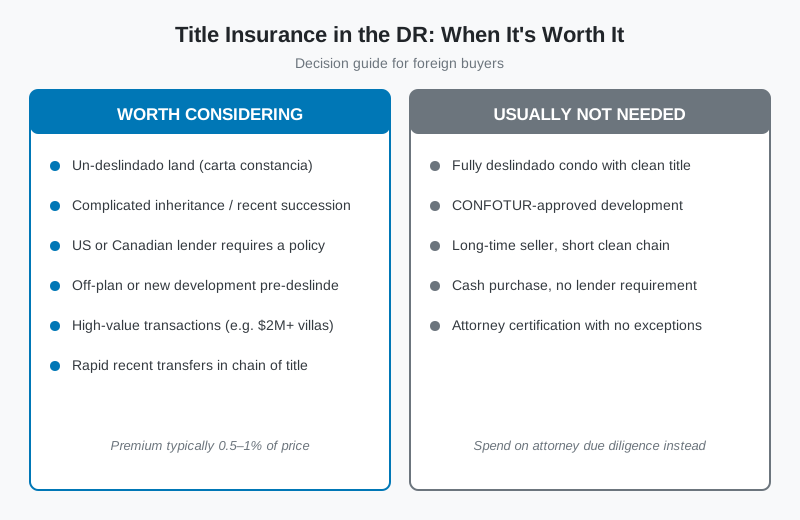
View text version of this infographic
Title Insurance in the DR: When It's Worth It — Decision guide for foreign buyers
Worth considering:
- Un-deslindado land (carta constancia)
- Complicated inheritance / recent succession
- US or Canadian lender requires a policy
- Off-plan or new development pre-deslinde
- High-value transactions (e.g. $2M+ villas)
- Rapid recent transfers in chain of title
Premium typically 0.5–1% of price.
Usually not needed:
- Fully deslindado condo with clean title
- CONFOTUR-approved development
- Long-time seller, short clean chain
- Cash purchase, no lender requirement
- Attorney certification with no exceptions
Spend on attorney due diligence instead.
- You're buying un-deslindado land. A "carta constancia" parcel without an individual survey is the single biggest reason to insure. Boundaries can be challenged, and the parent-title structure means you're sharing risk with strangers. If you're shopping land for sale in the Dominican Republic, ask up front whether the parcel is deslindado.
- The property has a complicated inheritance history. Multiple heirs, recent successions, or a death in the chain of title within the last decade are red flags. Missing-heir claims are exactly what title insurance is built for.
- You're financing through a US or Canadian lender. Most foreign banks lending against DR property require a lender's title policy as a condition of the mortgage. You don't get to opt out. Our Dominican Republic mortgage guide for foreigners covers the lender side in more detail.
- You're buying off-plan or in a new development where the developer is parceling out a master title. Until your individual deslinde is complete, you're trusting the developer's process. See pre-construction vs pre-built homes in the DR for how this typically plays out.
- The transaction is high-value. On a $2M villa, a $10,000 premium is a small percentage of the loss exposure if something goes wrong. The math gets friendlier as the price goes up.
- The chain of title shows rapid recent transfers. Three owners in two years is a pattern that sometimes accompanies fraud. Insurance against forgery and impersonation matters more here.
When It Probably Isn't Worth It
For a large share of foreign buyers in the DR, title insurance is a soft sell that doesn't pay for itself. Skip it (or at least don't lose sleep skipping it) when:
- The property is a fully deslindado condo in an established project with its own clean Certificado de Título.
- You're buying in a CONFOTUR-approved development where the developer's legal team has already cleared and registered the master title. See our CONFOTUR tax benefits post for context on these projects.
- The seller has owned the property for many years, the chain of title is short and clean, and your attorney's certification comes back without exceptions.
- It's a cash purchase (no lender requirement) and your due-diligence package shows nothing unusual.
In these cases, you're paying a premium to insure a risk your attorney has already worked very hard to eliminate.
The Real Gold Standard: Attorney Due Diligence
The thing that actually keeps foreign buyers safe in the DR isn't insurance. It's a competent independent attorney doing a proper title search before you sign anything. A full search includes:
- Pulling a Certificación del Estado Jurídico del Inmueble from the Registry of Title. This is the official current status report on the property, including current owner, encumbrances, and any registered liens or annotations.
- Tracing the chain of title back through prior transfers to confirm there are no breaks.
- Verifying the deslinde status and matching the registered coordinates against the actual property on the ground.
- Confirming property taxes (IPI) are paid through the closing date and there are no municipal assessments outstanding.
- Checking that any powers of attorney used in past transactions were valid and properly registered.
- Reviewing condo or HOA documents for unpaid fees or pending special assessments.
A few practical points on hiring this work:
- Use your own attorney, not the seller's or the broker's. The conflict-of-interest math is obvious. Brokers often have a preferred attorney they recommend. Politely take the recommendation as a starting point and choose independently.
- Lawyers in the DR are members of the Colegio de Abogados de la República Dominicana, the national bar association. You can verify membership directly with the Colegio. (Real estate agents themselves are not licensed in the DR. There's no equivalent of a US real estate license, so don't ask for one.)
- Get the engagement and fee structure in writing before any money moves. A flat fee for closing services is more common than hourly billing.
If you'd like help finding professionals to work with, our find a real estate agent page is a starting point, and the general DR real estate FAQ covers other process questions.
How Title Insurance Fits Into the Closing Process
If you decide to buy a policy, the timing usually looks like this:
- Your attorney completes due diligence and issues a title opinion.
- You request a quote from a title insurer (Stewart Title Latin America / Secure Title Latin America, or First American), which reviews the same documents your attorney did.
- The insurer issues a commitment specifying coverage and any exclusions tied to issues found during their review.
- You and the seller sign the deed of sale (Contrato de Venta) before a Notary Public.
- The premium is paid at closing, typically through the same escrow account funding the purchase.
- The policy is issued once the new Certificado de Título is registered in your name.
The policy doesn't replace any step of the standard process. It sits on top of it. You still need the attorney, the Notary, the escrow, and the registration. Insurance is a backstop, not a shortcut.
Frequently Asked Questions
Do you need title insurance in the Dominican Republic? No. Title insurance is not legally required in the DR. The Certificado de Título issued under the Torrens system carries a state guarantee of ownership. Most foreign buyers of registered, deslindado properties rely on attorney due diligence rather than insurance.
How much does title insurance cost in the Dominican Republic? Premiums typically run about 0.5% to 1% of the purchase price as a one-time fee. On a $300,000 property, expect roughly $1,500 to $3,000. Costs vary by insurer, deslinde status, and whether escrow is bundled.
Is title insurance available in the Dominican Republic? Yes. The main providers are Stewart Title Latin America (now operating as Secure Title Latin America) and First American Title. Coverage and exclusions are similar to a US owner's policy.
What is a Certificado de Título in the Dominican Republic? The Certificado de Título is the state-issued ownership certificate for registered property. Issued under the Torrens system and Land Registry Law 108-05, it carries a government guarantee of the holder's ownership rights.
Does the Dominican Republic use the Torrens system? Yes. The DR has used a Torrens-style land registration system since 1920, modernized under Law 108-05. The state register is the definitive record of ownership, which is why title insurance is less central to closings than in the US.
What is deslinde and why does it matter? Deslinde is the official survey-and-registration process that gives a property its own individual Certificado de Título with surveyed boundaries. A deslindado property carries full Torrens protection. An un-deslindado parcel (held under a "carta constancia") shares a parent title with other owners and carries more boundary and ownership risk.
Should foreign buyers in the DR buy title insurance? For most buyers of fully deslindado condos or villas with clean titles, no. A thorough attorney title search is the better spend. Buyers of un-deslindado land, properties with messy inheritance, off-plan units before individual deslinde, or anyone using a US or Canadian mortgage should seriously consider it.
What does a Dominican attorney check during a title search? A proper search includes a Certificación del Estado Jurídico del Inmueble from the Registry of Title, full chain-of-title review, deslinde verification, IPI tax clearance, validation of any prior powers of attorney, and condo or HOA fee status.
Can I get a US mortgage on a DR property without title insurance? Usually no. Most US and Canadian lenders that finance DR property require a lender's title policy as a condition of the loan. Even if you'd otherwise skip the owner's policy, the lender's policy is non-negotiable on a financed deal.
David Logan
site_adminContributing writer for DRListings.com, sharing insights about Dominican Republic real estate.
Comments
Log in to join the conversation