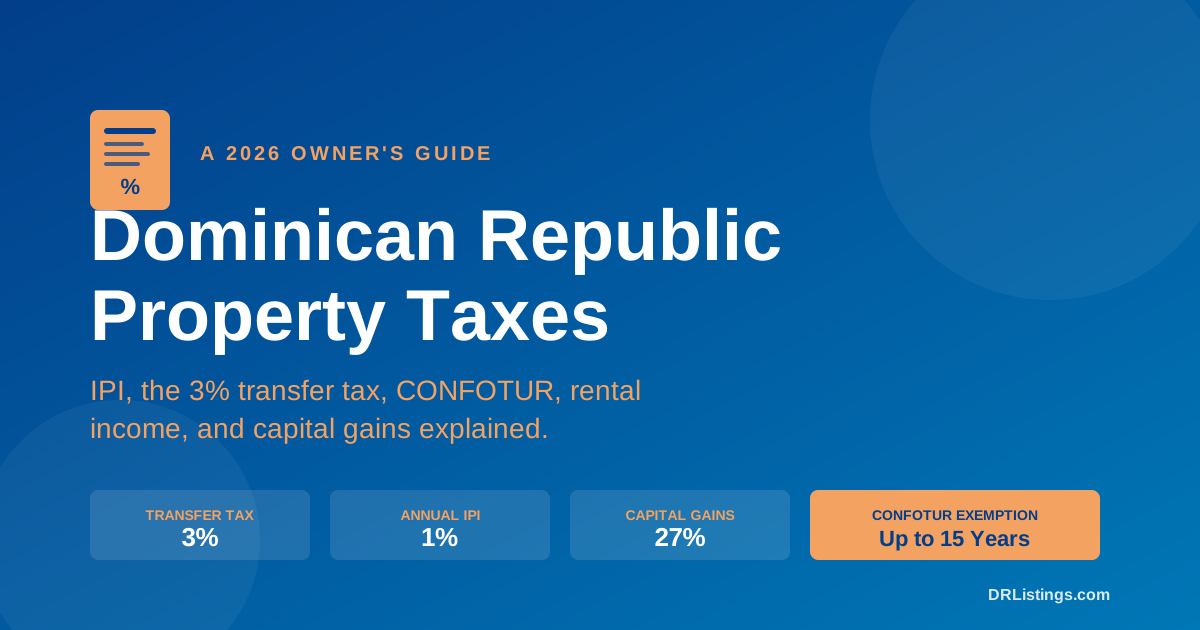
If you are buying a beach condo in Punta Cana or a hillside villa above Sosua, the property tax in the Dominican Republic is probably friendlier than you expect. Foreign owners pay the same rates as Dominican nationals. The annual rate is a flat 1%. A generous exemption threshold means a lot of vacation homes owe nothing each year.
This guide walks through every property-related tax you will touch as a foreign owner. That includes the one-time 3% transfer tax at closing, the annual IPI tax, the CONFOTUR exemption that wipes both out for many tourism-zone purchases, rental income tax if you let the property out, and the capital gains tax when you eventually sell. Always confirm specific figures with a Dominican attorney or accountant before closing. Tax rules and thresholds change yearly.
How Much Property Tax Do You Pay in the Dominican Republic?
Property owners in the Dominican Republic pay an annual 1% IPI tax. It applies only to the portion of a property's appraised value above RD$10,695,494 (about US$182,000) for 2026. Buyers also pay a one-time 3% transfer tax at closing, calculated on the DGII appraised value. Foreigners pay the same rates as Dominican nationals, with no surcharge for non-residents.
View text version of this infographic
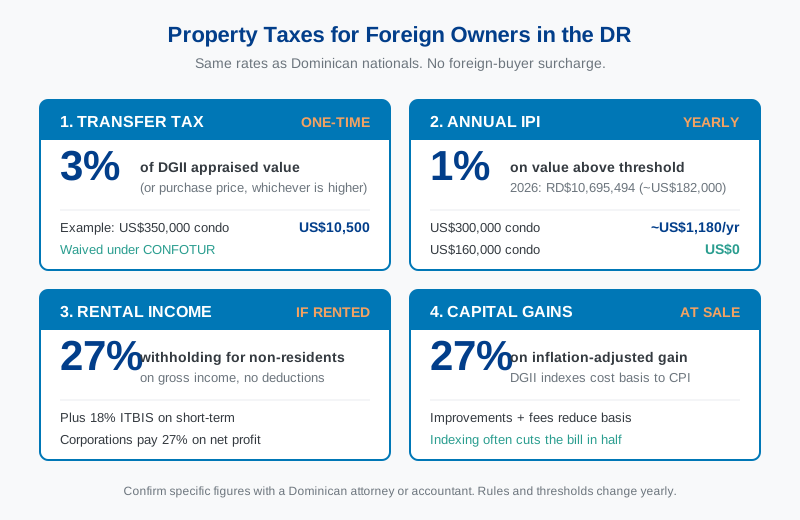
Property Taxes for Foreign Owners in the DR — Same rates as Dominican nationals. No foreign-buyer surcharge.
- Transfer Tax (one-time): 3% of DGII appraised value (or purchase price, whichever is higher). Example: a US$350,000 condo owes US$10,500. Waived under CONFOTUR.
- Annual IPI (yearly): 1% on value above the threshold. 2026 threshold: RD$10,695,494 (~US$182,000). A US$300,000 condo owes about US$1,180 per year. A US$160,000 condo owes US$0.
- Rental Income (if rented): 27% withholding for non-residents on gross income, no deductions. Plus 18% ITBIS on short-term rentals. Corporations pay 27% on net profit.
- Capital Gains (at sale): 27% on the inflation-adjusted gain. DGII indexes cost basis to CPI. Improvements and fees reduce basis. Indexing often cuts the bill in half.
Confirm specific figures with a Dominican attorney or accountant. Rules and thresholds change yearly.
That covers the headline numbers. The rest of this guide explains how each tax actually works, where the gotchas are, and what your real tax bill looks like on a typical foreign-owned villa or condo.
The 3% Property Transfer Tax (Paid Once, At Purchase)
The Dominican Republic property transfer tax is a flat 3% paid by the buyer when the title is transferred at the Title Registry Office (Registro de Titulos). It is the largest single line item in your closing costs and is non-negotiable on standard purchases.
How the 3% Is Calculated
The transfer tax is calculated on the DGII appraised value, not necessarily on the purchase price you negotiated. The Direccion General de Impuestos Internos (DGII) is the Dominican tax authority. It runs its own valuation on the property, and the higher of that value or your declared sale price becomes the tax base.
In practice, DGII appraisals are usually lower than market price, so most buyers pay 3% of their purchase price. But on undervalued contracts or in rapidly appreciating areas, DGII may re-appraise upward. If that happens, your attorney can challenge the appraisal with comparable sales data. The process adds weeks to closing.
A worked example: a US$350,000 condo in Punta Cana, with the DGII appraisal matching the purchase price, generates a transfer tax bill of US$10,500. Add notary fees, registry fees, and legal fees, and total closing costs typically land between 5% and 8% of the price. For a deeper walk-through of when each fee is paid, see our guide to the Dominican Republic property closing process.
Foreigners Pay the Same Rate
There is no surcharge, special foreign-buyer levy, or stamp duty inflation for non-Dominicans. A US passport at closing produces the same tax bill as a Dominican cedula. This is one of the bigger differences from places like the Bahamas (10% stamp tax tiers) or Bermuda (foreign buyer surcharges).
When the 3% Disappears: CONFOTUR
If the project you are buying into is CONFOTUR-certified, the 3% transfer tax is waived entirely. We cover that below.
IPI: The Annual Property Tax (Impuesto al Patrimonio Inmobiliario)
The IPI tax in the Dominican Republic is the annual property tax. It is the equivalent of US property tax or Canadian municipal tax. DGII administers it at the national level, not individual municipalities, which keeps the system relatively uniform across the country.
Rate and Exemption Threshold
IPI is 1% of the property's appraised value above the annual exemption threshold. For 2026, the threshold is RD$10,695,494, roughly US$182,000 at recent exchange rates. Anything below the threshold is tax-free. Anything above pays 1%.
The threshold is indexed to inflation and adjusted by DGII each year. The dollar figure shifts slightly with both peso inflation and the USD/DOP exchange rate.
A worked example: a US$300,000 condo, with the DGII appraisal matching market value, has roughly US$118,000 above the threshold. The annual IPI bill is about US$1,180. That is significantly less than what the same value would pay in Florida or most US coastal states.
A second example: a US$160,000 condo in Sosua sits entirely below the threshold. Annual IPI: zero. Many smaller condos for sale in the Dominican Republic fall into this no-IPI bracket.
The Threshold Applies to People, Not Properties
This is the rule most foreign buyers miss. The IPI exemption threshold is cumulative across all properties owned by the same individual. If you own three condos worth US$100,000 each, you do not get three separate exemptions. Your combined US$300,000 portfolio is taxed as one, and only US$182,000 is shielded.
Properties Held in Corporations Get No Threshold
If you hold real estate through a Dominican corporation (SRL or similar) or a trust, the entire property value is subject to 1% IPI from the first dollar. No exemption threshold applies. This is a major planning consideration. Many foreign buyers default to corporate ownership for liability reasons. Then they discover their IPI bill is dramatically higher than a friend who bought in a personal name.
The right structure depends on whether you plan to rent the property, your home-country tax situation, and how many properties you eventually want to hold. Talk to a Dominican accountant before signing the purchase contract, not after.
When IPI Is Due
IPI is paid in two equal installments: March 11 and September 11 each year. DGII issues the assessment based on its appraisal of the property. You pay through the DGII Oficina Virtual portal or in person at any DGII office.
What Is Exempt From IPI Entirely
Several categories of property pay no IPI regardless of value:
- Undeveloped land and lots located outside city limits (generally agricultural zones)
- Working agricultural farms
- Properties owned by individuals 65 or older who have held the title for 15 or more years and own no other property
That last exemption is narrow but valuable for retirees who buy early and stay long-term. If you are evaluating raw land for sale in the Dominican Republic, the rural-land IPI exemption is worth understanding before deciding between a developed lot inside a tourism zone and an undeveloped parcel further out.
Late Payment Consequences
Missing the March 11 or September 11 deadline triggers a 10% surcharge on the unpaid amount, plus monthly interest on the balance. Continued non-payment results in a lien on the property's title, which blocks any future sale or refinancing until cleared. This is not a tax you can quietly ignore. It follows the title.
CONFOTUR: The 15-Year Tax Exemption Foreign Buyers Should Know About
CONFOTUR is the single most consequential tax program in Dominican real estate for foreign buyers. It is also the one most likely to change your math on a purchase.
What CONFOTUR Is
CONFOTUR is the tourism-incentives framework created by Law 158-01 (and amended by Law 195-13). It grants approved tourism developments — hotels, resorts, branded residences, and certain residential projects designated for short-term rental use — a package of tax exemptions designed to attract foreign investment.
For property buyers, the two relevant exemptions are:
- No 3% transfer tax at purchase. On a US$350,000 condo, that saves US$10,500 at closing.
- No annual IPI for up to 15 years. On a US$500,000 villa, that compounds to roughly US$48,000 over the exemption window.
Who Qualifies
You do not apply for CONFOTUR yourself. The developer applies for and obtains the certification on the project, and the benefits pass through to qualifying buyers. Before you sign anything, ask for the CONFOTUR certificate and the resolution number, then have your attorney verify the certification with the Ministry of Tourism and DGII.
If you are weighing a new build against an existing unit, pre-construction vs pre-built homes in the DR explains where CONFOTUR usually lives. Pre-construction projects in tourism zones are the most common path. You can also browse CONFOTUR-certified properties directly.
What Happens After Year 15
The exemption is finite. Once the 15-year window closes, standard IPI rules resume from year 16 onward. If you are buying CONFOTUR property as a long-term hold, build the post-exemption tax bill into your underwriting. A US$500,000 villa starts owing roughly US$3,200 a year in IPI once the clock runs out (assuming current thresholds and appraisal).
For a deeper breakdown, see our standalone guide to CONFOTUR tax benefits.
Rental Income Tax (If You Rent the Property Out)
If your Dominican property is purely a vacation home, you can skip this section. If you rent it (long-term, short-term, or a mix), these rules apply.
Long-Term Rentals
Long-term rental income is taxed differently depending on your tax residency:
- Dominican tax residents pay progressive personal income tax rates on net rental income (after deducting maintenance, HOA fees, property management, depreciation, and similar expenses).
- Non-residents are subject to a 27% withholding on gross rental income, with no deductions. The tenant or property manager is technically responsible for withholding and remitting the tax to DGII.
That non-resident treatment is harsh on paper. That is why many foreign owners hold rental property through a Dominican corporation. A corporation pays the 27% corporate income tax rate on net profits, which usually beats 27% on gross.
Short-Term Vacation Rentals
Short-term rentals (Airbnb, Vrbo, direct bookings) have an additional layer: 18% ITBIS (Impuesto sobre Transferencias de Bienes Industrializados y Servicios), the Dominican value-added tax. ITBIS generally applies to the rental fee charged to the guest. Whether and how it is collected varies in practice. Registered hospitality businesses charge it transparently. Many individual owners on platforms operate informally. DGII has been tightening enforcement, so assume you will need to register and remit if you rent regularly.
Why Foreign Owners Use a Corporation
Holding rental property in a Dominican SRL gets you:
- Full deduction of operating expenses against rental income
- Access to depreciation
- Cleaner separation for capital gains treatment at sale
- Liability shielding
The trade-off is the IPI threshold loss (corporate-held property pays 1% IPI from dollar one) plus annual corporate filing costs of roughly US$1,500–US$2,500. The math usually favors a corporation once gross rental income clears about US$25,000 a year. Run the numbers with a local accountant.
For investors thinking through total carry costs, our guide to DR mortgage options for foreign buyers covers the financing side.
Capital Gains Tax (When You Sell)
When you sell, the Dominican Republic capital gains tax property rules treat the gain as ordinary income at a flat 27% for individuals and corporations alike. There is no separate, lower capital gains regime.
How the Gain Is Calculated
The taxable gain equals:
Sale price − inflation-adjusted cost basis − documented improvements − allowable selling costs.
The big foreigner-favorable rule lives inside that formula. DGII inflation-indexes your cost basis using its published CPI series. That matters more than most buyers realize.
Imagine you bought a villa for US$400,000 in 2018 and sell it for US$600,000 in 2026. The nominal gain is US$200,000, which would mean a US$54,000 tax bill at 27%. But after DGII inflation-adjusts your US$400,000 cost basis to roughly US$520,000–US$540,000 (depending on the published CPI factor for that period), the taxable gain shrinks dramatically, often by half or more. The actual tax bill on the same sale could land closer to US$15,000–US$20,000.
Documentation That Protects Your Basis
To get the inflation indexing and capture every legitimate basis adjustment, keep:
- The original purchase deed (escritura) on file
- Receipts and contractor invoices for every capital improvement
- Records of legal, notary, and registry fees paid at purchase
- Records of brokerage commissions and legal fees paid at sale
Without documentation, DGII falls back to the deed price and your indexed gain looks much larger. Foreign sellers who lose receipts during a decade abroad routinely overpay capital gains.
Holding Structure at Sale
The corporation-vs-personal-name question reappears here. Selling shares of a Dominican corporation that owns a single property is sometimes structured to handle the gain at the corporate level, with different practical implications than a direct sale of the real estate. This is firmly attorney territory. Get specific advice well before listing the property.
Other Costs Foreign Owners Encounter
A few line items get confused with property tax but are not actually taxes:
- HOA / condo fees. Standard for any condominium or gated villa community. Run US$150–US$600 a month depending on amenities. Not a tax.
- Municipal "ayuntamiento" fees. Some municipalities charge small annual fees for services like trash collection. Modest in scale.
- Notary, registry, and certification fees on title transfer. Roughly 0.5%–1.5% of the purchase price, paid at closing.
- Legal fees. Standard buyer-side counsel runs 1%–1.5% of the purchase price.
These are part of total cost of ownership, not part of the formal tax burden.
How to Actually Pay IPI: The Practical Walkthrough
A surprising number of competitor articles skip the mechanics. Here is what actually happens.
Step 1: Property Registration With DGII
After closing, your property needs to be registered in the DGII system under your name (or your corporation). Your closing attorney typically handles this within 30–60 days of title transfer. If you closed on your own or with cut-rate counsel and skipped this, register it yourself at any DGII office before the next IPI cycle. Undocumented properties still owe tax, and unpaid back-tax accumulates.
Step 2: The Annual Assessment
DGII issues an assessment based on its valuation of the property. You can view your property's appraised value through the DGII Oficina Virtual online portal once your taxpayer profile is linked.
If the appraisal looks too high, your attorney can file a challenge with comparable sales evidence. Successful challenges happen but require documentation.
Step 3: Paying the Bill
You have two practical options:
- DGII Oficina Virtual (online). The cleanest path if you live abroad. Once registered as a taxpayer (RNC for corporations, cedula or passport for individuals), you can view IPI assessments, pay by credit card or bank transfer, and download receipts.
- In person at a DGII office. Plenty of offices, including in Santo Domingo, Santiago, Punta Cana, and Puerto Plata. Bring the assessment notice and your ID.
Many foreign owners simply ask their property manager or attorney to handle the twice-yearly payment for a small fee. That works fine, but always verify the receipts each year. Title liens from unpaid IPI are recoverable but a hassle.
Step 4: If You Miss the Deadline
The 10% surcharge plus interest hits automatically. Pay as soon as you realize, request a printed receipt, and confirm your title is clear. Liens take longer to clear than to create.
Frequently Asked Questions
Do foreigners pay property taxes in the Dominican Republic?
Yes. Foreigners pay the same property taxes as Dominican nationals. That means a one-time 3% transfer tax at purchase, an annual 1% IPI tax on value above the exemption threshold, and 27% on capital gains at sale. There is no foreign-buyer surcharge.
How much is property tax in the Dominican Republic?
The annual property tax (IPI) is 1% of the appraised value above RD$10,695,494 (about US$182,000) for 2026. Properties below that threshold pay nothing. A US$300,000 condo owes roughly US$1,180 a year. A US$160,000 condo owes nothing.
What is IPI tax in the Dominican Republic?
IPI (Impuesto al Patrimonio Inmobiliario) is the Dominican Republic's annual real estate tax, set at 1% of appraised value above an inflation-indexed exemption threshold. DGII administers it at the national level. Owners pay in two installments on March 11 and September 11 each year.
How is the 3% transfer tax calculated in the Dominican Republic?
The 3% transfer tax is calculated on the higher of the DGII appraised value or the declared purchase price. DGII performs its own valuation, and if that valuation exceeds the contract price, the tax base steps up. Buyers can challenge appraisals they believe are too high, but the process delays closing.
Is rental income taxable in the Dominican Republic?
Yes. Long-term rental income is taxed at progressive personal rates for residents on net income, or at a 27% flat withholding on gross income for non-residents. Short-term vacation rentals also generally trigger 18% ITBIS (VAT) on the rental fee. Many foreign owners hold rental property in a Dominican corporation to access deductions and the 27% corporate rate on net profits.
What is the capital gains tax rate in the Dominican Republic?
Capital gains on Dominican real estate are taxed at 27%, the same flat rate as ordinary income. The taxable gain equals the sale price minus the inflation-adjusted cost basis, documented capital improvements, and selling costs. The inflation indexing meaningfully lowers most foreign sellers' actual tax bill.
Are there property tax exemptions for retirees in the Dominican Republic?
Yes, two relevant ones. Individuals 65 or older who have held their Dominican property title for 15+ years and own no other property are exempt from IPI entirely. Separately, qualifying retirees with pensioner residency under Law 171-07 enjoy other tax incentives, though property-tax-specific benefits depend on the property's holding structure.
What is CONFOTUR and how does it reduce property taxes?
CONFOTUR (Law 158-01, amended by Law 195-13) is a tourism-incentives program that exempts certified tourism projects from the 3% transfer tax at purchase and from annual IPI for up to 15 years. The developer obtains the certification, and the benefits flow to qualifying buyers. After year 15, standard taxes resume.
When is property tax due in the Dominican Republic?
IPI is paid in two equal installments each year: March 11 and September 11. Missing either deadline triggers a 10% surcharge plus monthly interest, and unpaid balances eventually become a lien on the property's title.
What happens if you don't pay IPI in the Dominican Republic?
A 10% surcharge is added to the unpaid amount, plus monthly interest accrues on the balance. If the debt remains unpaid, DGII registers a lien against the property's title. The lien blocks any future sale or refinancing until the back-taxes, surcharges, and interest are cleared in full.
David Logan
site_adminContributing writer for DRListings.com, sharing insights about Dominican Republic real estate.
Comments
Log in to join the conversation