A property inspection in the Dominican Republic is the best money you will spend before closing on a house, villa, or condo. The DR's tropical climate is hard on buildings. Salt air corrodes rebar, humidity grows mold inside walls, and termites find any wood you forgot to treat. Skipping an inspection on a $300,000 beachfront condo to save $500 is the most expensive shortcut in Dominican real estate. This guide walks through what an inspection covers, who is qualified to do it, what it costs, and how to use the report to protect your deposit.
Is a Home Inspection Required When Buying in the Dominican Republic?
A home inspection is not legally required in the Dominican Republic, but it is strongly recommended for any foreign buyer. The DR's tropical climate speeds up wear from salt, humidity, and storms. Hiring an independent CODIA-licensed engineer or InterNACHI-certified inspector during the Promise of Sale contingency window is essential. Typical inspections cost $350 to $850 USD.
Here is where the inspection fits in the timeline. After you and the seller agree on price, your attorney drafts a Promise of Sale (Promesa de Venta), and you typically wire a 10 percent deposit into escrow. The Promise of Sale should include a clear inspection contingency, usually 10 to 21 days. During that window you can hire your own inspector, review the report, and either accept the property as-is, ask for repairs or a price reduction, or walk away with your deposit returned.
Without that contingency clause, you are buying blind. For the broader purchase sequence, see our complete guide on how to buy property in the Dominican Republic as a foreigner.
What a Property Inspection in the DR Actually Covers
A good Dominican Republic property inspection has two layers. First, the standard checks any North American inspector would run. Second, a tropical-climate layer that catches problems unique to the Caribbean.
Standard checks (any market)
- Foundation, walls, ceilings, and floors, looking for cracks, settlement, and moisture intrusion
- Roof condition, age, drainage, and gutters
- Electrical panel, GFCI outlets in wet areas, outlet and switch testing
- Plumbing pressure, leaks, drains, and water heater condition
- Kitchen appliances, ventilation, and cabinetry
- Bathroom fixtures, ventilation, and water damage signs
- Windows, doors, and locks
- Pest evidence, including termites, rodents, and ants
Tropical add-ons specific to the Dominican Republic
This is where most generic checklists fall apart. If your inspector skips these, get a different inspector.
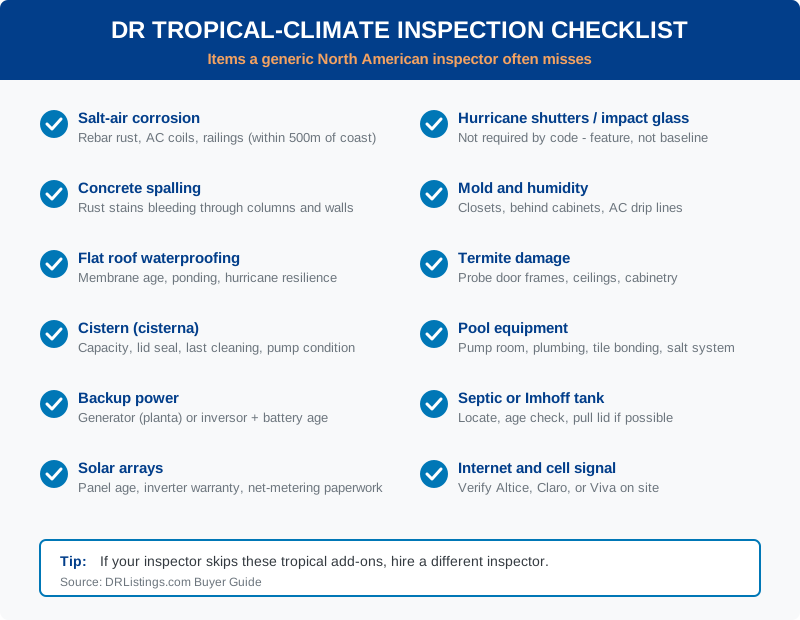
View text version of this infographic
DR Tropical-Climate Inspection Checklist — items a generic North American inspector often misses:
- Salt-air corrosion — Rebar rust, AC coils, railings (within 500m of coast)
- Concrete spalling — Rust stains bleeding through columns and walls
- Flat roof waterproofing — Membrane age, ponding, hurricane resilience
- Cistern (cisterna) — Capacity, lid seal, last cleaning, pump condition
- Backup power — Generator (planta) or inversor + battery age
- Solar arrays — Panel age, inverter warranty, net-metering paperwork
- Hurricane shutters / impact glass — Not required by DR code; feature, not baseline
- Mold and humidity — Closets, behind cabinets, AC drip lines
- Termite damage — Probe door frames, ceilings, cabinetry
- Pool equipment — Pump room, plumbing, tile bonding, salt system
- Septic or Imhoff tank — Locate, age check, pull lid if possible
- Internet and cell signal — Verify Altice, Claro, or Viva on site
Tip: If your inspector skips these tropical add-ons, hire a different inspector.
- Salt-air corrosion. Within roughly 500 meters of the coast, salt attacks rebar inside concrete columns, structural steel, AC condenser coils, and metal railings. The inspector should look for rust stains bleeding through concrete (a sign rebar is rusting and expanding) and tap suspect spots for spalling.
- Concrete spalling and rebar exposure. Once spalling starts, repairs run into the thousands. Catch it early.
- Roof systems. Most DR homes have flat concrete roofs. The membrane and waterproofing seal needs to be checked for age, ponding, and hurricane resilience.
- Cistern (cisterna). Almost every Dominican home has an underground cistern because municipal water is intermittent. Check capacity, lid seal, last cleaning date, and pump condition.
- Backup power. Power outages are routine. Look for either a generator (planta) with a working auto-transfer switch and fuel state, or an inversor with a battery bank. Lithium battery banks last longer than lead-acid; ask the age of the cells.
- Solar arrays. Increasingly common, especially on the north coast and in gated communities. Check panel age, inverter warranty, and net-metering paperwork.
- Hurricane shutters or impact windows. Especially relevant on the north and east coasts. Note that the DR building code does not uniformly require impact glass, so its presence is a feature, not a baseline.
- Mold and humidity. Closets, areas behind cabinetry, and spots around AC drip lines are the usual culprits. Many North American buyers underestimate how aggressive Caribbean mold is.
- Termite damage. Subterranean termites are aggressive in the DR. Any wood, including door frames, ceilings, furniture, and kitchen cabinetry, should be probed.
- Pool equipment. Pump room, plumbing, tile bonding, and salt-system condition.
- Septic or Imhoff tank. If the property is not on municipal sewer (most of the country is not), the inspector should locate the tank, check the age, and ideally pull the lid.
- Internet and cell signal. Practical, not structural. Verify Altice, Claro, or Viva coverage at the property if you plan to work remotely.
A thorough inspection of a single-family villa typically takes 3 to 5 hours on site, plus another day or two to compile the written report.
Who Is Qualified to Inspect: Your Three Options
This is the question every foreign buyer asks and that most online guides skip. The Dominican Republic has no national license for the title "home inspector," so credentialing comes from one of three sources.
| Inspector Type | Credential | Best For | Typical Cost (USD) | |----------------|------------|----------|--------------------| | CODIA-licensed structural engineer or architect | Colegio Dominicano de Ingenieros, Arquitectos y Agrimensores (CODIA) | Older construction, visible cracks, suspected structural issues, large estates, pre-construction milestone inspections | $400 to $1,200+ depending on scope | | Certified home inspector (InterNACHI or ASHI) | International certification, often expat-run firms operating in the DR | Standard resale condos and villas; English-language reports | $350 to $850 | | Builder or architect referral (informal) | None or CODIA | Quick walkthrough opinion before making an offer; not a substitute for a full inspection | $100 to $300 |
What CODIA actually is
CODIA is the Dominican professional college for engineers, architects, and surveyors. Membership requires a verified degree, and CODIA members face professional sanctions if they sign off on shoddy work. When a Dominican structural engineer or architect inspects your property, they typically stamp the report with their CODIA number. That stamp is what gives the report formal weight if you later need to negotiate or litigate.
For older buildings, post-hurricane assessments, or any property where you see cracks wider than a credit card, hire a CODIA structural engineer. A generalist home inspector cannot diagnose load-path problems.
InterNACHI and ASHI inspectors
InterNACHI (the International Association of Certified Home Inspectors) and ASHI (the American Society of Home Inspectors) certify inspectors using North American standards of practice. Several inspection firms in tourist-heavy regions of the DR are run by expats with these credentials. They generally produce English-language PDF reports with photos, which is exactly what most US and Canadian buyers want.
For a typical resale condo or villa with no obvious structural concerns, an InterNACHI- or ASHI-certified inspector who lives and works in the DR is the right choice. They know the tropical red flags and can communicate findings clearly.
The red flag
Any "inspector" who does not have a CODIA number, an InterNACHI or ASHI certification number, or any other verifiable credential is selling an opinion, not an inspection. Ask for the credential before you book.
One non-negotiable rule
Use your own inspector. Never the seller's, the developer's, or the listing agent's. Free inspections from the developer's chosen engineer are not inspections; they are sales tools. Coordinate the hire through your own buyer's agent or attorney. You can find a real estate agent in the Dominican Republic who will walk you through the process.
What Property Inspections Cost in the Dominican Republic
Pricing in the DR is more transparent than most buyers expect. Here are realistic ranges based on published inspection-firm price lists and CODIA fee structures.
- Condos (1-2 bedrooms): $350 to $550
- Standard villas (3-4 bedrooms): $550 to $850
- Large estates or beachfront mansions: $850 to $1,500+
- Pre-construction phased inspections: $1,000 to $3,000+ across multiple visits
- Standalone CODIA structural assessment: $400 to $1,200 depending on building size and scope
Travel surcharges
Inspectors based in Sosúa or Punta Cana will often charge a travel fee for jobs in remote regions like Las Galeras, Río San Juan, or Pedernales. Expect $100 to $300 added on for these trips. Ask up front.
What is usually not included
- Sewer-line camera scopes
- Mold lab tests (visual identification is included; lab confirmation is extra)
- Pool equipment deep diagnostic
- Detailed electrical load testing beyond a thermal scan of the panel
- Structural engineering analysis (if the home inspector flags something, the CODIA engineer is a separate hire)
When you are budgeting due diligence, plan for roughly 1 to 1.5 percent of purchase price across inspection, attorney fees, and escrow charges combined. The inspection itself is the cheapest line item and the one most likely to save you tens of thousands.
Pre-Construction (Off-Plan) Inspections
Buying off-plan in the DR, meaning before the building is finished, is common for new condo towers in Punta Cana, Bávaro, Cap Cana, and the north coast. Pre-construction inspections work differently from resale inspections.
Instead of one walkthrough, you commission phased site inspections at construction milestones:
- Foundation pour. Verifying rebar placement, footing depth, and concrete spec.
- Framing and structural shell. Column placement, slab thickness, hurricane reinforcement.
- MEP rough-in. Plumbing, electrical, and AC ductwork before drywall closes them up.
- Finishing walkthrough. Tile, fixtures, doors, paint, balconies, hurricane shutters or impact glass.
- Final acceptance. Punch list before you accept the unit and release the final payment.
For pre-construction work, hire a CODIA-licensed structural engineer rather than a generalist home inspector. The questions you need answered (rebar gauge, concrete strength, slab thickness) are engineering questions, not home-inspection questions. Tie each inspection sign-off to a milestone payment in your contract. That gives your engineer real leverage.
CONFOTUR-registered tourism projects sometimes carry their own construction supervision, but that supervision works for the developer, not for you. Your engineer is independent. For more on the trade-offs, see pre-construction vs pre-built homes in the Dominican Republic and current new development projects.
How to Find an English-Speaking Inspector by Region
Most foreign buyers want an English-language report with photos and a phone call to walk through findings. Here is where you tend to find them.
- Punta Cana / Bávaro / Cap Cana. The largest concentration of expat-run inspection firms in the country. Easiest region to find English-speaking inspectors.
- Las Terrenas / Samaná / Las Galeras. A handful of established inspectors, mostly French- and English-speaking. Expect a travel fee for Las Galeras specifically.
- Sosúa / Cabarete / Puerto Plata. Strong expat inspector pool; many German, Canadian, and US-trained.
- Santo Domingo and Santiago. Most CODIA structural engineers are based here. Fewer English-only home-inspector firms; lean on bilingual CODIA engineers.
- Casa de Campo / La Romana / Bayahibe. Smaller pool; inspectors often travel from Punta Cana.
How to vet an inspector before you book
- Ask for a sample report (PDF with photos).
- Confirm a CODIA number, InterNACHI ID, or ASHI ID, and verify it on the issuing body's site.
- Confirm the report will be delivered in English.
- Confirm independence. No relationship with the seller, the developer, or the listing agent.
- Ask whether the inspector will be on a phone or video call to walk through findings.
If the inspector hesitates on any of these, keep looking.
Reading Your Inspection Report and Negotiating
A good DR inspection report runs 30 to 80 pages with photos, organized by system, and ends with a summary of findings sorted by severity. Use this severity framework to negotiate.
- Structural. Foundation cracks, rebar corrosion, roof failure, hurricane vulnerability. These are deal-breakers or large credits.
- Safety. Bare wiring, missing GFCIs, gas leaks, pool fencing issues. Must be fixed at seller's cost or credit before closing.
- Functional. AC compressor near end of life, water heater corroded, generator transfer switch failing. Fair to negotiate as a credit or split cost.
- Cosmetic. Paint, tile chips, scuffs. Generally accepted as-is.
You have three plays during the contingency window:
- Ask for a credit at closing. Usually the cleanest path. The seller wires less to closing and you fix the items yourself with your trusted contractor.
- Ask for repairs. Slower, and you do not control quality. Use this only for items that must be repaired before closing for safety or financing reasons.
- Walk away. If the contingency was properly drafted, your deposit returns from escrow.
Because deposits sit in escrow, the inspection contingency is your protection, but only if your attorney drafted it correctly. Make sure your attorney ties the contingency to specific severity tiers, not vague language like "if buyer is not satisfied."
Inspection vs Legal Due Diligence: They Are Not the Same
Foreign buyers conflate these two and end up doing one but not the other. They are completely separate processes, run by different professionals, in parallel.
| Inspection (physical) | Legal Due Diligence | |-----------------------|---------------------| | Building condition | Title, survey (deslinde), IPI tax arrears, encumbrances, liens | | Engineer or certified inspector | Lawyer plus surveyor | | Days | Weeks | | Catches construction defects | Catches title defects | | Saves you from a bad building | Saves you from a property you cannot legally own |
Both are required. Skipping legal diligence is how foreign buyers end up with cloudy titles and unpaid property taxes attached to the property they thought they bought clean.
If you are financing locally, your lender will require its own appraisal. Note that an appraisal is not an inspection. Appraisals confirm value; inspections confirm condition. See more on Dominican Republic mortgages for foreigners.
Browsing the market? Most foreign buyers start with villas for sale in the Dominican Republic or condos for sale in the Dominican Republic before narrowing to specific neighborhoods.
Common Mistakes to Avoid
- Using the listing agent's recommended inspector. Conflict of interest. Hire your own.
- Skipping the contingency clause. Without it, your deposit is at risk regardless of what the inspection finds.
- Inspecting after the deposit becomes non-refundable. The whole point is to inspect inside the window where you can still walk.
- Hiring a generalist for a structural concern. If you see cracks, hire a CODIA engineer, not a home inspector.
- Accepting a verbal report. Always get a written PDF with photos. You will need it for any negotiation or future insurance claim.
- Assuming new construction is automatically sound. New does not mean good. DR construction quality varies wildly between developers.
Frequently Asked Questions
Are home inspections required in the Dominican Republic?
No. Home inspections are not legally required in the Dominican Republic, and they are arranged by the buyer. Virtually every foreign buyer commissions one inside the Promise of Sale contingency window because the DR's tropical climate ages buildings faster than temperate climates do.
How much does a home inspection cost in the Dominican Republic?
A standard home inspection in the DR costs $350 to $850 USD for condos and villas. Larger estates or pre-construction phased inspections can run $1,000 or more. CODIA-licensed structural assessments are priced separately from $400 to $1,200 depending on scope.
Who can perform a home inspection in the DR?
Three types of professionals are qualified: CODIA-licensed structural engineers or architects, InterNACHI- or ASHI-certified home inspectors operating in the DR, and (for informal walkthroughs) referred builders or architects. Anyone without a verifiable credential is selling an opinion, not an inspection.
What is CODIA and why does it matter for inspections?
CODIA is the Colegio Dominicano de Ingenieros, Arquitectos y Agrimensores, the professional college that registers Dominican engineers, architects, and surveyors. A CODIA-stamped inspection report carries formal weight, and the inspector is subject to professional sanctions for misconduct. That is why CODIA membership matters for structural questions.
What should a property inspection cover in a tropical climate?
Beyond standard checks, a DR inspection must cover salt-air corrosion of rebar and metal, concrete spalling, flat roof waterproofing, cisterns, backup power (generator or inversor), hurricane resilience, mold and humidity, termite damage, pool equipment, and septic systems. Generic North American checklists miss most of these.
How do I find an English-speaking home inspector in the Dominican Republic?
The largest concentration of English-speaking inspection firms is in Punta Cana, Cabarete-Sosúa, and Las Terrenas. Ask your buyer's agent or attorney for two or three independent referrals, then verify each inspector's CODIA, InterNACHI, or ASHI credential before booking.
Should I inspect a pre-construction property in the DR?
Yes, and you should commission phased inspections at foundation, framing, MEP rough-in, and finishing milestones rather than a single final walkthrough. Use a CODIA-licensed structural engineer for pre-construction work and tie each inspection sign-off to a milestone payment in the contract.
What's the difference between a home inspection and legal due diligence?
A home inspection covers physical condition (structure, systems, finishes) and is performed by an engineer or certified inspector over a few days. Legal due diligence covers title, survey, taxes, and encumbrances, is performed by your attorney and surveyor, and takes weeks. Both are required, and they happen in parallel.
Can I cancel the contract if the inspection finds problems?
Yes, if your Promise of Sale (Promesa de Venta) includes a properly drafted inspection contingency. The contingency lets you accept the property, ask for repairs or a credit, or walk away with your escrowed deposit returned. Without that clause, your deposit is at risk regardless of what the inspection reveals.
How long does a home inspection take in the Dominican Republic?
A typical single-family villa inspection takes 3 to 5 hours on site, plus 1 to 3 days for the inspector to compile the written PDF report with photos. Larger estates or commercial buildings can run a full day or more on site. Pre-construction phased inspections occur over the entire construction timeline.
David Logan
site_adminContributing writer for DRListings.com, sharing insights about Dominican Republic real estate.
Comments
Log in to join the conversation