A few days before closing on a Punta Cana villa, an American buyer got an email that looked exactly like every other message from her attorney. Same signature block. Same friendly tone. Same phone number at the bottom. The only difference: a brief note saying the law firm had "just changed banks," with new wiring instructions attached. She forwarded the new details to her bank, sent $280,000, and lost almost all of it. The email had come from a domain ending in .co instead of .com.
A wire transfer to the Dominican Republic for a property purchase is the highest-stakes moment of the whole transaction. This guide covers the three things that decide whether your money arrives where it should: which banking channel you use to send it, what the trip actually costs once every fee is counted, and how to verify wire instructions so you don't get phished. It's written for American and Canadian buyers paying in US dollars, and is informational only. It is not legal or financial advice.
Almost every foreign-buyer purchase in the DR closes in USD via international wire to an attorney-managed escrow account. Wire fraud is the biggest financial risk in any cross-border closing. Dominican closings get targeted because the dollar amounts are large, the wire path is long, and recall is functionally impossible once the money lands.
How a Property Wire Transfer to the Dominican Republic Actually Works
Most foreign-buyer purchases follow the same money flow. You sign a Promise of Sale (Promesa de Compraventa) and put down a deposit, usually 10% of the purchase price, into your attorney's escrow account. Your attorney runs due diligence on the property: title search at the Title Registry, lien check, deslinde (boundary) verification, tax-status review, and CONFOTUR validation if the project claims that exemption.
Once due diligence clears, the seller and buyer sign the Contract of Sale (Contrato de Venta). The balance of the purchase price is wired to the escrow account three to five business days before closing day. On closing, the attorney disburses the seller's proceeds, pays the 3% transfer tax to the DGII (the Dominican tax authority), pays registration and notary fees, and files the deed transfer at the Title Registry.
Where the escrow lives matters. Three options come up:
- A US-based attorney IOLTA or escrow account. The buyer's funds never leave the US banking system until disbursement. This is the safest setup for buyers with US-licensed counsel coordinating with a DR firm.
- A DR-based attorney escrow account. Standard for buyers using only DR counsel. The attorney has fiduciary duties under Dominican law, but recall mechanisms are weaker than in the US.
- A Dominican bank-held escrow. Less common but available. The bank acts as escrow agent rather than the attorney. It adds a fee, but also adds an institutional layer of protection.
Read more in our explainer on how escrow works in DR real estate. The currency is almost always USD. Dominican peso (DOP) transfers exist, but they add unnecessary FX exposure for foreign buyers and are rare in practice.
Timing matters too. International wires take two to five business days. US holidays, DR holidays, and weekends all add delay. Build a buffer of at least five to seven business days into your closing schedule. Wires sent on a Friday afternoon in the US frequently don't post in the DR until Wednesday.
Choosing the Sending Channel: Banks vs FX Specialists vs SWIFT
The send side of your wire (the bank or service that pushes the money out of your account) has a bigger impact on cost than most buyers realize. There are roughly four channels available to North American buyers.
1. Your US or Canadian retail bank. Chase, Bank of America, Wells Fargo, RBC, TD, BMO, and similar institutions all wire internationally through SWIFT. Outbound fees typically run $35 to $50 per international wire. If the bank converts USD to DOP for you, the FX spread is usually 2.5% to 4% above mid-market. Correspondent (intermediary) banks deduct another $15 to $30 mid-route, often invisibly. Retail banks are familiar and fast, but they are the most expensive channel by a wide margin.
2. FX specialists and money-transfer firms. Wise, OFX, Convera, and MTFX-style firms move money in bulk. They typically offer FX spreads of 0.5% to 1.5%, sometimes with no outbound fee at all. The catch: most have daily transfer limits, onboarding takes a few business days, and recipient compliance for property-purchase amounts (often $100k+) needs to be confirmed in advance. These firms are usually the cheapest path when conversion is involved, but they add a step. (MTFXGroup has a useful Canadians-buying-in-DR guide; note they sell this service.)
3. SWIFT direct from a private-banking relationship. If you bank at a tier where you have a relationship manager, ask about pricing. Private-banking SWIFT wires are often the best option for transfers above $500,000, because the relationship banker can waive fees and tighten the spread.
4. USD-to-USD wire with no FX conversion. This is the cheapest path, and the one most foreign buyers should aim for. If your attorney's escrow account holds USD (most do), you should send USD and let the receiving account hold USD. There's no FX spread to lose. The only fees are the outbound wire fee, possible correspondent deductions, and a small inbound fee at the DR bank.
Honest take: on a $400,000 property, the gap between the worst sending channel (a retail bank converting to DOP) and the best (USD-to-USD via an FX specialist or private banker) can run $4,000 to $6,000. That's real money.
The Real Cost of a Wire Transfer to the Dominican Republic: Fees You'll Actually Pay
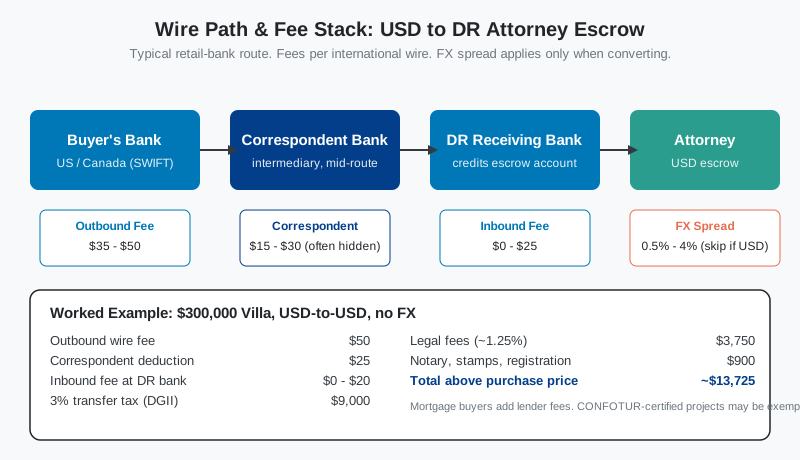
Wire fees are tricky because they show up in three or four different places along the path. Here's the full stack a buyer should plan for.
View text version of this infographic
Wire path: Buyer's Bank (US/Canada, SWIFT) -> Correspondent Bank (intermediary, mid-route) -> DR Receiving Bank (credits escrow account) -> Attorney USD Escrow.
Fees along the path:
- Outbound fee at sending bank: $35 - $50.
- Correspondent / intermediary deduction: $15 - $30 (often invisible until reconciliation).
- Inbound fee at DR receiving bank: $0 - $25.
- FX spread (only if converting USD to DOP): 0.5% - 4% above mid-market. Skip by sending USD-to-USD.
Worked example - $300,000 villa, USD-to-USD, no FX:
- Outbound wire fee: $50
- Correspondent deduction: $25
- Inbound fee at DR bank: $0 - $20
- 3% transfer tax (DGII): $9,000
- Legal fees (~1.25%): $3,750
- Notary, stamps, registration: $900
- Total above purchase price: ~$13,725
Mortgage buyers add lender fees on top. CONFOTUR-certified projects may be exempt from the 3% transfer tax.
Outbound wire fee (sending bank): $35 to $50 per international wire is the typical retail-bank range. FX specialists and private-banking customers often pay nothing.
Correspondent / intermediary bank fees: $15 to $30 deducted somewhere mid-route by a bank that bridges your sending bank and the DR receiving bank. These deductions are often invisible until reconciliation, which means the escrow attorney may receive slightly less than you sent. Always communicate the gross amount sent so your attorney can confirm the net received.
Inbound fee at the DR receiving bank: $0 to $25, depending on the institution.
FX spread (only if converting): banks 2.5% to 4% above mid-market; specialists 0.5% to 1.5%. On $300,000 converted, that's a $7,500 to $12,000 hit at a retail bank versus $1,500 to $4,500 at a specialist. Avoid converting if you can.
Then come the Dominican-side purchase costs that follow the wire and get paid out of escrow:
- 3% transfer tax to the DGII, calculated on the higher of the contract price or the assessed value. Our DR property taxes guide covers this in more depth.
- ~1% to 1.5% legal fees for the attorney handling the closing.
- Notarization, registration, and stamp fees of roughly 0.25% to 0.5%.
- CONFOTUR-certified projects can be exempt from the 3% transfer tax. Verify the certificate is active and that your specific unit is covered before relying on the exemption. See our CONFOTUR transfer-tax exemption guide.
Worked example for a $300,000 villa, USD-to-USD, no FX conversion:
- Outbound wire fee: $50
- Correspondent deduction: $25
- Inbound fee: $0 to $20
- 3% transfer tax: $9,000
- Legal fees (1.25%): $3,750
- Notary, stamps, registration: $900
- Total above purchase price: ~$13,725
Mortgage buyers add lender fees on top.
A note on under-reporting: some buyers are tempted to wire less than the recorded purchase price to dodge transfer tax. Don't. The wire amount is permanently recorded by both banks, the contract value is recorded at the Title Registry, and any mismatch is traceable. The DGII can reassess years later, and you've also created a paper trail for tax fraud. Pay the 3%.
Wire Fraud in DR Real Estate: How Buyers Lose Money
This is the section that matters most. Wire fraud is the biggest cause of catastrophic loss in DR closings, and the playbook is consistent.
Email compromise and spoofed wire instructions. This is the dominant scam. An attacker compromises your email, your attorney's email, or both, sometimes weeks before closing. They watch the thread quietly, learn the language and signature style, then strike days before the wire goes out. The phishing email looks identical to your attorney's normal correspondence. The signature block matches. The fake wiring instructions look right at a glance. The give-away is almost always the sender domain: a single-letter swap, a .co instead of .com, or a subdomain like attorney-firm.legal-secure.com.
Fake escrow accounts. An "agent" or unlicensed broker (and remember, the DR has no real estate licensing requirement, only voluntary professional memberships) sets up a personal account labeled "escrow" and asks for the deposit there. Real escrow runs through a licensed attorney with fiduciary duties. Always verify your attorney's standing through the Colegio de Abogados (the DR bar association). Our guide on working with a DR real estate lawyer walks through verification.
Pressure to wire before due diligence completes. A legitimate transaction lets you finish due diligence on DR property, including title, deslinde, lien check, and CONFOTUR validation, before the final-balance wire. If a seller or agent is pushing you to send the balance earlier, treat it as a red flag.
Pre-construction wires carry extra risk. Money sent to a developer before a unit exists is harder to claw back than money sitting in attorney escrow.
Imposter and traveler scams. Buyers who fly in for closing get targeted with calls or texts claiming a relative has been detained or hospitalized in the DR and needs an emergency wire. The US Embassy in Santo Domingo publishes alerts on these scams. They aren't property-specific, but the timing makes buyers vulnerable when they're already wiring large sums.
The Verification Protocol Every Buyer Should Run
Before sending any wire, run these four steps:
- Call your attorney at a phone number you got in person or from their official website's main page. Not a number in the wire-instructions email. Not a number a colleague forwarded. A number you got at the original engagement meeting, or by looking up the firm independently.
- Confirm bank name, account number, SWIFT or ABA code, and beneficiary name verbally. Read each digit out loud. Have them read it back.
- Send a $1 test wire 48 hours before the main wire if your bank allows. Confirm the test was received before sending the balance.
- Refuse last-minute changes to wire instructions, period. Any change less than 48 hours before sending should be treated as fraud until you have re-verified by phone with someone you've met in person.
View text version of this infographic
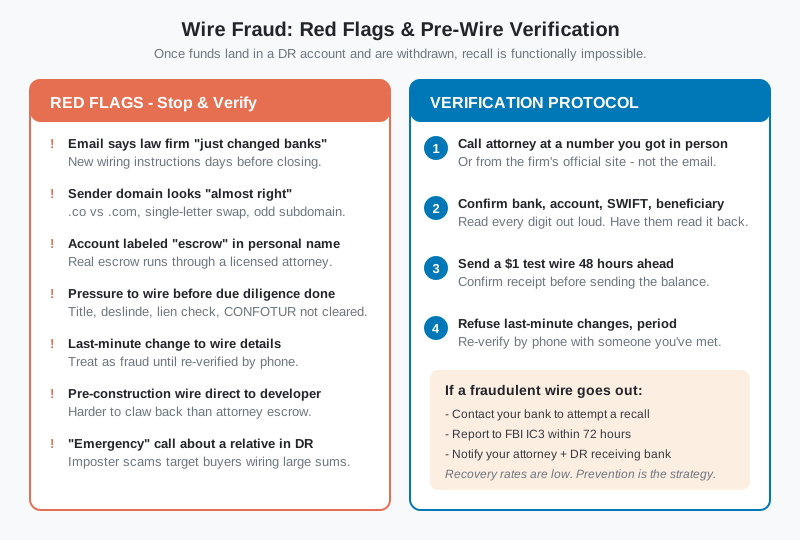
Red flags - stop and verify:
- Email says the law firm "just changed banks" with new wiring instructions days before closing.
- Sender domain looks "almost right" - .co vs .com, single-letter swap, odd subdomain.
- Account labeled "escrow" but in an individual's personal name.
- Pressure to wire before due diligence (title, deslinde, lien check, CONFOTUR) is cleared.
- Last-minute change to wire details - treat as fraud until re-verified by phone.
- Pre-construction wire sent direct to a developer rather than attorney escrow.
- "Emergency" call about a relative detained or hospitalized in the DR.
Verification protocol:
- Call your attorney at a phone number you got in person or from the firm's official site - not from the email.
- Confirm bank, account number, SWIFT/ABA, and beneficiary verbally. Read every digit out loud and have them read it back.
- Send a $1 test wire 48 hours ahead. Confirm receipt before sending the balance.
- Refuse last-minute changes, period. Re-verify by phone with someone you've met in person.
If a fraudulent wire goes out: Contact your bank to attempt a recall, report to the FBI IC3 within 72 hours, and notify your attorney and the DR receiving bank. Recovery rates are low - prevention is the strategy.
Recovery is bleak. Once funds land in a DR bank account and are withdrawn or moved, recall is functionally impossible. The FBI's IC3 (Internet Crime Complaint Center) has a small recovery program that can sometimes freeze funds if reported within 72 hours, but success rates are low. Prevention is the entire game.
Reporting and Compliance: What US and Canadian Buyers Owe
There's widespread confusion about what you have to report when you wire large sums to buy property abroad. Here's the plain version.
Form 8300 myth. Wires sent from a US financial institution are excluded from Form 8300 reporting. Form 8300 is for cash and cashier's-check transactions over $10,000 received by a US trade or business. As a buyer wiring funds, you do not file 8300 for sending the wire. The DR-side recipient may have its own Dominican AML reporting obligations, but that is not your form.
FBAR (FinCEN 114). If you open a Dominican bank account during or after the purchase, and the aggregate balance across your foreign accounts exceeds $10,000 USD at any point in the calendar year, you must file FBAR. The threshold is aggregate, not per-account. Failure to file is expensive.
Form 8938 (FATCA). Filed with your Form 1040 if your specified foreign financial assets exceed certain thresholds (higher than FBAR — typically $50,000 for single filers living in the US, higher for joint filers or expats). Real estate held directly is generally not reportable on 8938. Foreign-bank-account balances and certain investment vehicles are.
Source-of-funds documentation on the DR side. Dominican banks ask for source-of-funds papers on inbound foreign wires, especially over $10,000. Have ready: HUD-1 from a recent home sale, brokerage statements showing the funds, signed letters from your accountant or the prior asset's seller, or business sale documentation. Without these, the receiving bank can hold the wire pending review, which delays closing.
Canadian buyers — T1135. If your foreign property (DR real estate, DR bank accounts, foreign investments) exceeds CAD $100,000 cost basis at any time in the year, you file T1135 with the CRA. The DR property's cost basis includes the purchase price plus closing costs.
Confirm current threshold figures with a tax advisor before filing. They are stable, but worth re-checking each year.
Practical Pre-Wire Checklist
Run through this list before you authorize the balance wire:
- Attorney engaged, verified through Colegio de Abogados, met in person or via verified video call
- Promise of Sale signed and reviewed by your counsel
- Title search, deslinde, lien check, and CONFOTUR validation (if claimed) all cleared in writing
- Wire instructions received in writing and verbally confirmed via a phone number you got outside the email thread
- Sending bank notified of the planned wire amount; some banks require pre-notice for transfers above $100,000
- Source-of-funds package prepared for the DR receiving bank (HUD-1, brokerage statement, sale letter)
- Test wire (if available) sent and confirmed received
- A buffer of five to seven business days built in before your scheduled closing date
- A copy of the SWIFT MT103 confirmation saved as soon as the wire posts. The DR attorney often needs the reference number.
Walking through this list at the kitchen table with your attorney on the phone is twenty minutes that has saved buyers six-figure losses. If you want the full step-by-step, our how to buy property in the DR guide is the parent post for everything covered here.
Frequently Asked Questions
How do you wire money to the Dominican Republic safely? Send USD to your attorney's escrow account via SWIFT, verify the wire instructions verbally with your attorney using a phone number you got in person, and send a $1 test wire 48 hours ahead if your bank allows. Refuse any last-minute changes to instructions and treat them as fraud until proven otherwise.
What is the best way to send a large amount of money to the Dominican Republic? For amounts above $500,000, a SWIFT wire through your private-banking relationship usually offers the best pricing. For $50,000 to $500,000, an FX specialist (Wise, OFX, Convera) typically beats a retail bank by 1% to 3% if any conversion is needed. Send USD-to-USD whenever possible to skip FX entirely.
How long does an international wire to the Dominican Republic take? Two to five business days is typical. US holidays, DR holidays, and weekends add delay. Build a five-to-seven-business-day buffer before your closing date.
How much does it cost to wire money to the Dominican Republic? Expect $35 to $50 outbound from a retail bank, $15 to $30 in correspondent deductions, $0 to $25 inbound at the DR bank, and a 0.5% to 4% FX spread if you convert. USD-to-USD with no conversion is by far the cheapest path.
Do I have to report wiring money to the Dominican Republic to the IRS? You do not file Form 8300 for sending a wire. Wires from US financial institutions are excluded. You do file FBAR if you open a DR bank account that pushes your foreign-account aggregate over $10,000 in any year, and Form 8938 if you cross those (higher) thresholds. Real estate held directly is generally not reportable on 8938.
Can I wire money in USD to the Dominican Republic? Yes. USD wires are standard for foreign-buyer property purchases. Most DR attorney escrow accounts accept and hold USD, which lets you avoid FX conversion entirely.
Is escrow safe in the Dominican Republic? Attorney-managed escrow with a verified, Colegio-de-Abogados-registered lawyer is the standard, and is generally safe. Risks come from fake "escrow" accounts set up by unlicensed brokers, and from email-based wire fraud. Not from the legal escrow concept itself.
What is the 3% transfer tax in the Dominican Republic? The DGII charges a 3% tax on the higher of the contract price or assessed value when title transfers. CONFOTUR-certified tourism projects can be exempt. Verify the certificate is active and your specific unit is covered before relying on the exemption.
Can a wire transfer be reversed if I send to the wrong account? Functionally, no. Once funds land in a DR bank and are withdrawn, recall is near-impossible. The FBI IC3 program can sometimes freeze funds if reported within 72 hours, but success is rare. Prevention is the entire strategy.
How do I avoid real estate scams in the Dominican Republic? Use a Colegio-verified attorney, never wire to an account in an individual's personal name labeled "escrow," verify all wire instructions verbally before sending, complete due diligence (title, deslinde, liens, CONFOTUR) before the balance wire, and refuse any last-minute changes to instructions. None of this is legal advice. Talk to your own attorney before the closing.
David Logan
site_adminScrittore collaboratore per DRListings.com, condividendo approfondimenti sugli immobili nella Repubblica Dominicana.
Commenti
Accedi per unirti alla conversazione