Pre-Construction vs Pre-Built Homes in the Dominican Republic: Which One Makes Sense for You?
Pre-construction homes in the DR cost 15-30% less than market price. They come with flexible payment plans and CONFOTUR tax breaks. The trade-off? You face construction delays and developer risk. Pre-built homes let you move in right away, inspect everything in person, and start earning rental income on day one. But they cost more upfront and don't qualify for CONFOTUR tax benefits on resale. Understanding the differences between pre-construction vs pre-built homes in the Dominican Republic is the first step toward making a smart purchase.
If you're buying property in the DR, this is one of the first choices you'll face. Both paths lead to ownership. But the money you need upfront, the risks you take on, and how quickly the property starts working for you are different. This guide covers both options honestly so you can pick the one that fits your timeline, budget, and comfort with risk.
What Is Pre-Construction (Off-Plan) Property?
Pre-construction means buying a property before or during the build. You're buying based on floor plans, 3D renders, and a model unit if you're lucky. The building might be a hole in the ground or halfway up when you sign.
Here's how it typically works in the DR:
Reservation deposit: $5,000-$10,000 to hold your unit
Down payment: 20-30% of the purchase price, sometimes spread over several months
Milestone payments: Tied to construction progress (foundation poured, structure complete, etc.)
Final payment: 30-40% due at delivery
Most pre-construction activity happens in Punta Cana, Cap Cana, Cabarete, Sosua, and Las Terrenas. Developers in these areas regularly launch new projects aimed at foreign buyers. Many offer 0% financing during the build period.
What Is a Pre-Built (Completed or Resale) Property?
A pre-built property already exists. It's either brand new and finished by a developer, or it's a resale from a previous owner. Either way, you can walk through it, open the faucets, flip the light switches, and see exactly what you're getting.
The buying process is different. You agree on a price, put down a 10% good-faith deposit, and close in 30 to 90 days. Most resale deals in the DR are cash. Buyers put down 30-50% or pay the full amount outright. Local bank mortgages exist but carry rates of 8-12%+, which makes them a tough sell for most foreign buyers. For a full breakdown of financing, see the Dominican Republic mortgage guide for foreigners.
Pre-built properties are available in every market across the DR, from beachfront condos to rural villas.
Pros of Buying Pre-Construction in the Dominican Republic
Lower entry price. Early buyers typically pay 15-30% less than the same unit will cost once the building is complete. A condo that sells for $200,000 at delivery might cost $150,000-$170,000 during the pre-sale phase.
Spread-out payments. Instead of coming up with $150,000 at once, you might pay $7,500 as a reservation. Then $37,500 over the next six months. Then milestone payments over 12-18 months, with the balance due at handover. That staggered structure makes higher-value properties reachable for buyers who have steady income but not a large lump sum in the bank.
Customization. Buy early enough and you can often choose your finishes, flooring, kitchen cabinets, and sometimes even adjust the layout. That's not an option with a resale property unless you renovate.
CONFOTUR tax benefits. This is a big one. If the project is registered under CONFOTUR (Law 158-01), you skip the 3% property transfer tax at closing. You pay no annual property tax (IPI) for up to 15 years. And the project's income tax exemption (up to 10 years) can mean lower operating costs that benefit owners indirectly. These savings add up to tens of thousands of dollars over the life of ownership. You can browse CONFOTUR-eligible properties here.
Modern standards and warranties. New construction means current building codes, new electrical and plumbing systems, and typically a 1-year builder warranty on defects.
Built-in appreciation. Industry data suggests early pre-construction buyers in the DR see 15-25% growth by the time the project is delivered. This isn't a guarantee and depends on market conditions. But the discount at entry creates a margin that resale buyers don't get.
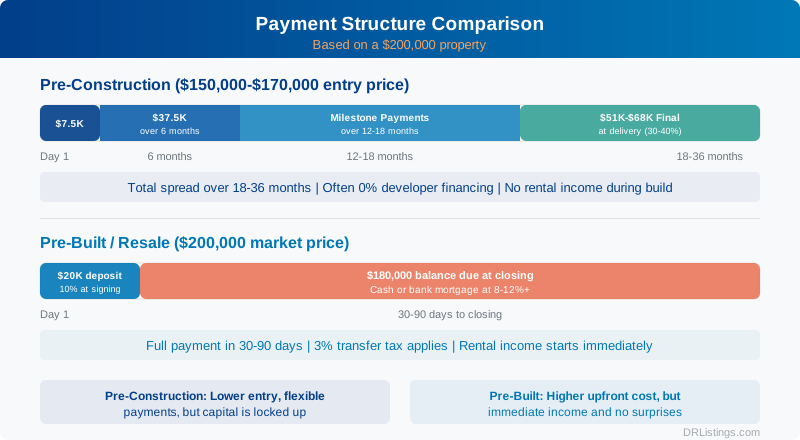
View text version of this infographic
Payment Structure Comparison (Based on a $200,000 property)
Pre-Construction ($150,000-$170,000 entry price):
Day 1: $7,500 reservation deposit
Months 1-6: $37,500 down payment spread over several months
Months 6-24: Milestone payments tied to construction progress
At delivery (18-36 months): $51,000-$68,000 final payment (30-40%)
Total spread over 18-36 months, often 0% developer financing, no rental income during build
Pre-Built / Resale ($200,000 market price):
Day 1: $20,000 good-faith deposit (10% at signing)
30-90 days to closing: $180,000 balance due (cash or bank mortgage at 8-12%+)
Full payment in 30-90 days, 3% transfer tax applies, rental income starts immediately
Cons of Buying Pre-Construction
Delays are the norm, not the exception. If a developer tells you the project will be done in 18 months, plan for 24. Dominican construction timelines stretch for all kinds of reasons: permitting holdups, material shortages, weather, labor gaps. Add at least 6 months to any quoted delivery date as a baseline.
Developer risk is real. Your money goes to the developer. If they run into money trouble, mismanage the project, or walk away, getting your funds back is hard and expensive. There is no required escrow in the DR. Unless you negotiate an escrow clause into your contract, your funds are in the developer's hands from day one.
You can't inspect what doesn't exist. You're buying based on a rendering and a promise. The finished product might have a different view than the model showed. The rooms might be smaller than the floor plan suggested. The finishes might be cheaper than what the sales office displayed.
No income while you wait. Your capital is tied up for 1-3 years producing zero rental income. A completed property in the same area could be pulling in $1,500-$3,000/month during that same period.
No cooling-off period. Unlike the US and Canada where you may have a window to cancel after signing, the DR has no cooling-off period. Once you sign the Promise of Sale, you're locked in. Getting out means losing your deposit or facing legal action.
Currency exposure. If you're making payments over 2-3 years in USD while the Dominican peso shifts, your total cost can change. This is a minor risk for most buyers, but it's worth knowing if you're on a tight budget.
Pros of Buying Pre-Built (Completed or Resale)
What you see is what you get. Walk through the property, test the plumbing, check the build quality, talk to the neighbors. No guessing about the final product.
Immediate occupancy or rental income. Close the deal, get the keys, list it on Airbnb the same week. For buyers who want their property earning income from day one, this is the clearest edge over pre-construction.
Established neighborhoods. A completed property sits in a neighborhood with a track record. You can check whether the water runs well, whether the roads flood, whether the HOA actually keeps up the common areas. With pre-construction in a new area, you're taking the developer's word on all of this.
Stronger bargaining position. Sellers of completed properties, especially motivated ones, will cut the price. You might get 5-15% below asking. Developers selling pre-construction units have less reason to budge because they're marketing to many buyers at once.
No developer risk or timeline guessing. The building exists. Nobody can go bankrupt mid-construction and leave you with a half-finished building.
Cons of Buying Pre-Built (Completed or Resale)
Higher upfront cost. You're paying full market price with less room on payment terms. Most resale deals require 30-50% down or full cash, and closings happen within 30-90 days.
No CONFOTUR benefits. The 3% transfer tax applies to resale properties. You'll also pay annual property tax (IPI) of 1% on the assessed value above the exemption threshold (roughly $170,000 USD as of 2026). Over 15 years, the tax gap between a CONFOTUR pre-construction purchase and a resale adds up fast.
Limited customization. If the kitchen layout doesn't work for you or the bathroom tile is dated, you're paying for renovations on top of the purchase price. Renovation costs and timelines in the DR can be hard to predict.
Slower appreciation. You're buying at market price, so your equity growth matches the market rate. Pre-construction buyers who got in at a 20% discount already have that margin built in at delivery.
Financing is expensive. If you need a mortgage, local banks charge 11-13.5% for peso loans and 8-10.5% for USD loans. Most foreign buyers skip local financing and pay cash.
Pre-Construction vs Pre-Built Homes: Side-by-Side Comparison
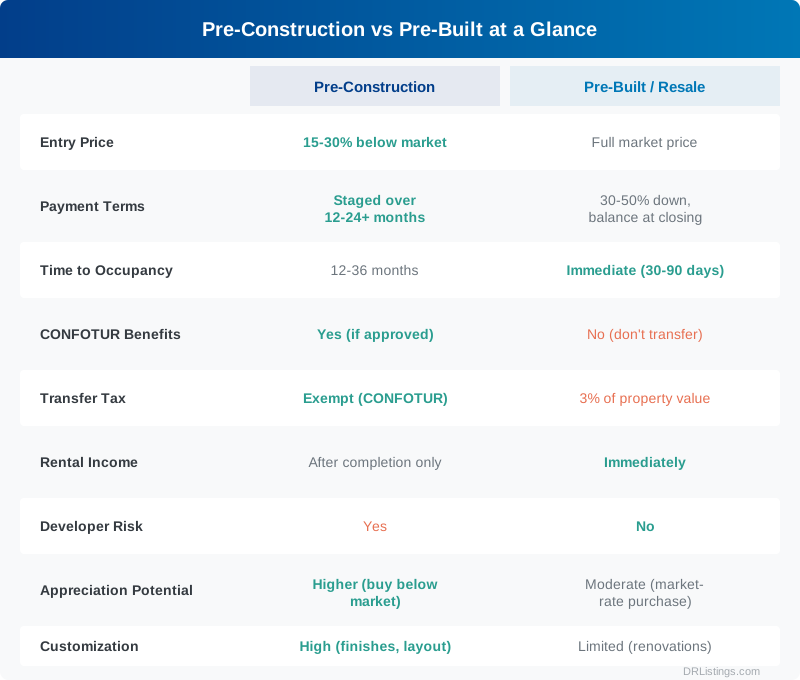
| Factor | Pre-Construction | Pre-Built / Resale | |--------|-----------------|-------------------| | Entry Price | 15-30% below market | Full market price | | Payment Flexibility | Staged over 12-24+ months | 30-50% down, balance at closing | | Time to Occupancy | 12-36 months | Immediate (30-90 day closing) | | Customization | High (finishes, layout) | Limited (renovations needed) | | CONFOTUR Eligible | Yes (if project is approved) | No (benefits don't transfer) | | Transfer Tax | Exempt under CONFOTUR | 3% of property value | | Property Tax | Exempt up to 15 years (CONFOTUR) | 1% annually above ~$170K threshold | | Rental Income Start | After completion only | Immediately | | Inspection | Based on plans/renderings | Physical walkthrough | | Developer Risk | Yes | No | | Appreciation Potential | Higher (buy below market) | Moderate (market-rate purchase) | | Financing | Developer financing (often 0%) | Bank mortgage (8-13%+) or cash |
View text version of this infographic
Pre-Construction vs Pre-Built at a Glance:
| Factor | Pre-Construction | Pre-Built / Resale | |--------|-----------------|-------------------| | Entry Price | 15-30% below market (advantage) | Full market price | | Payment Terms | Staged over 12-24+ months (advantage) | 30-50% down, balance at closing | | Time to Occupancy | 12-36 months | Immediate, 30-90 days (advantage) | | CONFOTUR Benefits | Yes, if approved (advantage) | No, don't transfer | | Transfer Tax | Exempt under CONFOTUR (advantage) | 3% of property value | | Rental Income | After completion only | Immediately (advantage) | | Developer Risk | Yes | No (advantage) | | Appreciation Potential | Higher, buy below market (advantage) | Moderate, market-rate purchase | | Customization | High, finishes and layout (advantage) | Limited, renovations needed |
Which Option Is Right for You?
There is no single better option. The right choice depends on your goals and situation.
If you're a long-term investor focused on growth and tax savings, pre-construction makes more sense. The lower entry price, CONFOTUR breaks, and 15-25% growth by delivery create a stronger return profile. Just make sure you pick a solid developer. For broader market context, read about the Dominican Republic economy and investment climate.
If you're a retiree or expat planning to move to the DR soon, a pre-built property is the practical choice. You need somewhere to live now, not in two years.
If you want rental income right away, buy something that's already built. Every month your pre-construction unit sits unfinished is a month of lost income.
If you have limited cash upfront but steady income, pre-construction payment plans let you buy a property you couldn't afford outright. Spreading $180,000 over 24 months is easier than wiring $90,000 tomorrow.
If you're risk-averse and want certainty, pre-built removes the biggest unknowns: construction delays, developer track record, and finished product quality.
If you want to customize your home, pre-construction gives you the chance to choose finishes and make layout changes before the walls go up.
For a full overview of the buying process for either option, read the guide to buying property in the Dominican Republic.
Due Diligence for Both Options
No matter which path you choose, hire an independent Dominican real estate attorney. Not the developer's lawyer, not the agent's lawyer. Your own attorney who works only for you.
For pre-construction: Verify the developer's track record by visiting their past projects. Confirm they hold clear title to the land. Check whether the project has CONFOTUR approval (don't take the salesperson's word for it). Push for an escrow setup for your payments. Review the Promise of Sale contract line by line with your attorney.
For pre-built: Run a full title search through the Registro de Titulos. Check for liens or debts on the property. Review HOA documents and fee history. Get a property inspection, especially for older builds. Verify that property taxes are paid up. The Dominican Republic safety guide also covers neighborhood research tips for buyers.
For both: Budget 5-7% of the purchase price for closing costs on resale (including the 3% transfer tax, legal fees, notary fees, and filing fees), or 1-2% for CONFOTUR pre-construction. The Promise of Sale is a binding contract. Read every clause before signing.
Frequently Asked Questions
Is it safe to buy pre-construction property in the Dominican Republic?
It can be, but it depends on the developer. Research their past projects, talk to previous buyers, check their finances, and hire your own attorney to review the contract. The biggest risk is working with a new or poorly funded developer.
What are the risks of buying off-plan in the DR?
The main risks are construction delays, developer money problems, and quality that doesn't match the renderings. There's also no escrow for your payments and no cooling-off period after signing. Your capital sits idle during the entire build.
Do foreigners pay property tax in the Dominican Republic?
Yes. The IPI (Impuesto a la Propiedad Inmobiliaria) is 1% per year on the total assessed value of all properties you own above roughly RD$10.7 million (about $170,000 USD as of 2026). CONFOTUR properties are exempt for up to 15 years.
What is CONFOTUR and how does it save buyers money?
CONFOTUR (Law 158-01) is a tourism incentive law. It exempts qualifying projects from transfer tax (3%) and annual property tax for up to 15 years. The project-level income tax exemption lasts up to 10 years. Only new projects registered under the program qualify. This is one of the main financial perks of buying pre-construction.
How much deposit do you need to buy property in the Dominican Republic?
For pre-construction, reservation deposits typically range from $5,000 to $10,000. The total down payment is 20-30%, often spread over months. For resale, expect a 10% good-faith deposit at signing with the rest (often 90-100% of the price) due at closing.
Can you get a mortgage as a foreigner in the Dominican Republic?
Yes, but rates are high. Dominican banks offer mortgages to foreigners at roughly 8-10.5% for USD loans and 11-13.5% for peso loans. Most foreign buyers pay cash or use developer financing during pre-construction. For more details, see the Dominican Republic mortgage guide for foreigners.
How long does it take to build a house in the Dominican Republic?
Condo projects typically take 18-36 months from launch to delivery. Single-family homes take 12-18 months. Add at least 6 months to any quoted timeline. Delays from permitting, weather, and material sourcing are common.
What happens if a developer goes bankrupt in the DR?
Getting your money back is hard. The DR has no required escrow, so your payments may have already been spent on the build or other costs. You would need to take legal action, which is slow and costly. This is why developer research and escrow clauses matter so much.
Is it better to buy new or resale property in Punta Cana?
It depends on what you're after. Punta Cana has plenty of both. Pre-construction condos there start around $120,000-$150,000 with CONFOTUR benefits and payment plans. Resale properties offer instant rental income in proven communities with known occupancy rates. Investors with a 3-5 year outlook often pick pre-construction. Those wanting income now pick resale.
What are closing costs for buying property in the Dominican Republic?
For resale, budget roughly 5-7% of the purchase price: 3% transfer tax, plus legal fees (1-1.5%), notary fees, title registration (~0.5%), and filing fees. For CONFOTUR pre-construction, the 3% transfer tax is waived, bringing total closing costs down to about 1-2%.
Sources
CONFOTUR Law in Dominican Republic -- Tax Benefits Explained (Dominican Real Estate Group)
Property Taxes, Fees and Costs in the Dominican Republic 2026 (TheLatinvestor)
DGII Sets New Amount for IPI Payment in 2026 (El Inmobiliario)
Foreigner Mortgage Dominican Republic: Eligibility, Tips 2026 (TheLatinvestor)
David Logan
site_adminАвтор статей для DRListings.com, делится информацией о недвижимости в Доминиканской Республике.
Комментарии
Войдите, чтобы присоединиться к обсуждению