If you are buying property in the Dominican Republic, you will likely come across the term CONFOTUR. It shows up in listings, developer brochures, and conversations with agents. But what does it actually mean for your wallet? And what should you watch out for?
CONFOTUR Dominican Republic is a government tax incentive program created by Law 158-01 in 2001. Short for Consejo de Fomento Turistico, it exempts buyers of approved tourism-related properties from the 3% property transfer tax. It also exempts them from the annual 1% property tax for up to 15 years. Both Dominican citizens and foreign buyers qualify equally for these benefits.
This guide covers the four tax exemptions CONFOTUR provides and where it applies. You will also learn how to verify a property actually qualifies and the mistakes that trip buyers up.
What Is CONFOTUR and Where Did It Come From?
CONFOTUR stands for Consejo de Fomento Turistico. That translates to Tourism Development Council. The Dominican government created it through Law 158-01 in October 2001. The goal was simple: attract investment into tourism-related real estate by offering tax breaks to developers and, by extension, the buyers of those properties.
The original law covered specific tourism zones and offered exemptions lasting 10 years. Then in December 2013, the government passed Law 195-13. That update changed the program in several important ways:
- Extended the exemption period from 10 years to 15 years
- Expanded coverage to all tourist areas on the island, including cities like Santo Domingo and Puerto Plata that were left out before
- Added coverage for hotel and resort reconstruction and remodeling, not just new builds
The 2013 update is the reason CONFOTUR now shows up in property listings across the country, not just in traditional beach resort areas. Over 570 tourism-related projects have been developed under these frameworks. That makes it one of the most widely used real estate tax incentives in the Caribbean.
The Four CONFOTUR Tax Benefits in the Dominican Republic
CONFOTUR provides four distinct tax exemptions. Here is what each one means in practice.
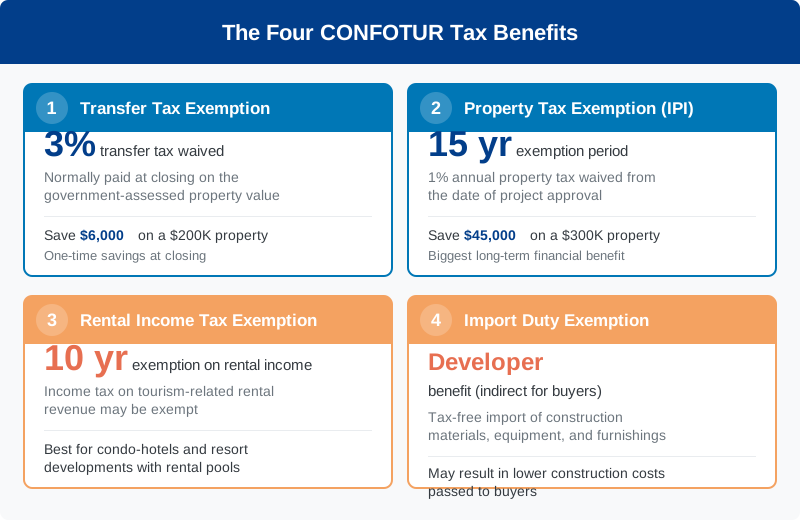
View text version of this infographic
The Four CONFOTUR Tax Benefits:
-
Transfer Tax Exemption - 3% transfer tax waived. Normally paid at closing on the government-assessed property value. Save $6,000 on a $200K property. One-time savings at closing.
-
Property Tax Exemption (IPI) - 15-year exemption period. 1% annual property tax waived from the date of project approval. Save $45,000 on a $300K property. Biggest long-term financial benefit.
-
Rental Income Tax Exemption - 10-year exemption on rental income. Income tax on tourism-related rental revenue may be exempt. Best for condo-hotels and resort developments with rental pools.
-
Import Duty Exemption - Developer benefit (indirect for buyers). Tax-free import of construction materials, equipment, and furnishings. May result in lower construction costs passed to buyers.
Transfer Tax Exemption (3%)
When you buy property in the Dominican Republic, a 3% transfer tax normally applies. This is paid at closing and based on the government-assessed value. CONFOTUR-approved properties are exempt from this tax entirely.
In real numbers: on a $200,000 condo, you save $6,000. On a $400,000 villa, you save $12,000. On an $800,000 luxury property in Cap Cana, you save $24,000. This is a one-time savings, but for many buyers it covers a large part of their closing costs.
Annual Property Tax Exemption (IPI) for Up to 15 Years
The Dominican Republic charges an annual property tax called the IPI (Impuesto sobre la Propiedad Inmobiliaria). For individual owners, it is 1% per year on the portion of property value above the exempt threshold, which is roughly RD$10,695,494 (about $170,000 USD) for 2026. This threshold adjusts annually for inflation. With CONFOTUR, you skip this tax entirely for up to 15 years from the date the project received its CONFOTUR resolution.
The savings add up fast, especially on higher-value properties. On a $300,000 property, the annual IPI savings would be roughly $1,300 per year for an individual owner (1% on the $130,000 above the threshold). Over 15 years, that is about $19,500 in property tax savings alone. On a $500,000 property, the annual savings reaches about $3,300 per year, or roughly $49,500 over 15 years. Properties held through a Dominican corporation (SRL) are taxed at 1% on the full value with no threshold exemption, so the savings are even larger. Add the transfer tax exemption, and a $500,000 CONFOTUR purchase could save you $65,000 or more compared to a non-CONFOTUR property at the same price. This is the benefit that makes the biggest long-term financial difference.
View text version of this infographic
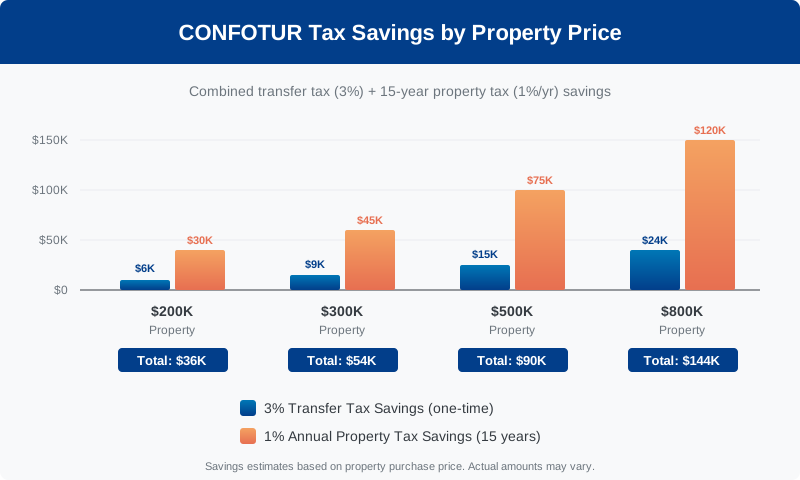
CONFOTUR Tax Savings by Property Price (combined transfer tax + 15-year property tax savings):
- $200K property: $6K transfer tax savings + $30K property tax savings = $36K total savings
- $300K property: $9K transfer tax savings + $45K property tax savings = $54K total savings
- $500K property: $15K transfer tax savings + $75K property tax savings = $90K total savings
- $800K property: $24K transfer tax savings + $120K property tax savings = $144K total savings
Savings estimates assume corporate (SRL) ownership where IPI applies to the full property value. For individual owners, IPI only applies to the portion above the ~$170,000 exempt threshold, so savings would be lower. Government-assessed values may differ from purchase price. Actual amounts may vary.
Income Tax Exemption on Rental Income (Up to 10 Years)
If you rent out your CONFOTUR-approved property as part of a tourism project, rental income may be exempt from income tax for up to 10 years from the completion of construction. This matters most for buyers in condo-hotels or resort developments with rental pools.
Import Duty Exemptions for Developers
Developers of CONFOTUR-approved projects get exemptions on the import of construction equipment, materials, and furnishings. This benefit goes to the developer, not directly to the buyer. But it often means lower construction costs. Some developers pass these savings along through discounted furniture packages or lower per-unit pricing.
Where CONFOTUR Applies: Approved Tourism Zones in the Dominican Republic
CONFOTUR does not apply to every property in the Dominican Republic. Projects need to go through an approval process, and they tend to cluster in areas the government has designated for tourism development.
These are the areas with the most CONFOTUR-approved properties:
Punta Cana, Bavaro, and Cap Cana have the largest number of CONFOTUR projects in the country. If you are looking at real estate in Punta Cana, the development likely carries CONFOTUR approval.
The Samana Peninsula, including Las Terrenas and Samana, is another major CONFOTUR zone. You will find a growing number of approved projects here, especially boutique condo and villa developments.
The North Coast covers Sosua, Cabarete, and Puerto Plata. Puerto Plata was added after the 2013 update, so newer developments there are increasingly CONFOTUR-approved.
Santo Domingo was also added after the 2013 update. CONFOTUR projects in the capital tend to be newer residential towers and mixed-use developments.
La Romana and Bayahibe, Jarabacoa and Constanza (mountain eco-tourism areas), and emerging areas like Miches and Pedernales also have CONFOTUR-approved projects, though in smaller numbers.
One critical point: not every project in these areas has CONFOTUR approval. Two condos on the same street could have different CONFOTUR status. It must be verified project by project.
Who Can Benefit from CONFOTUR? Foreigners, Residents, and Corporations
The Dominican Republic does not treat local and foreign buyers differently for CONFOTUR. There is no nationality or residency requirement. Whether you are a U.S. citizen, a Canadian snowbird, a European investor, or a Dominican national, you qualify for the same benefits.
You can purchase a CONFOTUR property under your personal name or through a Dominican corporation (known as an SRL, similar to an LLC). Both structures qualify for the same tax exemptions.
Talk to a Dominican real estate attorney about the choice between personal and corporate ownership before you buy, not after. If you are purchasing a single vacation home you plan to keep long-term, personal ownership is simpler. Less paperwork too. If you are buying multiple units, plan to rent them out, or might sell within the CONFOTUR period, a corporate structure may offer more flexibility. Your ownership structure affects what happens when you decide to resell.
The Resale Question: Are CONFOTUR Benefits Transferable?
This is where the information online gets contradictory. Here is what you need to know.
Most Dominican real estate attorneys agree that CONFOTUR benefits do not automatically transfer to a new buyer when you resell. Say you bought a CONFOTUR-approved condo in 2025 with a 15-year exemption. If you sold it in 2030, the new buyer would likely not get the remaining 10 years of tax benefits.
There is a widely discussed workaround, though. If you hold the property through a Dominican corporation (SRL) and sell the shares, the legal owner (the corporation) has not changed. Some attorneys argue this keeps the CONFOTUR benefits for the new shareholder. This approach is commonly mentioned but not universally agreed upon.
The honest answer: do not assume CONFOTUR benefits will transfer on resale. If you are buying for investment with plans to flip the property, factor the potential loss of benefits into your return projections. And in all cases, work with a Dominican real estate attorney who can advise on the current legal reading.
What CONFOTUR Does NOT Do: Common Misconceptions
Buyers sometimes arrive in the DR expecting CONFOTUR to be more than it is. Here is what it does not cover:
It does not grant residency or legal status. CONFOTUR is purely a tax incentive. If you want Dominican residency, that is a separate process handled through the immigration authority (Direccion General de Migracion).
It does not apply to every property in a tourism zone. The developer must go through a specific approval process for each project. A property being in Punta Cana does not automatically mean it has CONFOTUR status.
It does not mean the buyer applies for it. The developer obtains CONFOTUR approval at the project level before units are sold. By the time you are buying, the project either has it or it does not.
It does not apply to raw land purchases unless the land is part of a developer's CONFOTUR-approved master plan that includes a land-and-build package.
It does not eliminate all ownership costs. Legal fees, due diligence costs, notary fees, registration fees, and HOA or condo fees still apply. CONFOTUR exempts specific government taxes, not every cost of buying and owning property. Budget for legal help (typically 1-1.5% of the purchase price) and ongoing maintenance fees.
How to Verify CONFOTUR Approval Before You Buy
This is where many buyers skip steps and regret it later. A developer telling you "this project is CONFOTUR-approved" is not enough. Here is how to verify it yourself, or more precisely, how your attorney should verify it.
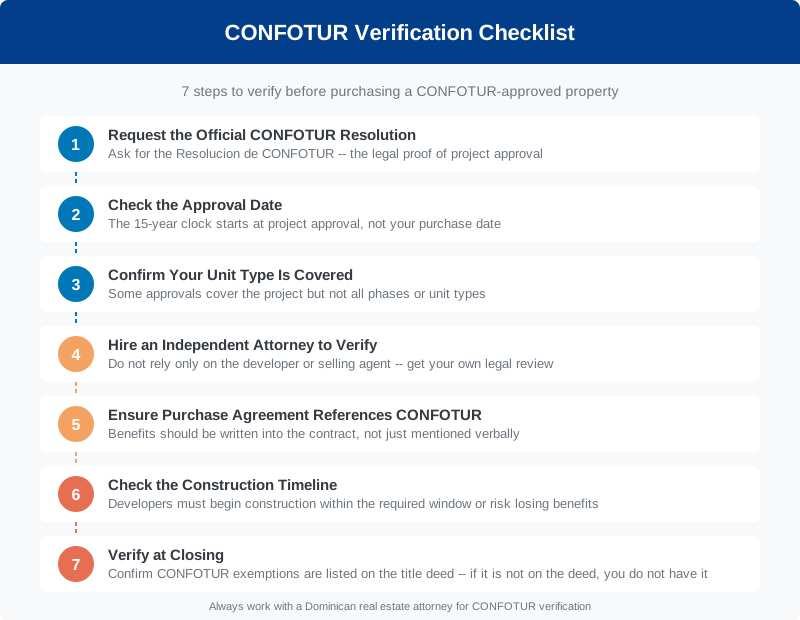
View text version of this infographic
7-Step CONFOTUR Verification Checklist:
- Request the Official CONFOTUR Resolution - Ask for the Resolucion de CONFOTUR, the legal proof of project approval.
- Check the Approval Date - The 15-year clock starts at project approval, not your purchase date.
- Confirm Your Unit Type Is Covered - Some approvals cover the project but not all phases or unit types.
- Hire an Independent Attorney to Verify - Do not rely only on the developer or selling agent. Get your own legal review.
- Ensure Purchase Agreement References CONFOTUR - Benefits should be written into the contract, not just mentioned verbally.
- Check the Construction Timeline - Developers must begin construction within the required window or risk losing benefits.
- Verify at Closing - Confirm CONFOTUR exemptions are listed on the title deed. If it is not on the deed, you do not have it.
Always work with a Dominican real estate attorney for CONFOTUR verification.
-
Ask for the official CONFOTUR Resolution. This is the legal document (Resolucion de CONFOTUR) that proves approval. Every approved project has one.
-
Check the approval date. The 15-year clock starts when the project gets approved, not when you close on your unit. If the project was approved in 2018, you get the remaining years, not a fresh 15.
-
Confirm your unit type is covered. Some approvals cover the overall project but may have details about which phases or unit types qualify. Make sure yours is included.
-
Have an independent attorney verify everything. Do not rely only on the developer or the selling agent. Hire your own Dominican real estate attorney to review the CONFOTUR paperwork.
-
Make sure the purchase agreement references CONFOTUR. The benefits should be written into your contract, not just mentioned in conversation.
-
Check the construction timeline. Developers must begin construction within a set window (typically 3 years) after getting approval, or they risk losing benefits. If a project was approved years ago but construction never started, ask questions.
-
Verify at closing. Confirm the CONFOTUR exemptions are correctly listed on your title deed during the closing process. This is the final safeguard. If it is not on the deed, you do not have it.
Skipping these steps can be costly. A buyer who purchases a "CONFOTUR-approved" unit without checking could find out at closing that the exemption expired or was never granted. At that point, you owe the full 3% transfer tax and get no exemption from annual property taxes.
If you are new to the buying process in the Dominican Republic, CONFOTUR checks should be part of your due diligence. That means title searches, property inspections, and legal review too.
What Happens After the 15-Year CONFOTUR Period Expires?
This question barely gets addressed online, but it matters if you plan to hold a property long-term.
When the CONFOTUR exemption period ends, the property enters the standard Dominican tax structure. You start paying the annual 1% IPI property tax (assuming your property value exceeds the threshold at that time). You do not owe back taxes for the exemption period. There is no penalty. You simply go from tax-exempt to standard tax status.
If you are buying a CONFOTUR property today and plan to hold it for 20+ years, factor in the eventual annual tax. For an individual owner of a property valued at $400,000, that would be roughly $2,300 per year starting after the exemption expires (1% on the amount above the ~$170,000 threshold). For corporate-held properties, expect about $4,000 per year on the full value.
Frequently Asked Questions
What is CONFOTUR in the Dominican Republic?
CONFOTUR (Consejo de Fomento Turistico) is a Dominican government tax incentive program created by Law 158-01. It gives buyers of approved tourism-related properties exemptions from the 3% transfer tax and the 1% annual property tax for up to 15 years.
What taxes does CONFOTUR exempt you from?
CONFOTUR exempts buyers from the 3% property transfer tax at closing and the 1% annual property tax (IPI) for up to 15 years. Developers also get import duty exemptions on construction materials. Rental income may be exempt from income tax for up to 10 years.
Can foreigners benefit from CONFOTUR in the Dominican Republic?
Yes. The Dominican Republic does not treat local and foreign buyers differently for CONFOTUR benefits. U.S. citizens, Canadians, Europeans, and all other foreign nationals qualify on the same terms as Dominican citizens. There is no residency requirement.
Does CONFOTUR apply to resale properties?
Generally, no. CONFOTUR benefits are tied to the original purchase of an approved property and do not automatically transfer when the property is resold. Some buyers use corporate ownership structures to work around this, but the approach is not universally guaranteed. Talk to a Dominican real estate attorney before relying on transferability.
How long do CONFOTUR tax benefits last?
Under the current framework (Law 195-13, passed in 2013), CONFOTUR property tax exemptions last up to 15 years from the date of project approval. The original Law 158-01 from 2001 provided 10 years. The 2013 update extended it.
Does buying a CONFOTUR property give you Dominican residency?
No. CONFOTUR is a tax incentive program, not a residency program. Buying property in the DR can support a residency application through immigration. But CONFOTUR itself does not grant any form of legal status.
Can you get CONFOTUR benefits on raw land?
Not on a standalone raw land purchase. CONFOTUR benefits apply to approved tourism development projects. If raw land is part of a developer's CONFOTUR-approved master plan with a land-and-build package, the finished property may qualify. But buying an empty lot on your own in a tourism zone does not come with CONFOTUR benefits.
What happens when CONFOTUR expires?
The property enters the standard Dominican Republic tax structure. You start paying the annual 1% property tax (IPI) if your property value exceeds the exemption threshold. You do not owe any back taxes for the years your property was exempt. There is no penalty or lump sum payment required.
Sources
- ICLG -- Understanding the CONFOTUR Law and its Benefits for Foreign and Non-Resident Real Estate Investors in the Dominican Republic
- Chambers and Partners -- Dominican Republic: An Introduction to Law
- Guzman Ariza -- Tourism Law in the Dominican Republic (Law 158-01 as modified by Law 195-13)
- PwC Tax Summaries -- Dominican Republic Corporate Tax Credits and Incentives
- Arthur & Castillo Lawyers -- Dominican Tourism Tax Incentives Law 158-01
- TheLatinvestor -- Property Taxes, Fees and Costs in the Dominican Republic (2026)
Автор:
David Logan
Автор статей для DRListings.com, делится информацией о недвижимости в Доминиканской Республике.
Связаться с авторомКомментарии
Войдите, чтобы присоединиться к обсуждению
Войти для комментирования