If you are weighing Mexico vs. the Dominican Republic, you are not alone. These are two of the most popular countries for Americans and Canadians looking to buy property, retire, or live abroad. Both have warm weather, lower costs than the U.S. or Canada, and active expat communities. But they differ in ways that matter a lot depending on what you are looking for.
The Dominican Republic is generally easier for foreign property buyers. Foreigners own property outright with a title deed in their name, while Mexico requires a fideicomiso bank trust for coastal properties. The DR also offers lower property prices, CONFOTUR tax exemptions, and a territorial tax system that does not tax foreign income.
This is not a vacation comparison. This guide breaks down the practical differences between Mexico and the Dominican Republic across the categories that matter most if you are thinking about buying property, retiring, or making a long-term move.
Property Ownership: Who Makes It Easier for Foreigners?
This is where the two countries are most different, and it is the first thing most buyers ask about.
In the Dominican Republic, foreigners have the same property rights as Dominican citizens. You buy a property, the title deed goes in your name, and you own it outright. There is no special structure required, no ongoing fees to maintain your ownership, and no restrictions based on location. The process follows a simple civil law system. If you want a deeper walkthrough, here is a guide to buying property in the Dominican Republic.
Mexico works differently. Under the Mexican constitution, foreigners cannot directly own property within 50 kilometers (about 31 miles) of the coastline or 100 kilometers of an international border. Since most expat-popular areas are on the coast, most foreign buyers need a fideicomiso. This is a bank trust where a Mexican bank holds the title on your behalf while you keep full rights to use, rent, sell, or pass down the property. It works, but it adds complexity. There are annual trust fees (typically $500-$1,000 per year), the trust needs to be renewed every 50 years, and you are depending on a bank to administer your ownership.
Mexico also has ejido land, which is communal agricultural land. Purchasing ejido land is risky because the title process is complicated and ownership disputes can drag on for years. This is not an issue in most resort or urban areas, but it is a trap that catches some uninformed buyers in rural Mexico.
For buyers who want a clean, direct ownership experience, the DR has a clear advantage here.
Mexico vs. Dominican Republic Cost of Living
Your monthly budget goes further in the Dominican Republic for most categories. Based on Numbeo comparison data, the DR is roughly 13-17% cheaper than Mexico overall, excluding rent. Here is how it breaks down:
Housing costs are where you see the biggest difference. Rent in the DR runs 16-36% lower than comparable areas in Mexico, depending on whether you are in a city center or outside of one. If you are buying instead of renting, property prices per square meter are 21-27% lower in the DR.
Groceries are about 19% cheaper in the DR. Meat, bread, and dairy cost less. Fresh produce is comparable.
Dining out is similar in both countries for mid-range restaurants. Budget meals and local spots tend to be slightly cheaper in the DR.
Utilities are the one category where the DR is more expensive, roughly 40% higher than Mexico. Electricity costs in the Dominican Republic are a known pain point. Many expats offset this with solar panels or by choosing properties with energy-efficient design.
In practice, a comfortable monthly budget for a couple looks like $1,500-$2,500 in the DR and $2,000-$3,000 in Mexico. Both are a fraction of what you would spend in most U.S. or Canadian cities.
Taxes and Financial Incentives
Tax differences are one of the most overlooked factors in the Mexico vs. Dominican Republic comparison, and they favor the DR heavily.
The DR uses a territorial tax system. Only income earned inside the Dominican Republic is taxed. Your U.S. pension, Social Security, and other foreign-source earned income are not subject to Dominican taxes. The top income tax rate on Dominican-sourced income is 25%.
Mexico taxes worldwide income for residents who spend 183 or more days in the country. If you are a U.S. citizen living in Mexico, you are dealing with tax obligations in both countries. Mexico's top income tax rate is 35%.
The DR also offers CONFOTUR tax benefits under Law 158-01. If you buy a qualifying property (and many new developments in tourism zones qualify), you get a full exemption from the 3% transfer tax at purchase and a 15-year property tax exemption. That is real money back in your pocket, especially on higher-value properties. You can browse CONFOTUR properties to see what is currently available.
Mexico does not have an equivalent broad-based tax incentive program for foreign property buyers.
Residency and Visas: Getting Legal
If you plan to live in either country long-term, the Dominican Republic has a much lower financial barrier.
The DR's pensionado visa requires $1,500 per month in pension income. The rentista visa requires $2,000 per month in passive income from any source. There is also an investor option that requires a $200,000 investment, which can be in property. All three categories can fast-track to permanent residency without going through a temporary residency phase first. Dominican citizenship is available after two years of permanent residency.
Mexico's temporary resident visa requires proof of roughly $4,300 per month in income, or around $70,000 in savings or investments. That is more than double the income bar that the DR sets. From temporary residency, you can apply for permanent residency after four years. Citizenship requires five years of residency.
For retirees on moderate fixed incomes, the DR's lower thresholds make it accessible to a much wider range of people.
Safety: What the Travel Advisories Actually Say
Both countries carry a U.S. State Department Level 2 advisory, which means "Exercise Increased Caution." That is the same level as France, the United Kingdom, and dozens of other countries that millions of people visit without issue.
The difference is in the details. Mexico has six states rated at Level 4, meaning "Do Not Travel," due to cartel-related violence. These are generally in areas far from the popular expat destinations, but it shows how much safety varies region by region in Mexico. Popular expat areas like Merida, Playa del Carmen, and Puerto Vallarta are generally safe, but the country as a whole has a wider range of risk.
The Dominican Republic has no Level 4 zones. The main safety concerns are petty theft in urban areas and the usual caution you would exercise in any developing country. Violent crime against foreigners is rare. The DR also has CESTUR, a dedicated tourist police unit that provides security in tourist and expat areas.
Both countries have gated communities and organized neighborhoods that provide an added layer of security. This is where most expat property buyers end up.
Healthcare
This is one area where Mexico has a clear edge. Mexico has a larger, more developed healthcare system with multiple JCI-accredited hospitals and a wider network of specialists. Mexico ranks 45th globally for healthcare quality according to the 2025 CEOWORLD Magazine Health Care Index, compared to 71st for the DR.
Mexico also offers IMSS, a public healthcare system that residents can join for a few hundred dollars per year. It is not perfect, but it provides a baseline of coverage that reduces your out-of-pocket exposure.
The Dominican Republic has good private hospitals in Santo Domingo, Punta Cana, Puerto Plata, and Santiago. Facilities like Hospiten, CEDIMAT, and HOMS provide quality care, and costs are a fraction of U.S. prices. But the network is smaller. If you need a highly specialized procedure, you may need to travel to Santo Domingo or leave the country.
In both countries, private health insurance is recommended for full coverage.
Lifestyle and Expat Community
Mexico has a much larger expat population. Roughly 1.5 million U.S. citizens live in Mexico, spread across dozens of communities from the Riviera Maya to San Miguel de Allende to Lake Chapala. If you want a big, diverse expat community with lots of social infrastructure (clubs, volunteer groups, English-language media), Mexico offers more of that.
The Dominican Republic has a smaller but close expat community. About 14,600 Americans and Canadians live in the country, concentrated in Cabarete, Sosua, Las Terrenas, Punta Cana, and Santo Domingo. The smaller size means you get to know people quickly, and the communities tend to be close.
Mexico also wins on geographic diversity. You can choose between beaches, mountains, colonial cities, and desert terrain. The DR is a Caribbean island with a consistent tropical climate year-round. If you want four seasons or a mountain lifestyle, Mexico has more options. If you want warm weather and beaches all the time, the DR delivers that reliably.
Both countries speak Spanish as the primary language. English is widely spoken in tourist and expat areas in both.
Dominican Republic vs. Mexico Property Investment
For investors focused on rental income, the Dominican Republic has a few structural advantages.
DR tourism hit over 11 million visitors in 2024 and continues to grow. Rental yields in tourism-heavy areas run 6-10% gross, and that number improves further if your property qualifies for CONFOTUR tax savings. The Dominican government has been actively encouraging foreign investment in the real estate sector, and direct ownership means less friction when buying, selling, or transferring property.
Mexico has a larger overall tourism market, but visitor traffic is spread across a much bigger country. The fideicomiso system adds cost and complexity that eats into returns. For condos for sale in the Dominican Republic or villas for sale in the Dominican Republic, the combination of lower purchase prices, tax incentives, and strong rental demand creates a solid investment case.
Side-by-Side Comparison
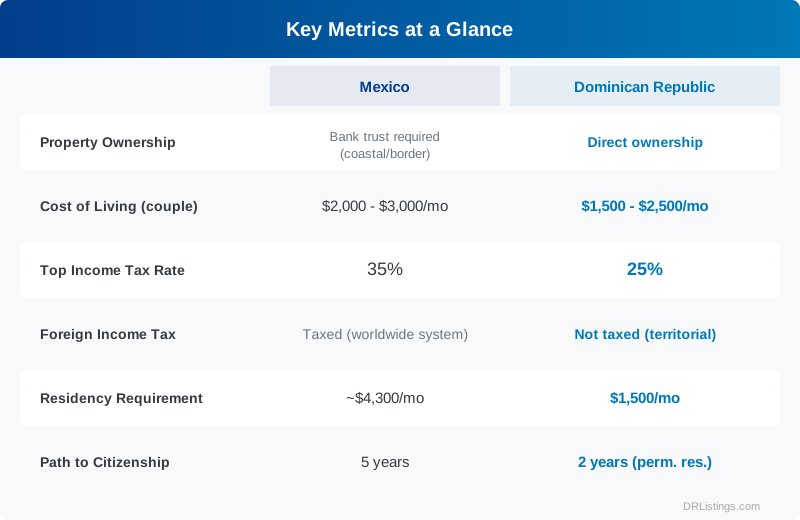
The following graphic summarizes the key differences between the Dominican Republic and Mexico across the categories that matter most for expats and property buyers.
View text version of this infographic
Key Metrics Comparison: Dominican Republic vs Mexico for Expats
Property Ownership: Mexico requires a bank trust (fideicomiso) for coastal/border areas. Dominican Republic offers direct ownership with same rights as citizens.
Cost of Living (couple): Mexico $2,000 - $3,000/month. Dominican Republic $1,500 - $2,500/month.
Top Income Tax Rate: Mexico 35%. Dominican Republic 25%.
Foreign Income Tax: Mexico taxes worldwide income. Dominican Republic does not tax foreign income (territorial system).
Residency Requirement: Mexico ~$4,300/month. Dominican Republic $1,500/month (pensionado).
Path to Citizenship: Mexico 5 years. Dominican Republic 2 years of permanent residency.
Category | Dominican Republic | Mexico |
|---|---|---|
Property ownership | Direct ownership, same rights as citizens | Fideicomiso (bank trust) required for coastal/border areas |
Cost of living | 13-17% cheaper than Mexico overall | Higher, especially for rent and groceries |
Tax system | Territorial (foreign income not taxed) | Worldwide income taxed for residents (183+ days) |
Top income tax rate | 25% | 35% |
Property tax incentives | CONFOTUR: 15-year property tax exemption | No equivalent program |
Residency income requirement | $1,500/month (pensionado) | ~$4,300/month (temporary resident) |
Path to citizenship | 2 years of permanent residency | 5 years of residency |
Safety (State Dept.) | Level 2, no Level 4 zones | Level 2, six Level 4 states |
Healthcare ranking | 71st globally | 45th globally |
Expat population | ~14,600 Americans/Canadians | ~1.5 million U.S. citizens |
Rental yields | 6-10% gross | Varies widely by region |
Climate | Tropical year-round | Varies by region (tropical to desert to mountain) |
Which Country Is Right for You?
There is no single right answer here. It depends on your priorities.
The Dominican Republic makes more sense if you want direct property ownership without a bank trust, lower income requirements for residency, a territorial tax system that leaves your foreign income alone, CONFOTUR tax savings on qualifying properties, and lower overall cost of living. The DR is also the better fit if you are primarily focused on a Caribbean beach lifestyle.
Mexico makes more sense if you want a larger expat community, better healthcare infrastructure, more geographic diversity (mountains, colonial towns, desert, and beaches), or if you already have ties to the country. Mexico's higher residency income threshold may not be an issue if your budget is larger.
Many expats research both countries and end up choosing based on one or two factors that matter most to them. Property ownership simplicity and tax structure tend to tip the scales toward the DR, while healthcare quality and community size tend to favor Mexico.
Frequently Asked Questions
Can foreigners buy property in the Dominican Republic?
Yes. Foreigners have the same property ownership rights as Dominican citizens. You buy a property, the title goes in your name, and you own it directly. There are no restrictions based on location or nationality, and no bank trust or special structure is required.
Is it cheaper to live in Mexico or the Dominican Republic?
The Dominican Republic is roughly 13-17% cheaper than Mexico overall. Rent is 16-36% lower, groceries are about 19% cheaper, and property prices per square meter are 21-27% lower. The main exception is utilities: electricity in the DR costs about 40% more than in Mexico.
Is the Dominican Republic safer than Mexico?
Both countries have the same U.S. State Department Level 2 rating. The main difference is that Mexico has six states rated Level 4 ("Do Not Travel") due to cartel violence, while the DR has none. Popular expat areas in both countries are generally safe, but Mexico has a wider range of regional risk.
What is a fideicomiso in Mexico?
A fideicomiso is a bank trust required for foreigners purchasing property within 50 kilometers of Mexico's coastline or 100 kilometers of its borders. A Mexican bank holds the title on your behalf while you retain full rights to use, rent, sell, or inherit the property. Annual fees run $500-$1,000, and the trust must be renewed every 50 years.
Do you pay taxes on foreign income in the Dominican Republic?
The Dominican Republic uses a territorial tax system, meaning only income earned inside the DR is taxed. Foreign pensions, Social Security, and other earned income from outside the country are not subject to Dominican taxes. Note that foreign financial investment income (dividends, interest) may be taxed for residents after three years.
How much money do you need to retire in the Dominican Republic vs. Mexico?
The DR's pensionado visa requires $1,500 per month in pension income. Mexico's temporary resident visa requires roughly $4,300 per month in income or around $70,000 in savings. Monthly living costs run $1,500-$2,500 for a couple in the DR and $2,000-$3,000 in Mexico.
Which country has better healthcare for expats, Mexico or the Dominican Republic?
Mexico has a larger and more developed healthcare system, ranked 45th globally compared to the DR at 71st. Mexico also has more JCI-accredited hospitals and offers IMSS public healthcare at low annual cost. The DR has good private hospitals in major cities, but the network is smaller.
Is it easier to get residency in the Dominican Republic or Mexico?
The Dominican Republic has much lower income requirements. The DR pensionado visa needs $1,500/month versus Mexico's ~$4,300/month. The DR also offers a faster path to citizenship (two years of permanent residency vs. five years in Mexico) and allows investors, pensionados, and rentistas to fast-track to permanent residency.
Scritto da
David Logan
Scrittore collaboratore per DRListings.com, condividendo approfondimenti sugli immobili nella Repubblica Dominicana.
Contatta l'autoreCommenti
Accedi per unirti alla conversazione
Accedi per commentare