How to Buy Property in the Dominican Republic as a Foreigner
Yes, foreigners can buy property in the Dominican Republic with the same legal rights as Dominican citizens. You don't need residency, citizenship, or any special permits. You can sign a purchase contract while visiting on a tourist visa, and the title goes directly in your name.
That's the good news. The process itself is straightforward, but "straightforward" doesn't mean "impossible to mess up." Foreigners who run into trouble usually skip steps that seemed optional at the time. They don't hire their own lawyer, don't verify the title, or don't complete the official registration. This guide walks through the full buying process, including what it actually costs, how financing works, and the mistakes that catch people off guard.
What You Can Buy (and a Few Things You Can't)
Foreigners can purchase condos, houses, villas, land, and commercial properties in the DR. You can hold the property in your personal name or through a Dominican company (SRL). There's no limit on how many properties you can own.
A few restrictions apply to everyone, including Dominican citizens. The first 60 meters from the high-tide line along any coast is public land. Nobody can own it. If you see a "beachfront" property listing, make sure the lot actually starts beyond that 60-meter zone. Land within 60 kilometers of the Haitian border requires special government approval before purchase. National parks and protected areas are off-limits entirely.
Personal name vs. company: Most individual buyers purchase in their personal name. Setting up a Dominican SRL costs $2,000 to $5,000 and adds ongoing paperwork. It can offer liability protection and some tax advantages, but for a single vacation property or rental condo, it's usually not worth the cost. Talk to a local attorney about your specific situation before deciding.
Pre-construction properties: Many developments in Punta Cana, Las Terrenas, and Samaná sell units before they're built, often with payment plans spread over the construction period. This can be a good deal. However, verify that the developer holds a registered title to the land and that the project has proper permits. Ask your attorney to review the developer's legal standing before you put money down.
The Buying Process, Step by Step
The typical timeline from making an offer to receiving your Certificate of Title is 30 to 60 days. Here's what happens at each stage.

View text version of this infographic
Step 1: Find Property and Agent (choose a local, region-specific agent). Step 2: Make an Offer (usually verbal or simple written format). Step 3: Sign Promise of Sale (10% deposit, legally binding). Step 4 (Critical): Hire YOUR Attorney (1-1.5% fee, independent from seller). Step 5: Due Diligence (title check, no-debt certificate, deslinde survey). Step 6: Final Sales Contract (signed before notary, full payment). Step 7: Pay Transfer Tax (3% to DGII). Step 8: Register the Title (at Registro de Títulos, takes weeks). Done: Certificate of Title issued, you are the legal owner. Warning: Without official registration, you do not legally own the property. Typical costs: 3% transfer tax + 1-1.5% legal fees + ~0.5% notary = 4.5-5.5% total closing costs. On a $200,000 property, that's roughly $9,200-$10,500.
Find a Property and Choose an Agent
Work with a local real estate agent who knows the specific area you're interested in. Unlike the US, the Dominican Republic doesn't have a universal MLS system, so agents tend to specialize by region. A good agent speaks your language, knows which properties have clear titles, and won't pressure you toward one development over another.
Make an Offer
Offers are usually verbal or in a simple written format. There's no standard offer form like you'd see in the US or Canada. Once the seller accepts, you move to a formal agreement.
Sign the Promise of Sale (Contrato de Promesa de Venta)
This is the binding purchase agreement. It spells out the price, payment schedule, conditions, and timeline. You'll typically put down a 10% deposit at this stage. This contract is legally enforceable. If you back out without cause, you can lose your deposit. Have your attorney review it before you sign.
Hire a Real Estate Attorney
This is not optional. In the DR, there are no title companies like in the United States. Your attorney handles the work that a title company would: verifying ownership, checking for liens, and making sure the property can legally transfer to you.
Hire your own attorney, not the seller's, not the developer's, not the agent's. Attorney fees typically run 1% to 1.5% of the purchase price.
Due Diligence
Your attorney will handle several checks.
Title verification at the Registro de Títulos (Title Registry) confirms the seller is the legal owner and the property boundaries match what's being sold.
No-debt certificate (Certificación de Cargas y Gravámenes) confirms the property has no outstanding mortgages, liens, or legal claims against it.
Deslinde (land survey) establishes the exact boundaries of the property. This step matters most for land purchases and rural or beachfront properties where boundary disputes are more common. If the property doesn't have a completed deslinde, your attorney may need to arrange one. That adds time and cost.
If any of these checks come back with problems (unclear title history, unresolved liens, boundary disputes), your attorney should flag them before you proceed. This is exactly why you need independent legal representation.
Sign the Final Sales Contract (Contrato de Venta)
Once due diligence clears, you sign the final contract in front of a Dominican notary public. The remaining balance is paid at this point, usually by wire transfer to the seller's Dominican bank account.
Pay the Transfer Tax
The buyer pays a 3% transfer tax to the DGII (Dirección General de Impuestos Internos, the Dominican tax authority). The tax is calculated on either the sale price in the contract or the government's assessed value, whichever is higher. So if you negotiate a below-market price, you may still owe tax based on the government's appraisal.
Register the Title
Your attorney submits the signed contract and proof of tax payment to the Registro de Títulos. The registry processes the transfer and issues a new Certificate of Title in your name. This step makes your ownership legally enforceable. Without it, you don't officially own the property, no matter what other documents you have.
This registration process typically takes a few weeks after the contract is signed.
Costs and Taxes: What You'll Actually Pay
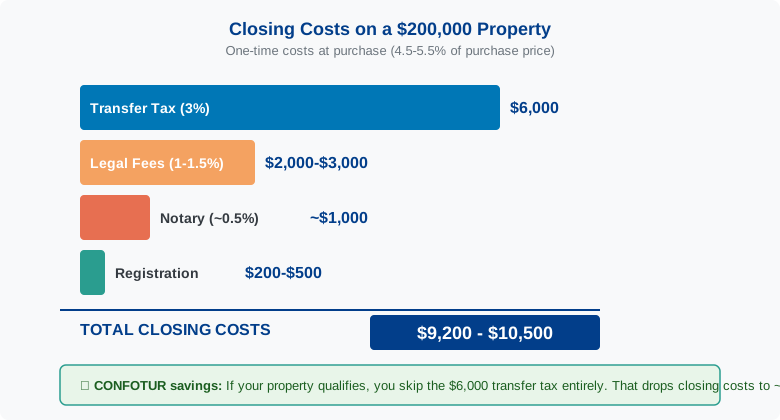
Most guides mention the 3% transfer tax and stop there. Here's a more complete picture, using a $200,000 condo as an example.
View text version of this infographic
Closing costs on a $200,000 property: Transfer Tax (3%) = $6,000. Legal Fees (1-1.5%) = $2,000-$3,000. Notary (~0.5%) = ~$1,000. Registration = $200-$500. Total closing costs: $9,200-$10,500 (4.5-5.5% of purchase price). CONFOTUR savings: If your property qualifies, you skip the $6,000 transfer tax entirely, dropping closing costs to ~$3,200-$4,500.
One-time closing costs:
Transfer tax (3%): $6,000
Attorney fees (1-1.5%): $2,000-$3,000
Notary fees (~0.5%): ~$1,000
Registration and administrative fees: $200-$500
Total closing costs: roughly $9,200-$10,500, or about 4.5% to 5.5% of the purchase price
Ongoing costs:
Annual property tax (IPI): 1% of the property value above roughly RD$10.19 million (about $166,000 USD). On a $200,000 property, you'd pay 1% of the amount above the threshold, or roughly $340 per year. Properties valued under the threshold owe nothing.
HOA / condo fees: In resort communities and gated developments, these can range from $100 to $500+ per month. Don't overlook this. In some Punta Cana developments, monthly HOA fees cost more than the annual property tax.
Rental income tax: 27% on net rental income for non-residents, or 15% if you're a Dominican tax resident. Deductions for expenses are available.
CONFOTUR: The Tax Break Most Buyers Don't Fully Understand
CONFOTUR (Law 158-01) is a tourism development incentive that can save you thousands of dollars. Properties in designated tourism zones that are approved under CONFOTUR get exemptions from the transfer tax, annual property tax (IPI), and income tax on rental earnings. These exemptions can last up to 15 years.
On that same $200,000 condo, CONFOTUR could save you the $6,000 transfer tax at purchase, plus around $340 per year in property tax. Over 15 years, that adds up to more than $11,000 in savings.
The catch: not every property in a tourist area qualifies. The development itself must be registered and approved under CONFOTUR. Ask the developer for proof of CONFOTUR certification before you factor these savings into your budget. Also note that CONFOTUR benefits apply to the first owner. If you buy a resale property, the exemption may not transfer.
Many new developments in Punta Cana, Cap Cana, Las Terrenas, and Samaná carry CONFOTUR approval. Older resale properties generally don't.
Financing: How Most Foreigners Pay
Most foreign buyers pay cash. There's a practical reason: Dominican mortgage rates for foreigners run between 8% and 13%, with down payments of 20% to 40%. That's expensive compared to what Americans and Canadians are used to. The approval process takes 4 to 8 weeks and requires a lot of paperwork, including proof of income, bank references, credit history, and sometimes a translated and apostilled tax return.
Banks that work with foreign buyers include Banreservas, Banco Popular, BHD León, and Scotia Bank. Getting pre-approved before you start shopping is a good idea if you plan to go this route.
Developer financing is more common for pre-construction purchases. Developers typically ask for 30% to 50% down with the balance paid over 2 to 5 years. Interest rates may be higher than bank loans, but the approval process is faster and simpler.
Seller financing occasionally comes up in private sales. If you go this route, make sure the terms are written into a legally binding contract and registered properly.
Some buyers take out a home equity loan or line of credit from their US or Canadian bank to fund the purchase in cash. This effectively gives them North American interest rates while buying in the DR.
Wire transfers: You'll need to move money internationally. Use a reputable bank or transfer service, keep detailed records of every transaction, and make sure the funds are traceable. This matters for both legal compliance and your own protection if any dispute arises later.
Where to Buy: Popular Areas for Foreign Buyers
The Dominican Republic isn't one market. It's several, each with a different character and price point.
Punta Cana, Bávaro, and Cap Cana have the strongest rental market and the highest concentration of foreign buyers. If short-term vacation rentals are your goal, this is the most proven market. Condos for sale in Punta Cana range from around $100,000 for a studio to $400,000+ for beachfront units in Cap Cana.
Las Terrenas on the Samaná Peninsula has a large European expat community and a more relaxed, village-like feel. It's popular with buyers looking for lifestyle over pure investment returns. Browse properties in Las Terrenas to see what's available.
Cabarete and Sosúa on the north coast are known for water sports, a social expat scene, and more affordable entry points than Punta Cana. You can find properties in Cabarete starting around $120,000, and villas in Sosúa with ocean views for under $300,000.
Santo Domingo is the capital and economic center. It's a real city with urban apartments, commercial opportunities, and strong long-term rental demand from professionals. Apartments in Santo Domingo offer a different kind of investment than beach towns.
Puerto Plata and Samaná are quieter options with lower price points and growing infrastructure. Good for buyers who want more space, more nature, and fewer crowds.
Common Mistakes and How to Avoid Them
Not completing the title registration. This is the single most dangerous mistake. Some buyers sign the contract, pay the seller, get the keys, and never register the transfer at the Registro de Títulos. Without registration, you are not the legal owner. The seller (or the seller's creditors) can still claim the property. Always complete the registration.
Relying on the seller's attorney. The seller's lawyer works for the seller. You need your own independent attorney to verify documents and protect your interests. This is worth every dollar of the 1-1.5% fee.
Buying unregistered land. Some properties in the DR, particularly rural land, don't have a registered title. These are sometimes called "terrenos comuneros" (communal lands). Buying unregistered land is risky because you can't get a clear title, and boundary disputes are common. If the property doesn't have a Certificate of Title, proceed with extreme caution or walk away.
Ignoring HOA rules. In resort developments, the homeowners association bylaws may restrict short-term rentals, renovations, or property use in ways you didn't expect. Read the bylaws before you buy, especially if your plan depends on Airbnb income.
Skipping the deslinde. Without a proper land survey, you may not know exactly what you're buying. You might discover later that the boundaries overlap with a neighbor's property. This matters most for land and beachfront purchases.
Wiring money without a paper trail. Always send funds through a traceable bank transfer. Keep copies of everything. If a dispute arises months or years later, you'll need to prove what you paid and when.
Frequently Asked Questions
Can foreigners buy property in the Dominican Republic?
Yes. Foreigners have the same property ownership rights as Dominican citizens under Foreign Investment Law 16-95. You can buy condos, houses, villas, land, and commercial property in your own name without residency, citizenship, or special permits.
Do I need residency to buy property in the DR?
No. You can buy property on a tourist visa. That said, purchasing property worth $200,000 or more can support an application for investor residency if you decide you want it.
How much are closing costs in the Dominican Republic?
Plan for roughly 4.5% to 5.5% of the purchase price. The biggest item is the 3% transfer tax, plus 1-1.5% in legal fees and additional notary and registration costs.
Is it safe to buy property in the Dominican Republic?
Yes, if you follow the process correctly. Hire your own attorney, verify the title at the Registro de Títulos, get a no-debt certificate, and register the transfer in your name. Problems come from cutting corners, not from the legal system itself.
Can I get a mortgage as a foreigner?
You can, but it's uncommon. Dominican banks offer mortgages to foreigners with 20-40% down payments at 8-13% interest. Most foreign buyers pay cash or use developer financing for pre-construction properties.
What is CONFOTUR and how does it save me money?
CONFOTUR (Law 158-01) is a tourism incentive program. It exempts qualifying properties from the 3% transfer tax, annual property tax, and rental income tax for up to 15 years. Many new developments in Punta Cana, Las Terrenas, and Samaná qualify. Ask the developer for proof of CONFOTUR certification before you buy.
Sources
Scritto da
David Logan
Scrittore collaboratore per DRListings.com, condividendo approfondimenti sugli immobili nella Repubblica Dominicana.
Contatta l'autoreCommenti
Accedi per unirti alla conversazione
Accedi per commentare