The buying property in Dominican Republic process looks very different from a closing in the United States or Canada. There is no MLS-driven escrow company holding everyone's hand. Title insurance is not built into every transaction. There is no county recorder's office where transfer happens the same afternoon. Instead, you work inside a Torrens-style land registry governed by Property Registration Law 108-05. Until the Registro Inmobiliario issues a new Certificate of Title in your name, you do not legally own the property. It does not matter how many papers you have signed.
This guide walks through the Dominican Republic property closing process from accepted offer through final title registration. It covers timelines, costs, and the pitfalls foreign buyers actually hit. Most purchases by Americans and Canadians are cash deals, so the process is not mortgage-driven the way a U.S. closing is. It is a notary-and-registry process, and the order in which things happen really matters.
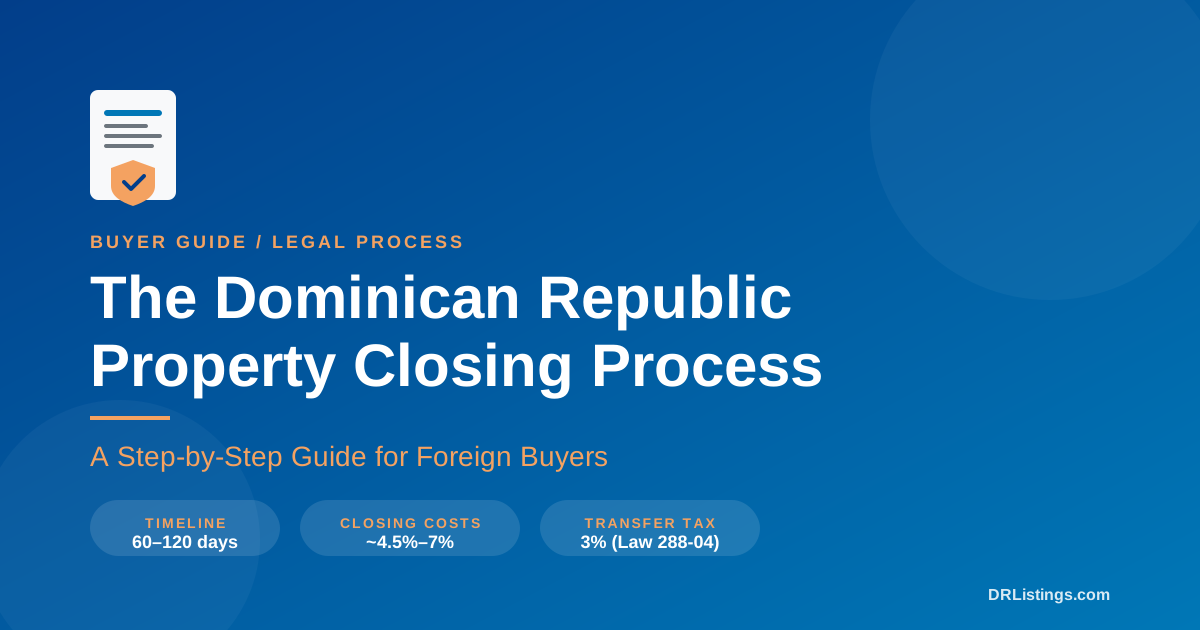
The path looks roughly like this. You sign a Promise of Sale and put 10% in escrow. Your attorney runs due diligence. You sign the final Contrato de Venta in front of a Dominican notary. You pay the 3% transfer tax to DGII. Your file goes to the Registro de Títulos. A few weeks later your new Certificate of Title comes back. End to end, plan on 60 to 120 days.
For broader context on the foreign-buyer journey, our guide to buying property in the Dominican Republic covers lifestyle, financing, and area selection. This post focuses on the closing mechanics.
Before You Get to the Closing Table — Pre-Closing Foundations
A clean closing depends on what you do in the first two weeks. Three things should already be in motion before you sign anything binding.
Hiring an Independent Attorney
You need your own attorney. Not the seller's lawyer. Not the developer's in-house counsel. Not the lawyer your real estate agent recommends without options. In the Dominican Republic, attorneys often double as notaries, agents, and even title-search runners. A lawyer wearing too many hats in a single transaction is the most common reason foreign buyers get burned.
Expect to pay 1.0% to 1.5% of the purchase price in legal fees, plus the 18% ITBIS sales tax on professional services. On a $300,000 villa, that is $3,540 to $5,310 in legal fees including ITBIS. Cheap quotes (under 1%) usually mean the lawyer is collecting a referral kickback from the seller side. Pay the full rate and get an attorney whose only client is you.
The Promise of Sale (Promesa de Venta)
The first binding document in a Dominican closing is the Promesa de Venta, sometimes called the Contrato de Promesa. This is a promise-to-sell contract, not the final deed. It locks in the price, the property description, the closing date, the deposit terms, and the conditions that must be satisfied before the final contract is signed.
The standard earnest money deposit is 10% of the purchase price, held in escrow. The promesa should include a due-diligence period (usually 30 to 45 days) during which your deposit is refundable if the title search turns up problems. If it does not, do not sign it. The final document — the Contrato de Venta — is what actually transfers ownership and gets registered.
Setting Up Real Escrow
This is where buyers get into trouble. The Dominican Republic does not have nationwide escrow regulation the way most U.S. states do. "Escrow" can mean three different things, and only two of them are safe:
- Attorney trust account. Your independent attorney holds the deposit in a segregated client trust account. This works only if your attorney is genuinely independent and reputable.
- U.S.-based escrow company. Stewart Title and First American both operate in the Dominican Republic and offer cross-border escrow. This is the gold standard for foreign buyers. Funds sit in a U.S. account governed by U.S. law until closing conditions are met.
- Developer escrow. Common in pre-construction. Acceptable only if the developer uses a fideicomiso (a regulated trust structure) with a third-party trustee. A "developer escrow account" with no trustee is just the developer holding your money, which is not escrow at all.
If you are remote and someone asks you to wire 10% directly to a seller's personal account "for now," walk away.
Power of Attorney for Remote Closings
Many foreign buyers cannot fly in to sign the final contract. The fix is a Poder Especial (Special Power of Attorney) authorizing your Dominican attorney to sign on your behalf. The POA must be drafted in Spanish. It must specifically describe the property and the transaction. And it must be apostilled by the Secretary of State in your home jurisdiction (the Dominican Republic is a Hague Apostille Convention signatory). For U.S. buyers, the apostille comes from the state where the document is notarized. For Canadian buyers, it comes from Global Affairs Canada or the relevant provincial authority. Plan two to three weeks for the POA round trip. Start it the day you sign the promesa.
Due Diligence — What Your Lawyer Is Actually Checking
The 30 to 45 days between the Promise of Sale and the final contract are due-diligence days. This is where a good attorney earns the entire fee.
A complete title search at the Registro de Títulos pulls the current Certificate of Title and the chain of ownership behind it. Your lawyer is looking for the seller's clean title, plus any anotaciones — the Dominican term for liens, mortgages, easements, or pending lawsuits attached to the property. A property can look perfect online and have a six-figure mortgage or an embargo (judicial freeze) attached at the registry.
Beyond title, your attorney should be pulling:
- An IPI tax-paid certificate from DGII confirming the seller has no back property taxes owed. IPI is the annual 1% property tax on registered values above the inflation-indexed threshold (RD$10,695,494 for 2026, roughly $182,000 USD). Unpaid IPI follows the property, not the seller.
- An HOA or condo dues paid certificate, if applicable. Like IPI, unpaid dues attach to the unit.
- The deslinde status of the parcel. Deslinde is the cadastral demarcation process — the legal definition of where the property's boundaries actually are. A property with definitive title (titulo definitivo) has been through deslinde and has an unambiguous registered footprint. A property with provisional title (often called "carta constancia" land) has not. Provisional titles are sellable but riskier. Boundary disputes, double-titling, and undivided-interest fights are far more common. If the property is provisional, your lawyer needs to explain exactly what risk you are taking on, and the price should reflect it.
- A survey reconciling the registered area with the physical area. Mismatches between what is on paper and what is on the ground are common.
- Seller identity and civil status. The Dominican Republic uses community-property rules for married couples by default. If the seller is married, both spouses usually have to sign — even if only one is on the title. Skipping this is how sales get unwound years later.
- Construction permits and as-built verification for new construction. Unpermitted additions can create real problems at registration.
- Utilities-paid certifications from the relevant water authority (CAASD in Santo Domingo, CORAASAN in Santiago) and electric utility (EdeEste, EdeNorte, or EdeSur depending on region). Unpaid utility balances attach to the meter, which means to you after closing.
If any of these come back dirty, the deal either gets re-priced, the seller fixes the issue before closing, or you walk and get your deposit back. This is the entire reason the promesa exists.
Funding the Closing — How Money Actually Moves in the Buying Property in Dominican Republic Process
Most foreign buyers wire funds from a U.S. or Canadian bank to either escrow or the seller. A few mechanics matter.
International wires use SWIFT and almost always pass through one or two intermediary banks. Each one can take a fee. Budget $30 to $75 in wire fees per leg. Wires to Dominican banks can take one to three business days. Wires to U.S. escrow companies clear same day or next day.
U.S. buyers should know that opening a Dominican bank account triggers FBAR filing (FinCEN Form 114) once aggregate foreign account balances cross $10,000 in a calendar year. FATCA reporting (Form 8938) kicks in at higher thresholds. You do not need a Dominican account to close — most buyers fund through escrow without one. But if you open one for utilities or HOA payments later, your CPA needs to know.
Closings can be denominated in U.S. dollars or Dominican pesos (DOP). USD denomination is standard for foreign-buyer transactions on the North Coast and in Punta Cana, which protects you from peso exchange-rate movement. DOP-denominated contracts shift exchange-rate risk to you between signing and funding. Pay attention to this if your closing date floats.
The Dominican Republic's anti-money-laundering regime (Law 155-17) requires source-of-funds documentation for real estate transactions above defined thresholds. Be ready to provide bank statements, sale-of-prior-property documents, or other paper trails showing where the closing funds came from. This is not optional and slows down closings when buyers are unprepared.
The 3% transfer tax under Law 288-04 is paid to DGII before title can transfer. The taxable base is the higher of your contract price or the DGII appraisal of the property. DGII appraisals are independent valuations. They can take two to six weeks to produce depending on the queue. They frequently come in below contract price for resale properties, which is helpful — the lower the appraised value, the lower the tax. Your attorney requests the appraisal as part of the closing package.
If you plan to finance, how mortgages work for foreigners in the DR covers the loan side. Expect extra time and rate premiums versus paying cash.
The Closing Itself — Signing Day Mechanics
Closing day in the Dominican Republic centers on the notary. Dominican notarios públicos are not the document-stamping clerks Americans know. They are licensed attorneys with state authority who draft, witness, and authenticate the final deed. The notary's signature gives the contract its public-instrument status, which is what allows it to be filed at the Registro de Títulos.
On signing day, the parties (or their attorneys-in-fact under POA) sign the Contrato de Venta — the final deed of sale. Buyer and seller present passports (and Dominican cédulas if they have them). Spouses sign where required. The notary reads the contract aloud in Spanish. The parties acknowledge it. The notary's protocol is signed. The buyer also signs the transfer-tax declaration forms that your attorney will file with DGII.
Funds release happens at the same table. Escrow releases the purchase price to the seller. Your attorney's fees and notary fees come out of your funds. The seller's agent commission (which by Dominican custom is paid by the seller) is disbursed from the seller's side. Keys change hands.
Here is the most counterintuitive thing about Dominican closings. When you walk out of that meeting, you do not own the property yet. You have a signed deed, an executed transfer-tax form, and possession of the keys. But legal ownership transfers only when the Registro de Títulos issues a new Certificate of Title in your name. That is still weeks away.
After Signing — Title Transfer at the Registro Inmobiliario
Within days of signing, your attorney files the closing package with the Registro de Títulos in the province where the property sits. The package includes the original Contrato de Venta, the transfer-tax payment receipt, the seller's prior Certificate of Title, the survey, the IPI clearance, and the rest of the diligence file.
Processing time varies by jurisdiction. In high-volume regions like the East Coast — particularly Higüey, which serves Punta Cana real estate — backlogs can push processing to eight to twelve weeks. The North Coast jurisdictions covering Sosua real estate and Cabarete real estate typically run four to eight weeks. Smaller provincial registries can be faster. December and January are slower across the board because of the holiday period.
When the registry finishes, it issues a new Certificate of Title in your name. This is the moment ownership legally transfers. Your attorney picks the title up and either delivers it to you or stores it in a fireproof safe pending your instructions. Take a digital scan and store the original carefully. You will need it for any future sale, for IPI registration, and for residency applications.
The final post-closing step is registering the property with DGII for IPI. If the registered value puts you above the threshold (RD$10,695,494 in 2026) , you will owe 1% annually on the value above the threshold. Most foreign buyers' homes fall above the line. Set a reminder. IPI is paid in two installments per year, and missing them creates a lien that resurfaces when you eventually sell.
Closing Costs Breakdown — All-In Numbers
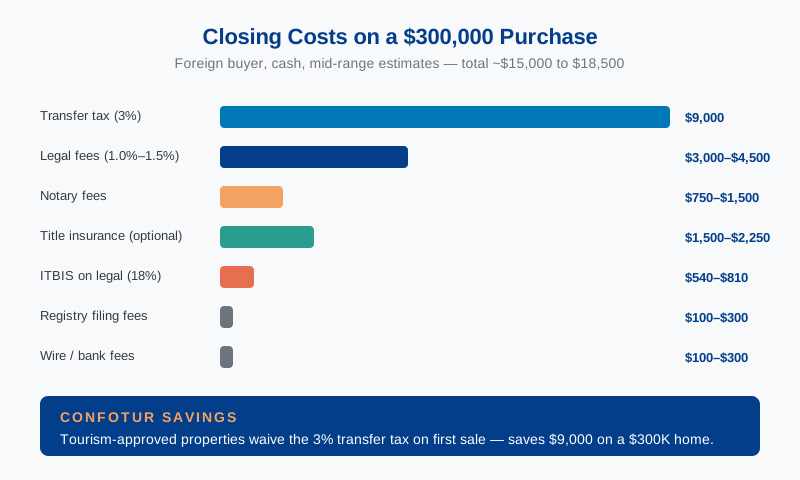
Here is what closing actually costs on a typical $300,000 cash purchase by a foreign buyer:
View text version of this infographic
Closing Costs on a $300,000 Purchase (foreign buyer, cash, mid-range estimates — total ~$15,000 to $18,500):
- Transfer tax (3% of DGII appraised value): $9,000
- Legal fees (1.0%–1.5%): $3,000–$4,500
- Notary fees (~0.25%–0.5%, sometimes bundled with legal): $750–$1,500
- Title insurance (optional, recommended; via Stewart Title or First American): $1,500–$2,250
- ITBIS on legal fees (18%): $540–$810
- Registry filing fees: $100–$300
- Wire and bank fees: $100–$300
CONFOTUR savings: Tourism-approved properties waive the 3% transfer tax on first sale — saves $9,000 on a $300K home.
| Cost | Rate | Approximate USD | |------|------|------------------| | Transfer tax (Law 288-04) | 3% of DGII appraised value | $9,000 | | Legal fees | 1.0%–1.5% | $3,000–$4,500 | | ITBIS on legal fees | 18% on the legal fee | $540–$810 | | Notary fees | ~0.25%–0.5% (sometimes bundled with legal) | $750–$1,500 | | Registry filing fees | Small fixed amounts | $100–$300 | | Title insurance (optional, recommended) | 0.5%–0.75% via Stewart Title or First American | $1,500–$2,250 | | Wire and bank fees | Per transaction | $100–$300 | | Total | ~4.5%–7% | ~$15,000–$18,500 |
Title insurance is optional but recommended for foreign buyers. It costs less than 1% of purchase price and protects against undiscovered title defects. That is the type of risk a foreign buyer is least equipped to assess.
The single biggest cost saver is CONFOTUR. Properties under approved tourism-development projects qualify for a transfer-tax waiver on the first sale, which removes the 3% line item entirely. On a $300,000 home, that is $9,000 back in your pocket. Our post on CONFOTUR tax benefits explains how the program works, and you can browse CONFOTUR-approved properties directly.
Timeline — What "30 to 90 Days" Really Means
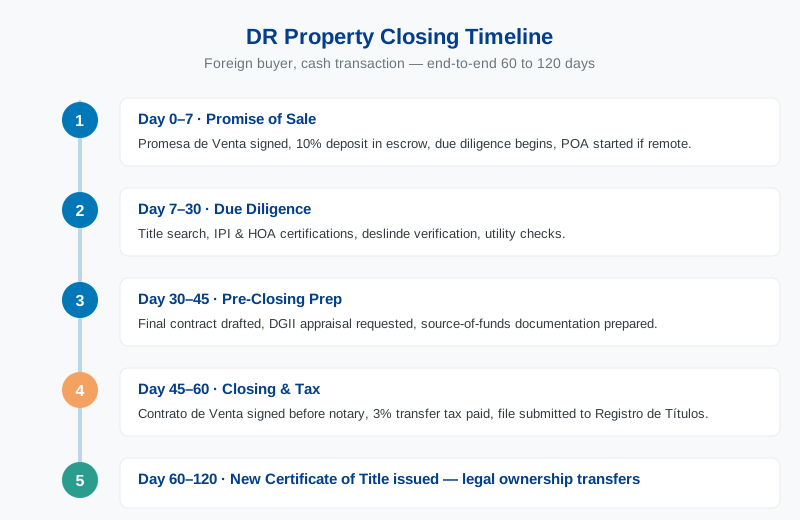
The "30 to 90 days" you see on most websites refers to time from accepted offer to signed final contract — not to the moment legal ownership transfers. Realistic ranges for a clean foreign-buyer transaction:
View text version of this infographic
DR Property Closing Timeline (foreign buyer, cash transaction — end-to-end 60 to 120 days):
- Day 0–7 — Promise of Sale: Promesa de Venta signed, 10% deposit in escrow, due diligence begins, POA started if remote.
- Day 7–30 — Due Diligence: Title search, IPI and HOA certifications, deslinde verification, utility checks.
- Day 30–45 — Pre-Closing Prep: Final contract drafted, DGII appraisal requested, source-of-funds documentation prepared.
- Day 45–60 — Closing and Tax: Contrato de Venta signed before notary, 3% transfer tax paid, file submitted to Registro de Títulos.
- Day 60–120 — New Certificate of Title issued; legal ownership transfers.
- Day 0 to 7: Promise of Sale signed, 10% deposit in escrow, due diligence begins, POA process started if remote.
- Day 7 to 30: Title search, IPI and HOA certifications, deslinde verification, utility checks.
- Day 30 to 45: Final contract drafted, DGII appraisal requested, source-of-funds documentation prepared.
- Day 45 to 60: Closing signed, transfer tax paid, file submitted to Registro de Títulos.
- Day 60 to 120: Registry processes the transfer; new Certificate of Title issued.
Common delays: provisional-title issues that surface during diligence, slow DGII appraisals (especially in summer and around year-end), missing seller documents (death certificates for estate sales, divorce decrees for marital-status verification), and the December-to-mid-January slowdown across all government offices.
Common Closing Pitfalls (and How to Avoid Them)
The mistakes that cost foreign buyers money are predictable:
- Skipping independent legal counsel. Using the seller's, developer's, or agent's attorney is the single fastest way to get burned.
- Wiring money before due diligence finishes. Your deposit is refundable during the diligence window only if the contract spells that out — and only if the funds are actually in escrow.
- Buying provisional-title land without understanding the risk. Carta constancia properties can be fine, but you need to know what you are signing up for and price it accordingly.
- Not verifying the seller's marital status. Community-property rules in the Dominican Republic mean many sales need both spouses' signatures even when only one is on title. A signature missing here can unwind the sale years later.
- Treating verbal "escrow" as real escrow. If it is not in writing with a regulated trustee or bonded escrow company, it is not escrow.
- Forgetting post-closing IPI registration. This creates a lien you discover when you try to sell.
- Skipping the apostille on a remote-closing POA. A POA without apostille will not be accepted by a Dominican notary, and you will be flying down at the last minute.
When you are assembling your team, choose your agent and attorney as deliberately as you would in your home market. Our directory lets you find a real estate agent who works with foreign buyers regularly.
Special Cases
Pre-construction and off-plan purchases work differently. Payments come in milestones tied to construction progress (typically 30% at signing, then installments at structural completion, finishing, and delivery). The closing itself happens at delivery. There is no Certificate of Title to transfer until the building exists and the developer has registered the condo regime. The right protection here is a fideicomiso, a regulated trust that holds buyer funds and releases them as milestones are verified. For more on the off-plan-versus-resale tradeoff, see our post on pre-construction vs pre-built homes.
Land-only purchases require extra deslinde diligence. A lot more provisional titles exist on land than on titled condos.
Inherited property sales require the sucesión (probate) paperwork to be complete before the seller can transfer. Verify the sucesión is finished, not in process. Sales out of an unfinished sucesión are not transferable.
Seller financing is uncommon but legal. The structure is usually a recorded mortgage running to the seller, not a land contract. Get this drafted by your attorney, not the seller's.
Whether you are buying villas for sale in the Dominican Republic, condos for sale in the Dominican Republic, or land in an emerging area on the East Coast, the closing process follows the same skeleton. The differences are in the diligence depth, not the legal flow.
Frequently Asked Questions
How long does it take to close on a property in the Dominican Republic?
Plan on 60 to 120 days end-to-end for a clean cash transaction. Roughly 30 to 60 days from accepted offer to signed final contract, plus another 4 to 12 weeks for the Registro de Títulos to issue a new Certificate of Title. Pre-construction and provisional-title properties take longer.
What are the closing costs when buying property in the Dominican Republic?
Total closing costs for foreign buyers run 4.5% to 7% of the purchase price. The 3% transfer tax under Law 288-04 is the largest line, followed by legal fees of 1.0% to 1.5% plus 18% ITBIS. Title insurance adds another 0.5% to 0.75% if you choose to buy it. CONFOTUR-approved properties waive the 3% transfer tax on the first sale.
Do foreigners pay more transfer tax in the Dominican Republic?
No. Foreign buyers pay the same 3% transfer tax as Dominican citizens. The Dominican Republic does not impose foreign-buyer surcharges, places no restrictions on foreigners owning real estate, and applies tax treatment identically regardless of nationality.
Do I need to be in the Dominican Republic to close on a property?
No. You can close remotely by granting your Dominican attorney a Special Power of Attorney (Poder Especial). The POA must be drafted in Spanish, signed and notarized in your home country, and apostilled by the relevant authority — the Secretary of State for U.S. buyers and Global Affairs Canada or the equivalent provincial body for Canadians.
What documents do I need to close on a property in the DR?
Foreign buyers need a valid passport, source-of-funds documentation under Law 155-17 (bank statements, sale-of-prior-property records), and the apostilled Power of Attorney if closing remotely. If married, you may also need a marriage certificate. You do not need a cédula or residency to buy.
What is the role of a notary in a DR property closing?
Dominican notarios públicos are licensed attorneys with state authority — not document-stamping clerks. They draft and authenticate the final Contrato de Venta, witness signatures, and produce the public instrument that gets filed at the Registro de Títulos. Without a notary's signature, the deed cannot be registered.
What is escrow in the Dominican Republic?
The Dominican Republic has no nationwide escrow regulation, so real escrow takes only three legitimate forms: a segregated attorney trust account, a U.S.-based escrow company like Stewart Title or First American, or a developer fideicomiso (regulated trust) for pre-construction. Anything else — including funds wired directly to a seller's personal account — is not escrow.
What is a deslinde and why does it matter at closing?
Deslinde is the cadastral demarcation process that fixes a property's legal boundaries. A property with deslinde complete has a definitive title; one without has provisional title (often called carta constancia). Provisional-title properties are riskier to buy because boundary disputes, double-titling, and undivided-interest claims are more common. Always confirm deslinde status before closing.
Can I get a mortgage as a foreigner in the Dominican Republic?
Yes, but most foreign buyers pay cash. Dominican banks offer mortgages to qualified non-residents, typically with 30% to 40% down payments, rates higher than U.S. or Canadian rates, and longer approval timelines. Income verification and source-of-funds documentation are required.
What happens after closing — when does the title transfer to my name?
Legal ownership transfers only when the Registro de Títulos issues a new Certificate of Title in your name. Your attorney files the closing package with the registry within days of signing, and processing typically takes 4 to 12 weeks depending on jurisdiction. Until that new title is issued, you have a signed deed and possession but not yet legal ownership.
Sources
- Law 108-05 (Real Estate Registration) — FAM Legal Services overview
- DGII IPI Threshold Resolution DG-AR1-2026-00001 — Punta Cana Villa summary
- Law 288-04 Transfer Tax — DR Lawyer
- Law 155-17 Anti-Money Laundering — DR Lawyer real-estate application
- CONFOTUR Law 158-01 — ICLG briefing
- Hague Apostille Convention — DR accession (HCCH)
- Dominican Republic Tax Summary (ITBIS, transfer tax) — PwC
David Logan
site_adminRédacteur contributeur pour DRListings.com, partageant des perspectives sur l'immobilier en République dominicaine.
Commentaires
Connectez-vous pour rejoindre la conversation