

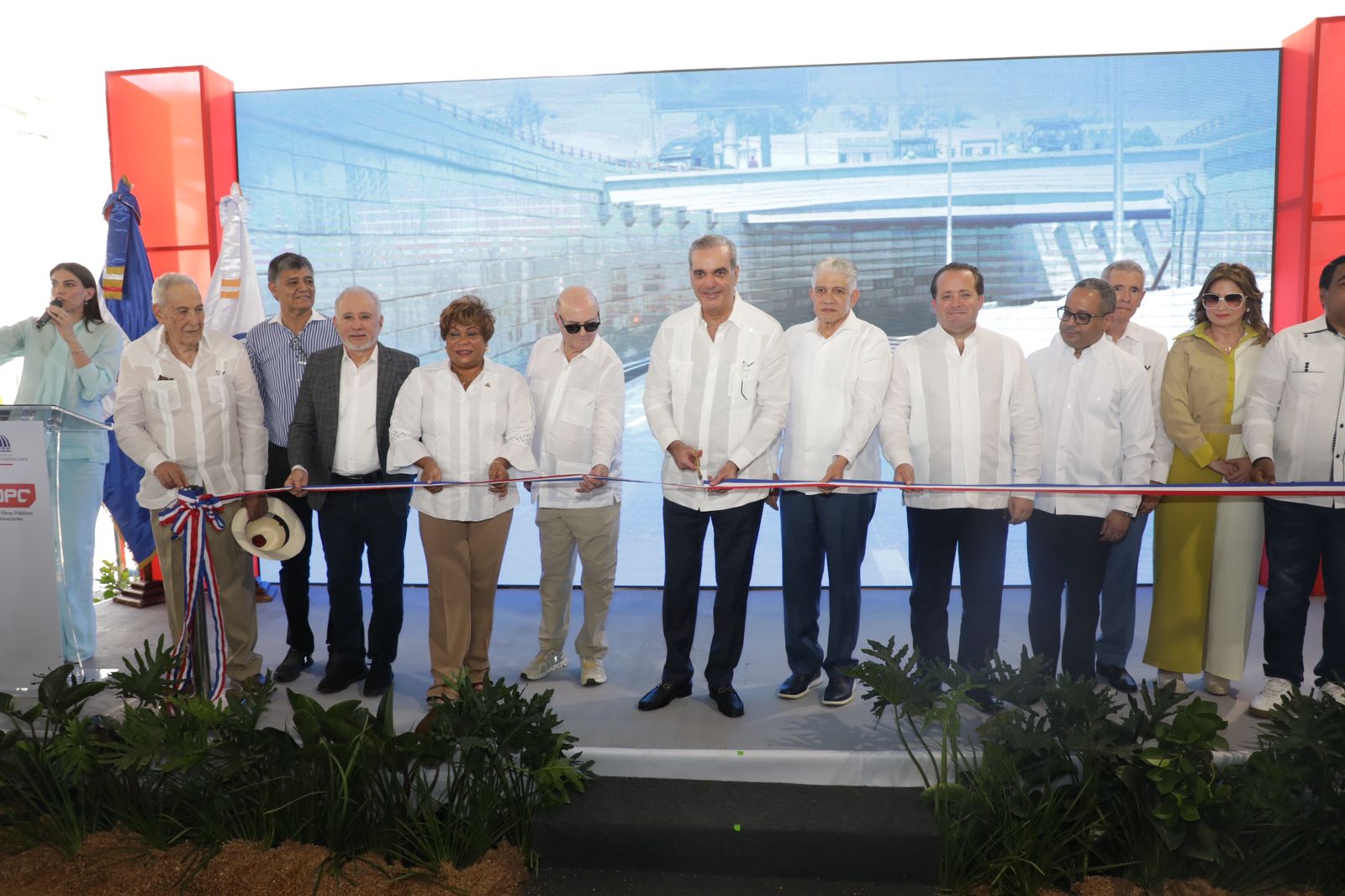
SANTO DOMINGO OESTE, Dominican Republic — President Luis Abinader inaugurated a long-awaited overpass in Santo Domingo Oeste on Wednesday, a project expected to significantly improve traffic flow and reduce travel times for more than a million commuters in the Greater Santo Domingo area.
The new 27 de Febrero–Isabel Aguiar overpass is projected to cut travel times by up to 40% between Santo Domingo Oeste, the southern region, and the National District. Officials anticipate the infrastructure will also lead to substantial savings in fuel and operational costs, boost labor productivity, and reduce traffic accidents.
During the ceremony, President Abinader, accompanied by Minister of Public Works Eduardo Estrella, emphasized that the overpass is a component of a comprehensive strategy to alleviate congestion and enhance mass transportation across Greater Santo Domingo and the entire country.
The president announced plans for a public-private terminal in Santo Domingo Oeste, which will integrate with a new cable car system expected to be completed by mid-next year. He stated that these initiatives, combined with the existing Metro system, will significantly improve public and general transportation for residents of Santo Domingo Oeste, the southern provinces, and even those traveling from the Cibao region.
Abinader also noted that the new overpass, alongside improvements at Kilómetro 9, República de Colombia Avenue, and the upcoming opening of the final section of Ecológica Avenue next month, will help decongest entry points into Santo Domingo.
Regarding water infrastructure, the president highlighted that the Barrera de Salinidad aqueduct in Santo Domingo Este is 50% complete and slated for a December finish. For Santo Domingo Oeste, he mentioned upgrades to the Haina water intake and the Hatillo aqueduct, which will supply 10 cubic meters of water, providing a decade-long solution for the western zone.
Abinader underscored the government's integrated approach to public works, encompassing potable water, transportation, and improved storm drainage. He also announced the upcoming tender for a new bridge over the Ozama River.
"Santo Domingo Oeste is changing," Abinader said. "You used to lose about 20 minutes getting home; starting this afternoon, you'll arrive much faster. These are quality projects, executed efficiently and transparently." He affirmed the government's commitment to continue working on its development plan to improve citizens' quality of life.
The overpass, a RD 2 billion investment, was funded through the renegotiation of a contract with Aerodom, enabling its execution without external loans, consistent with the government's policy of responsible and transparent investment.
This infrastructure represents a strategic advancement in the capital's road network, directly connecting the country's south with the National District and Santo Domingo Oeste via Autopista 6 de Noviembre and 27 de Febrero Avenue. It will soon link with the Luperón Avenue tunnel at 27 de Febrero, traversing Plaza de la Bandera in a north-south direction.
The new structure is 480 meters long, comprising three sections and a two-level trumpet interchange with eight operational ramps designed to ensure continuous traffic flow in both directions. The marginal roads feature six lateral lanes—three per direction—for both heavy and light vehicles, promoting efficient and safe travel.
Constructed from reinforced concrete with post-tensioned beams, the project incorporates New Jersey-type barriers, vertical and horizontal signage, protective railings, LED lighting, and landscaping to integrate with the urban environment. An innovative drainage system, capable of holding one million gallons of water and connected to the Guajimía canal, ensures permanent rainwater evacuation and prevents flooding.
Designed under international AASHTO 2018 standards, the overpass guarantees a safe, durable, and highly efficient operational structure, with a design speed of 50 km/h allowing for fluid traffic without the need for traffic lights.
Minister Estrella highlighted that the quality of public works is achieved through effective execution, diligent supervision, and timely payments, all ensured by President Abinader’s administration. He noted that the project, initiated in April 2024, was delivered to the Dominican people just 18 months later, demonstrating responsible management.
Estrella also announced the forthcoming delivery of the Constitutional Tribunal building and the construction of the Plaza de la Bandera trench. He listed ongoing projects including the Kilómetro 28 elevated highway, the expansion of the Sánchez highway, and Ecológica Avenue towards Caucedo Port.
Other works in progress include the Monte Plata–Bayaguana–Hato Mayor corridor, bypasses for San Francisco de Macorís, Navarrete, and Higüey, and improvements to the Samaná boardwalk. He informed that 53 bridges would be tendered in January with support from the Inter-American Development Bank (IDB), reinforcing the government’s commitment to national road development.
Senator Antonio Taveras of Santo Domingo Province remarked that the overpass was a long-standing promise from previous governments that had gone unfulfilled, now realized through President Abinader's commitment.
Notable attendees at the inauguration included former President Hipólito Mejía, Constitutional Tribunal President Napoleón Estévez Lavandier, Minister of the Presidency José Ignacio Paliza, and other government and military officials.
Sources
Related News
World Bank Officials Praise Dominican Republic's Economic Stability
3 min read
Dominican Republic Launches $106 Million Fund for Irrigation Upgrade
3 min read
Dominican Republic to Overhaul 496 Schools with RD$2 Billion Investment
3 min read
Dominican Government Settles $104 Million Debt with Small Farmers
3 min read