Dominican Republic Mortgage for Foreigners: How Financing Actually Works
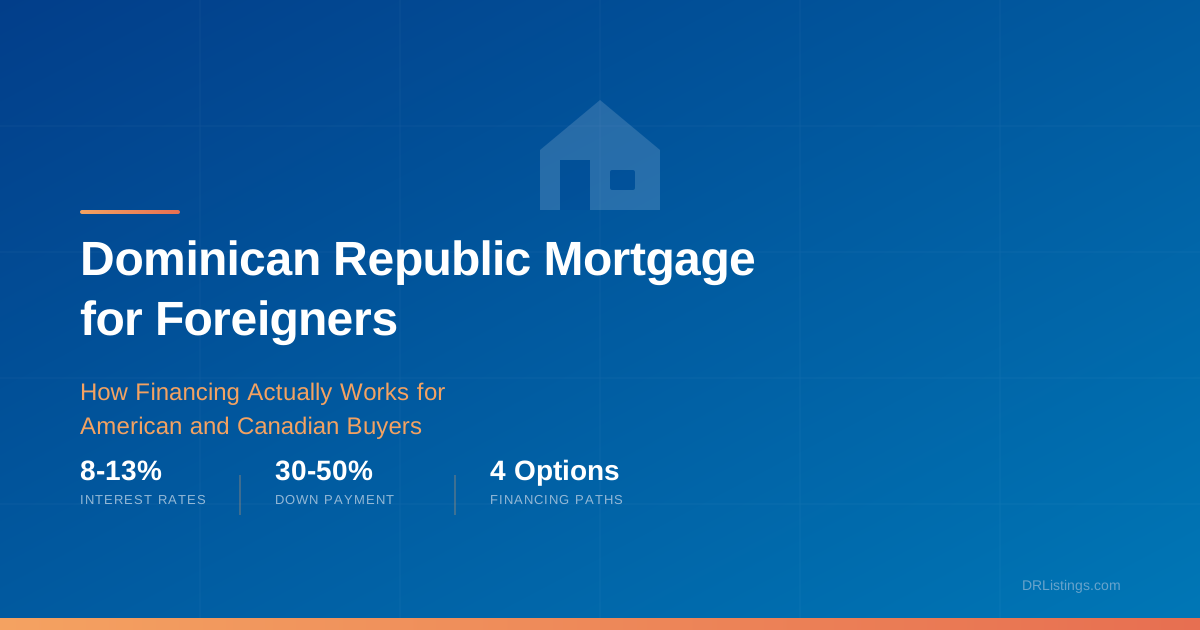
Yes, foreigners can get a mortgage in the Dominican Republic. Banks like Banco Popular, Scotiabank, and BanReservas offer home loans to foreign buyers with 30-50% down payments at 8-13% interest rates. Other options include developer financing for pre-construction properties, owner financing from sellers, and borrowing against home equity from US or Canadian properties.
That said, the DR real estate market works differently than what most Americans and Canadians are used to. Most property deals here are cash. Mortgage financing exists, but it is less common and the terms are less favorable than US rates. The process also has a few quirks worth knowing before you start. This guide covers every financing option for foreign buyers, what each one costs, and how to pick the right one for your situation.
Dominican Republic Mortgage Rates and Bank Loans for Foreign Buyers
Several Dominican banks lend to foreigners, including non-residents. The main players are Banco Popular, Scotiabank, BanReservas, Banco BHD, APAP, and Banco Lopez de Haro. Each has slightly different terms, but the general picture looks like this.
Interest rates run 8-10% for USD loans and 11-14% for loans in Dominican pesos (DOP), as of early 2026. These Dominican Republic mortgage rates are higher than US mortgage rates. That is a big reason why many buyers look at other options.
Down payments depend on your residency status. Non-residents need 30-50% down. If you have DR residency (even temporary), that drops to 20-30%. The gap is large enough that some buyers pursue residency just to get better loan terms.
Loan terms for foreigners are usually 10-15 years, shorter than the 30-year mortgages common in the US. Residents can get terms up to 25 years. Loan-to-value (LTV) ratios follow the same pattern: 50-70% for non-residents, up to 80-90% for residents.
Credit checks are more flexible than you might expect. Dominican banks accept foreign credit reports. You do not need a local credit history. Most banks want a minimum monthly income of $4,000-$8,000 USD and a debt-to-income ratio below 35-40%.
Approval timeline is 4-8 weeks from start to finish. The process includes a property appraisal, document checks, and legal review. Plan ahead if your purchase has a closing deadline.
USD vs. DOP loans: Most foreigners pick USD loans because they earn in dollars. A peso loan means your payment changes with the exchange rate. If the peso weakens against the dollar, your payments get cheaper. If it strengthens, they get more expensive. The Dominican peso has held fairly steady against the dollar in recent years. But even small shifts add up over a 10-15 year loan. For most foreign buyers earning in USD, the stability of a dollar loan beats the chance of currency gains.
Not every bank offers both options. Scotiabank and Banco Popular are the most common picks for USD loans to foreigners. If a bank only offers DOP loans, compare the total cost before committing. For broader context on the Dominican Republic economy and investment climate, our article covers the big picture.
How Residency Improves Your Mortgage Terms
The gap between resident and non-resident borrower terms is large enough to matter. Here is what changes with DR residency:
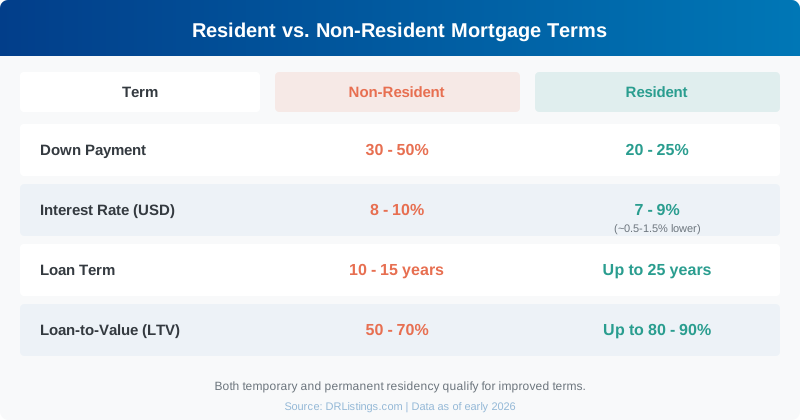
- Down payment drops from 30-50% to 20-25%
- LTV ratios increase from 50-70% to as much as 80-90%
- Interest rates decrease by roughly 0.5-1.5 percentage points
- Longer loan terms become available (up to 25 years vs. 10-15)
View text version of this infographic
Resident vs. Non-Resident Mortgage Terms:
- Down Payment: Non-Resident 30-50% | Resident 20-25%
- Interest Rate (USD): Non-Resident 8-10% | Resident 7-9% (~0.5-1.5% lower)
- Loan Term: Non-Resident 10-15 years | Resident Up to 25 years
- Loan-to-Value (LTV): Non-Resident 50-70% | Resident Up to 80-90% Both temporary and permanent residency qualify for improved terms.
Both temporary and permanent residency qualify for better terms. Temporary residency requires fewer documents and is faster to obtain. Many buyers start with temporary and upgrade to permanent after a year or two.
Is it worth getting residency just to improve your mortgage terms? Run the numbers on your specific purchase. On a $300,000 property, dropping your down payment from 40% ($120,000) to 25% ($75,000) frees up $45,000 in cash. A 1% rate cut on a $200,000 loan over 15 years saves roughly $20,000 in interest. The residency process costs a few thousand dollars and takes several months. But for most buyers above $200,000, the savings easily justify the time and cost.
There is another angle worth thinking about. Many foreign buyers who start with a property purchase end up spending more time in the DR than they planned. If you might eventually live here part-time or full-time, getting residency early helps. It sets you up for better banking, easier renewals on your stay, and those improved mortgage terms all at once. Check out our guide to buying property in the Dominican Republic for more on how residency fits into the overall purchase process.
Developer Financing in the Dominican Republic
Developer financing is the most common option besides bank mortgages, especially for pre-construction properties. The developer acts as the lender, and the terms are often more flexible than what banks offer.
A typical deal looks like this. You put down 10-30% of the price, then make interest-free monthly payments during the build period (usually 12-24 months). When construction finishes, you pay the rest, either in cash or by refinancing with a bank mortgage.
The benefits are real. No bank approval process, no credit checks, lower upfront costs, and flexible payment schedules. Many new developments in popular areas like Punta Cana, Sosua, and Cabarete offer developer financing as a standard option.
The downsides are worth knowing too. If the deal includes interest (some do, some don't), the total cost can be higher than a bank loan. You are also taking on developer risk: delays, quality issues, or in the worst case, projects that stall entirely. And if there is a lump-sum payment at the end, you need a plan for covering it.
Due diligence matters here. Before committing, check the developer's track record. Have they finished past projects on time? Are past buyers happy? Visit finished projects in person if you can. Get your own attorney to review the financing deal before you sign. A common approach is to use developer financing during construction, then refinance into a bank mortgage once you have keys. This gives you low upfront costs during the build phase and a more standard loan structure after.
Owner Financing for Dominican Republic Property
Owner financing means the seller funds the purchase directly. The seller holds the title until you finish all payments. This is less common than developer financing but works for resale properties where the seller is willing.
Typical terms: 40-60% down payment, 4-6 year payoff period, and interest rates around 6.5-8%. These are market norms, not fixed rules. Everything is up for discussion between buyer and seller.
The legal setup involves three documents prepared by an attorney: a Purchase Offer, a Promise of Sale, and a Finance Contract. Dominican law gives the seller "privilege of the unpaid seller," a legal protection that puts them first in line if the buyer defaults. This makes sellers more willing to offer financing.
Owner financing works best for buyers who cannot qualify for bank loans or want a faster closing. The approval is between you and the seller, not a bank. The trade-off is a larger down payment and shorter payoff window than a bank mortgage.
One thing to watch for: unlike a bank mortgage, owner financing has less oversight. The terms are whatever you and the seller agree to. This is why having your own attorney review the deal is not optional. Make sure the contract spells out what happens if you miss a payment and what the cure period is. It should also cover how title transfer works upon final payment. A good DR real estate attorney will have handled dozens of these and can spot anything unusual.
Financing from Your Home Country
A method many foreign buyers skip: borrowing against property you already own in the US or Canada to fund a DR purchase.
A home equity line of credit (HELOC) or cash-out refinance on your US or Canadian property often offers rates well below what Dominican banks charge. As of early 2026, US HELOC rates are roughly 7-9%, compared to 8-10%+ for a Dominican Republic mortgage for foreigners through a local bank. You can usually borrow up to 85% of your home's value minus your current mortgage balance.
The biggest plus is that this makes you a cash buyer in the Dominican Republic. Cash buyers close faster, get better prices, and skip the DR mortgage process entirely. You are dealing with a US or Canadian lender in a system you already know.
The trade-off: your US or Canadian home becomes the collateral. If something goes wrong with your DR investment, it is your primary home on the line. This approach works best for buyers who have solid equity in their home country property and are comfortable with the added risk.
Exchange rate risk does not apply here since you are borrowing and paying in USD (or CAD). This is a real edge over peso-based DR bank loans.
Here is a quick comparison. Say you want to buy a $250,000 condo in Las Terrenas. With a DR bank mortgage at 9% and 40% down ($100,000), your monthly payment on the $150,000 loan over 15 years would be roughly $1,520. With a US HELOC at 8% on the same $150,000, your payment starts around $1,100 (interest-only phase), though it will rise during the payoff period. The gap in total interest paid over the life of the loan can be $30,000-$50,000 depending on rates and terms. That is real money worth the homework.
Choosing the Right Financing Option
The right financing depends on your situation. Here is how to think about it:
If you have the cash to pay outright: Cash gives you the strongest position at the table and the fastest closing. You avoid interest entirely. If you do not want to tie up all your capital, owner financing with a large down payment is a middle ground.
If you own a home in the US or Canada: Look at a HELOC. You will likely get the lowest interest rate of any option. The process is familiar, and you become a cash buyer in the DR.
If you are buying pre-construction: Developer financing is the natural fit. Low upfront costs, no bank approval, and you can refinance with a bank mortgage after the building is done.
If you are a DR resident (or plan to become one): A bank mortgage gives you the best terms available. With residency, you get lower rates, smaller down payments, and longer terms that keep monthly payments in check.
If you are a non-resident without home equity: Your options are a DR bank mortgage (with higher rates and larger down payment) or owner financing if you find a willing seller.
View text version of this infographic
DR Financing Options at a Glance:
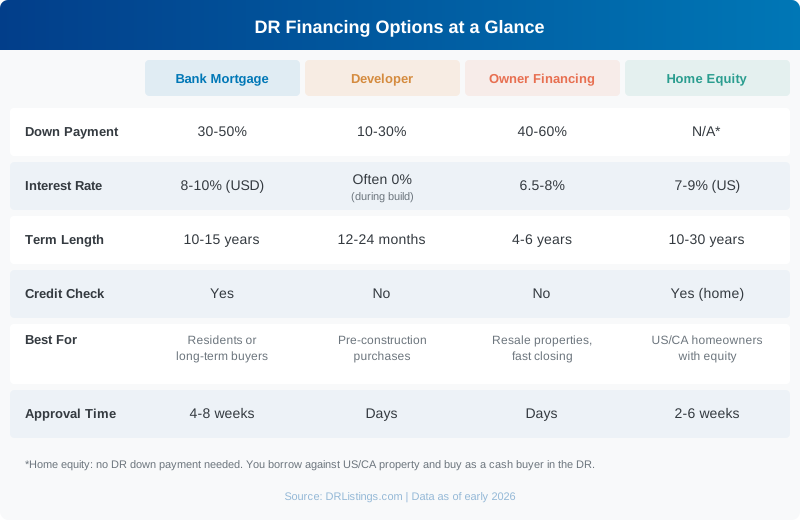
Bank Mortgage: 30-50% down, 8-10% interest (USD), 10-15 year term, credit check required, best for residents/long-term buyers, 4-8 weeks approval.
Developer Financing: 10-30% down, often 0% interest during build, 12-24 month term, no credit check, best for pre-construction, days to approve.
Owner Financing: 40-60% down, 6.5-8% interest, 4-6 year term, no credit check, best for resale/fast closing, days to approve.
Home Equity (HELOC): No DR down payment needed (borrow against US/CA property), 7-9% interest, 10-30 year term, US credit check, best for US/CA homeowners with equity, 2-6 weeks approval.
One more thing to factor in: if you are buying in a CONFOTUR-designated area, you get tax breaks that lower your overall cost. CONFOTUR properties are exempt from annual property tax and transfer tax for a set period. This does not change your financing terms directly, but it changes the total cost math. A CONFOTUR property can save you thousands per year in taxes, which offsets higher mortgage rates. Note that the 27% capital gains tax still applies when you sell, even with CONFOTUR. See our CONFOTUR tax benefits guide for the details.
Working with a local real estate agent who knows your target area can help you find which financing options are open for specific properties. Some listings come with developer financing already set up, while others fit bank loans or owner deals better. You can find a real estate agent through our directory to get area-specific advice.
Documents You Will Need for a DR Bank Mortgage
If you go the bank mortgage route, start gathering these documents early. The process moves faster when everything is ready upfront.
For all applicants:
- Valid passport (with at least 6 months remaining)
- Proof of income: last 2 years of tax returns, recent pay stubs, and 3-6 months of bank statements
- Employment verification letter
- Credit report from your home country
- Proof of funds for the down payment
For self-employed applicants, add:
- 2+ years of business tax returns
- Business bank statements (6-12 months)
For corporate purchases, add:
- Articles of incorporation
- Corporate tax returns
- Board resolution authorizing the purchase
View text version of this infographic
DR Bank Mortgage: Required Documents
All Applicants:
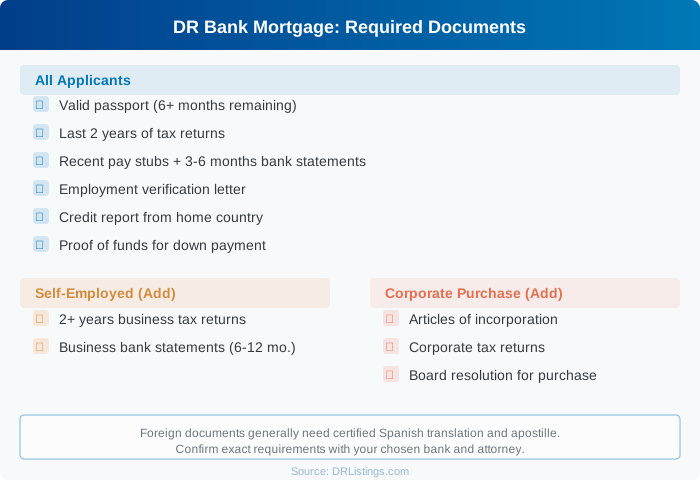
- Valid passport (6+ months remaining)
- Last 2 years of tax returns
- Recent pay stubs + 3-6 months bank statements
- Employment verification letter
- Credit report from home country
- Proof of funds for down payment
Self-Employed (Add):
- 2+ years business tax returns
- Business bank statements (6-12 months)
Corporate Purchase (Add):
- Articles of incorporation
- Corporate tax returns
- Board resolution for purchase
Note: Foreign documents generally need certified Spanish translation and apostille. Confirm exact requirements with your chosen bank and attorney.
Foreign documents generally need to be translated into Spanish by a certified translator and apostilled. Check the exact needs with your chosen bank and attorney before submitting, as they vary.
Frequently Asked Questions
Can foreigners get a mortgage in the Dominican Republic?
Yes. Several Dominican banks lend to foreign buyers, including non-residents. Banco Popular, Scotiabank, BanReservas, Banco BHD, and APAP all offer mortgage products for foreigners. You will need a larger down payment (30-50%) than a resident and should expect interest rates between 8-13%.
What is the interest rate for a mortgage in the Dominican Republic?
As of early 2026, USD mortgage rates for foreigners are typically 8-10%. Peso loans run 11-14%. Rates vary by bank, loan amount, and whether you are a resident or non-resident. Residents usually get rates 0.5-1.5% lower than non-residents. Check current rates with lenders directly, as they change often.
How much down payment do you need for a property in the Dominican Republic?
Non-residents need 30-50% down for a bank mortgage. Residents can qualify with 20-25% down. Developer financing may need as little as 10-30% upfront. Owner financing usually asks for 40-60% down. The amount depends on the financing type, the bank or seller, and your financial profile.
What banks in the Dominican Republic lend to foreigners?
The major banks lending to foreign buyers include Banco Popular (the largest private bank), Scotiabank, BanReservas (state-owned), Banco BHD, APAP, and Banco Lopez de Haro. Each has different rate structures, minimum loan amounts, and paperwork needs. Compare offers from at least two or three banks.
Do you need residency to get a mortgage in the Dominican Republic?
No. Non-residents can qualify for bank mortgages, though the terms are less favorable. Without residency, expect higher down payments (30-50% vs. 20-25%), higher interest rates, and shorter loan terms (10-15 years vs. up to 25 years). Getting even temporary residency can improve your mortgage terms a lot.
Can Americans finance property in the Dominican Republic?
Yes. Americans can get mortgages from DR banks, use developer or owner financing, or borrow against US property through a HELOC or cash-out refinance. The HELOC route often gives you the lowest interest rate and makes you a cash buyer in the DR. That can help you get a better price.
What is developer financing in the Dominican Republic?
Developer financing is when the builder acts as the lender, most often for pre-construction projects. You typically pay 10-30% upfront, make payments during construction (often interest-free), and pay the balance when the property is done. No bank approval or credit check is needed.
Is it better to pay cash or get a mortgage in the Dominican Republic?
Cash gives you the strongest position at the table and cuts out interest costs. Most DR property deals are cash. But if keeping cash on hand matters to you, financing frees up capital for other uses or rainy days. The answer depends on your finances and whether the interest rates make sense for your goals.
What documents do you need for a Dominican Republic mortgage?
Bank mortgages require a valid passport, proof of income (tax returns, pay stubs, bank statements), employment verification, a credit report from your home country, and proof of down payment funds. Self-employed applicants also need business tax returns and bank statements. Foreign documents typically need certified Spanish translation and apostille.
How long does mortgage approval take in the Dominican Republic?
Plan for 4-8 weeks from start to finish. The process includes document checks, a property appraisal, legal review, and underwriting. Having all your documents ready before you apply speeds things up. Some banks can move faster on smaller loans or repeat clients.
Sources
- TheLatinvestor — Foreigner Mortgage Dominican Republic: Eligibility, Tips (2026)
- Global Property Guide — Dominican Republic Mortgage Rates: Historical and Current Averages
- Perez Real Estate — Mortgages in the Dominican Republic for Foreigners: USD and DOP Options
- ICLG — Understanding the CONFOTUR Law and its Benefits for Foreign and Non-Resident Real Estate Investors
- Bankrate — Current HELOC Rates in March 2026
- Lexology — Snapshot: Real Estate Financing in Dominican Republic
David Logan
site_adminBeitragender Autor für DRListings.com, der Einblicke in Immobilien in der Dominikanischen Republik teilt.
Kommentare
Melde dich an, um an der Diskussion teilzunehmen